

TreeTake Network
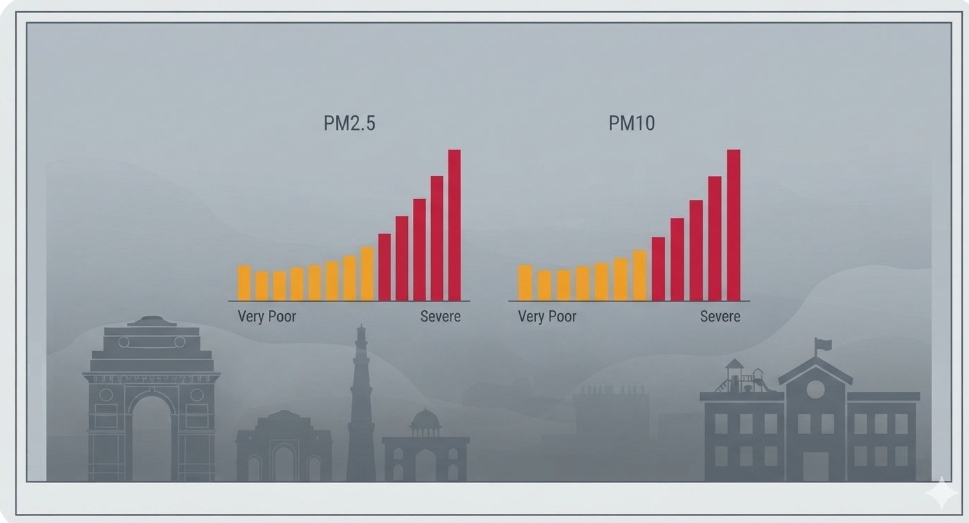
The Delhi Directorate of Education has issued a mandatory directive forcing all government, municipal, and private primary schools up to Class 5 to immediately shift to online and hybrid learning modules. The emergency structural shift follows a sustained drop in the regional airshed quality, marking the first major administrative closure of the current winter phase. Technical data verified by the Central Pollution Control Board confirmed that the capital region's comprehensive Air Quality Index breached the 364 mark, categorised as "Very Poor," while localised micro-monitoring stations at Punjabi Bagh and IIT Delhi recorded toxic spikes peaking at 443, entering the "Severe" band.
The Commission for Air Quality Management responded by implementing Stage III of the Graded Response Action Plan across the entire National Capital Region. The legal framework enforces a total ban on non-essential construction and demolition activities, alongside strict entry curbs on older light commercial vehicles. Under the current mandate, all BS-III petrol and BS-IV diesel four-wheelers are prohibited from operating within Delhi and its immediate borders, with violations attracting a statutory penalty of 20,000 rupees.
Environmental scientists and health experts have raised alarms over the long-term biological impact of this early-season pollution baseline on vulnerable demographics. Specialists emphasise that emergency vehicular bans, whilst necessary for temporary mitigation, fail to address the core airshed mechanics of the northern plains.
"The execution of Stage III restrictions is a critical short-term shield for public health, particularly for primary school pupils whose respiratory baselines are highly susceptible to fine particulate intrusion," stated Dr Anjali Malhotra, Senior Consultant in Pulmonary Medicine at the Environmental Health Research Institute. "However, moving classrooms online is a reactive measure. Until our municipal frameworks enforce absolute compliance on localised dust suppression and regional biomass combustion limits, we will continue to penalise children for systemic regulatory gaps."
Administrative enforcement squads have been deployed across 11 distinct municipal zones to monitor violations. A retrospective atmospheric analysis issued by the Ministry of Environment, Forest and Climate Change indicated that the January to October average air quality showed a minor improvement of 4% compared to the identical blocks of 2024 and 2025. Despite this marginal baseline progression, the sudden onset of stagnant meteorological conditions and low wind speeds has trapped industrial and agricultural emissions close to the surface, creating an immediate public health emergency.
"Our monitoring data indicates that localised dust from unpaved transit corridors and small-scale construction bypasses remains a major contributor to the PM2.5 baseline," observed Rajesh Kumar, Chief Environmental Engineer at the Air Quality Enforcement Bureau. "The current multi-agency task force is executing round-the-clock physical inspections, and we have penalised 47 major infrastructure firms in the last 24 hours alone. The transition to hybrid school sessions is an unfortunate but absolute necessity to minimise cumulative exposure times for young citizens."
Editor's Note
The administrative decision to transition primary schools to hybrid models underscores the persistent failure of reactive urban planning in managing the northern Indian airshed. While emergency closures under the Graded Response Action Plan protect immediate public health, they disrupt educational infrastructure without resolving the structural drivers of winter smog. The ultimate way forward requires a shift from emergency city-centric bans to a year-round, legally binding airshed governance model that unifies cross-border industrial regulations, agricultural biomass processing, and permanent urban dust management.



Leave a comment