

TreeTake Network
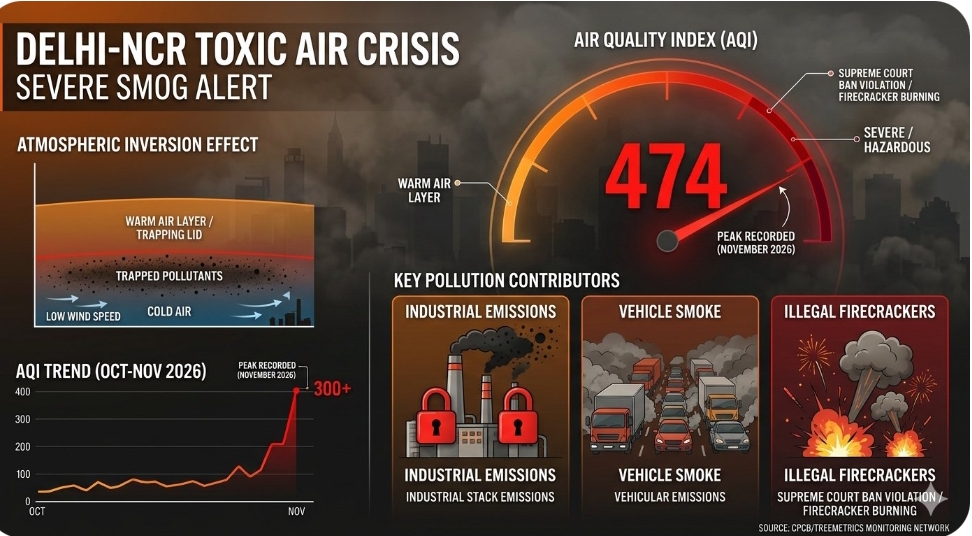
A dense layer of hazardous winter smog enveloped the entire National Capital Region on Friday, November 6, 2026, as ambient air quality indices surged deep into the severe category across multiple monitoring locations. Official real-time data from the Central Pollution Control Board confirmed that over half a dozen key monitoring stations—including IIT Delhi, Rohini, Dwarka Sector 8, and Punjabi Bagh—recorded particulate matter values peaking at 474 by mid-morning. The atmospheric stagnation, caused by a sharp drop in seasonal temperatures and low boundary-layer wind speeds, has trapped high concentrations of micro-pollutants close to the ground. Health authorities have issued urgent public safety alerts advising vulnerable populations to minimise outdoor exposure, as the atmospheric toxicity levels present acute pulmonary risks across the urban biosphere.
The ecological crisis has been severely compounded by the widespread illegal trade and ignition of firecrackers, which continues entirely unabated despite definitive, binding prohibitory orders from the Supreme Court of India. Environmental advocates note that local marketplaces have openly distributed non-compliant incendiary products, demonstrating a complete lack of public concern and a total absence of rigorous enforcement by regional administrative departments. Professor Mukesh Khare, Air Pollution Specialist at the Indian Institute of Technology Delhi, stated: "The current atmospheric stagnation behaves like a tight lid, holding vehicular emissions, firecracker smoke, and industrial particulate matter in a concentrated zone that cannot be cleared without strong top-down wind movements." Addressing the critical public health dimension, Dr Randeep Guleria, Chairman of the Institute of Internal Medicine at Medanta, observed: "Breathing air with an index score of 474 exposes the respiratory tract to extreme inflammation, which significantly increases acute emergency hospital admissions for chronic respiratory ailments and cardiovascular distress."
Civil society groups have expressed deep frustration at the institutional paralysis governing the implementation of environmental mandates. Anumita Roychowdhury, Executive Director of Research and Advocacy at the Centre for Science and Environment, noted: "The total breakdown in enforcing the Supreme Court firecracker ban reveals a worrying lack of administrative will, as municipal teams have failed to deploy adequate checking squads at regional borders, effectively allowing toxic materials to pour into the city unchecked." Furthermore, Professor Kalpana Balakrishnan, Director of the Centre for Advanced Research on Environmental Health, emphasised: "The prolonged exposure to such high concentrations of fine particulate matter demands an immediate transition toward clean energy transport systems, as temporary dust-suppression sprays offer no real structural solution to this systemic toxic crisis."
The persistent atmospheric inversion and civic non-compliance have also drawn deep concern from international environmental monitoring bodies tracking South Asian urban air sheds. Professor Christopher Frey, Environmental Systems Engineer, cautioned: "Without highly coordinated, cross-border airshed management programmes that target both agricultural residue burning and industrial stack emissions simultaneously, capital cities will continue to experience these annual ecological crises." Adding to this, Jyoti Pande Lavakare, Co-Founder of Care for Air, stated: "The unchecked sale of firecrackers shows that neither the local government nor the general public is treating this as the public health emergency it is, directly jeopardising the lives of millions of citizens who have no choice but to breathe this toxic mixture."
Editor's Note
The severe air quality crisis across Delhi NCR highlights the complete failure of localised, reactive pollution containment policies and civic enforcement frameworks. Moving forward, the regional administration must transition toward a unified airshed management framework that rigidly enforces judicial bans, implements strict emissions caps on heavy industries, and accelerates the electrification of public transit systems across state borders.



Leave a comment