

TreeTake Network
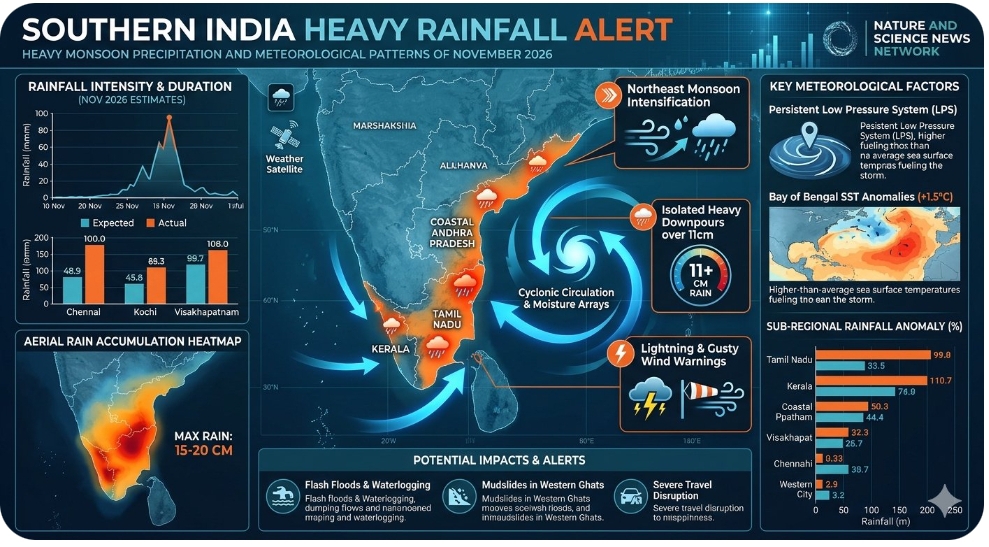
The India Meteorological Department issued targeted heavy rainfall, lightning, and gusty wind warnings across the southern peninsular states on Friday, November 6, 2026. Official atmospheric bulletins indicate that a persistent cyclonic circulation hovering over the southwest Bay of Bengal has intensified the northeast monsoon currents, driving heavy moisture arrays directly into coastal areas. The specialised weather tracking units have placed localised coastal zones in Tamil Nadu, Kerala, and Coastal Andhra Pradesh under an isolated downpour watch, with rain accumulations projected to cross 11 centimetres in certain sectors within 24 hours. Conversely, the weather systems across the northern plains face an entirely different atmospheric reality, remaining completely dry under a massive anticyclonic pattern that has trapped urban pollutants and suppressed natural ventilation.
The unpredictable distribution of monsoon precipitation creates immediate operational hurdles for agricultural water management programmes. Dr Mrutyunjay Mohapatra, Director General of the India Meteorological Department, stated: "The convective cloud bands interacting with the coastal topography are triggering high-intensity precipitation pockets over brief temporal spans, which necessitates absolute vigilance from regional disaster management teams regarding flash floods." Discussing the unique thermodynamic factors driving these localised aquatic systems, Professor Raghu Murtugudde, Earth System Scientist at the Indian Institute of Technology Bombay, observed: "The sustained warming trends observed across the Bay of Bengal surface waters act as an active fuel source, significantly enhancing the moisture-carrying capacity of the northeast monsoon winds and destabilising traditional coastal weather regimes."
Managing the ecological transitions accompanying heavy downpours is essential to safeguard fragile riverine and coastal biomes. Professor K J Ramesh, former Director General of the India Meteorological Department, cautioned: "Urban centres in the southern peninsula must immediately fortify their natural drainage channels and low-lying wetlands, as sudden high-volume downpours will easily overwhelm artificial drainage networks that have been compromised by concrete developments." Emphasising the broader climatological patterns at play, Dr Roxy Mathew Koll, Climate Scientist at the Indian Institute of Tropical Meteorology, noted: "The extreme contrast between a parched, stagnant northern landmass and a heavily active southern maritime boundary highlights the intensifying structural variability within our regional subcontinental weather systems, requiring highly adaptive conservation programmes."
Editor's Note
The stark contrast between the heavy downpours affecting the southern peninsula and the complete atmospheric stagnation across the northern plains highlights the complex challenges of subcontinental climate adaptation. Moving forward, water resource ministries must abandon uniform national directives in favour of highly decentralised, basin-level hydrological strategies that can simultaneously mitigate urban flash floods and conserve critical groundwater reserves.



Leave a comment