

TreeTake Network
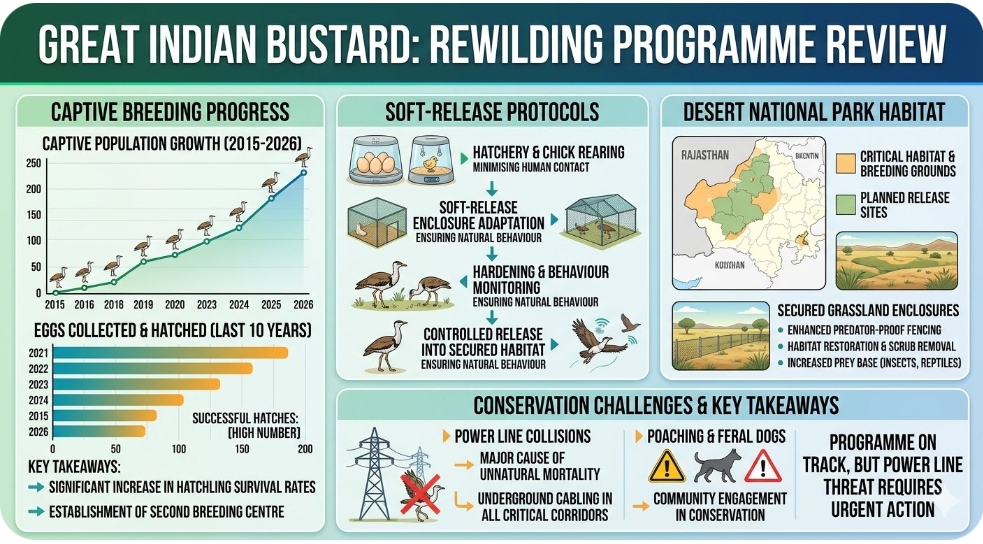
India’s high-stakes conservation initiative to save the critically endangered Great Indian Bustard from extinction remains fully operational and structurally on track in Rajasthan, wildlife authorities confirmed on Friday, November 6, 2026. The technical review by the Wildlife Institute of India follows intense public scrutiny after the tragic deaths of two captive-bred sub-adult bustards earlier this year due to unexpected sanctuary boundary collisions. Despite these setbacks, the collective population within the specialised captive-breeding centres at Sam and Ramdevra has successfully reached 31 individuals, marking a significant milestone for artificial incubation programmes. Conservationists are now preparing the first experimental cohort for controlled soft-release protocols into secured grassland enclosures, establishing the foundational stage for true rewilding in the Desert National Park habitat.
Managing this critically depleted avian species requires absolute precision across all habitat stabilisation phases. Professor Yadvendradev Jhala, former Dean of the Wildlife Institute of India and Lead Specialist in bustard ecology, stated: "The loss of two birds is undoubtedly a painful learning curve for our field teams, but the broader demographic trajectory of our captive stock proves that our artificial incubation and chick-rearing programmes are working efficiently." Explaining the tactical alterations made to the release sectors, Dr Bilal Habib, Senior Scientist at the Wildlife Institute of India, observed: "We have completely re-engineered our soft-release enclosures by introducing intensive predator-proof netting and clearing invasive scrub vegetation to maximise the open grassland visibility that these heavy-bodied birds naturally favour."
The long-term survival of the wild population continues to depend entirely on mitigating heavy anthropogenic infrastructure risks across the hyper-local desert landscape. Professor Madhusudan Katti, Avian Ecologist and Conservation Biologist, cautioned: "Even the most successful captive-breeding scheme will ultimately fail in its rewilding objectives if the regional power distribution utilities continue their slow deployment of underground cabling across the critical flight pathways." Emphasising the international significance of the current rewilding project, Dr Asad Rahmani, former Director of the Bombay Natural History Society, noted: "With fewer than 150 individuals remaining in the wild globally, this Rajasthan project represents the absolute final frontier to prevent the total extinction of the species, requiring undivided institutional funding from both state and central departments."
Editor's Note
The resilient progress of the Great Indian Bustard rewilding initiative highlights the vital importance of persistent, long-term conservation funding amidst inevitable field setbacks. Moving forward, the Ministry of Environment must enforce strict legal mandates that compel solar and wind energy developers to bury all high-voltage transmission lines within identified avian movement corridors.



Leave a comment