

TreeTake Network
Unprecedented Oceanic Heat Amplifies Human-Driven Warming
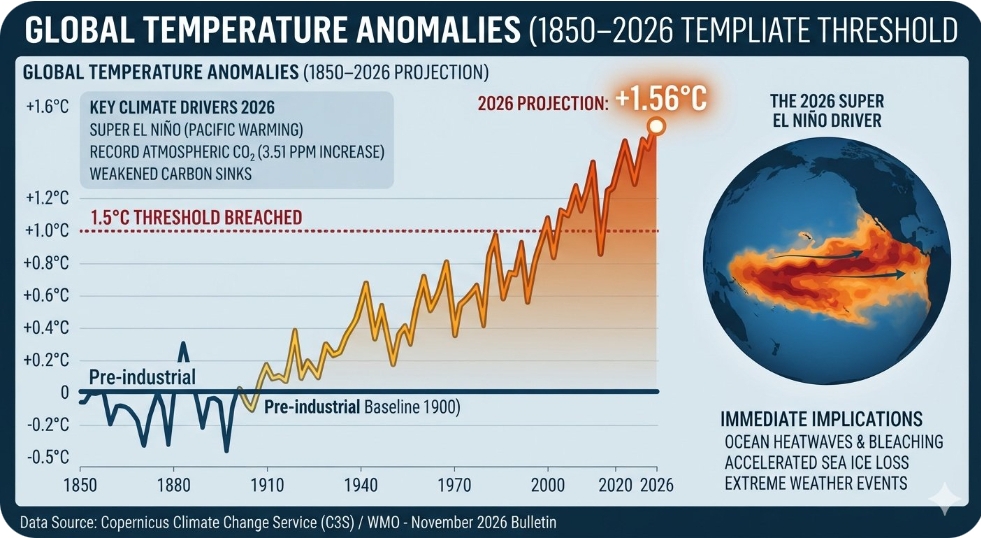
The global average temperature in 2026 is virtually certain to exceed 1.5C above pre-industrial levels, driven by a record-breaking Super El Niño, according to the Copernicus Climate Change Service monthly data bulletin published on Friday, November 6, 2026. Statistical projections indicate a 99 per cent probability that the annual average will settle between 1.56C and 1.61C, with an 80 per cent likelihood that 2026 will rank as the second-warmest year on record. This milestone follows the hottest October ever recorded globally, which reached 15.35C or 1.75C above pre-industrial baselines. In the equatorial Pacific, surface water temperatures in the Nino 3.4 zone hit a record of 29.94C, destabilising regional weather systems, shrinking central European river flows, and reducing sea ice volumes. Industrial emissions have further minimised the capacity of the biosphere to reabsorb carbon, accelerating the general rise in heat anomalies across all oceans.
Institutional Warnings On Weakening Carbon Sinks
The UK Met Office projected on November 6, 2026, a sharp acceleration in global atmospheric carbon dioxide concentrations, estimating an annual expansion of 3.51 parts per million as El Niño converts terrestrial carbon sinks into net greenhouse gas sources. Samantha Burgess, Strategic Lead for Climate at the European Centre for Medium-Range Weather Forecasts, stated: "The strong El Niño is compounding a climate already warmed by human activities, and the four-year average for 2023 to 2026 highlights the sustained nature of the warmth." Carlo Buontempo, Director of the Copernicus Climate Change Service, noted: "While the Paris Agreement measures targets over multi-year averages, these repeated monthly breaches serve as a clear warning that the window to prevent permanent overshoot is rapidly contracting."
Deepening Biological Strain Across Vulnerable Ecosystems
Independent monitors have raised alarms regarding the severe impact on marine ecosystems. Professor Richard Betts, Head of Climate Impacts Research at the UK Met Office, explained: "The current global atmospheric carbon cycle is losing its natural resilience because drought conditions in tropical regions have severely limited the photosynthetic capacity of major rainforests." Furthermore, Dr Valerie Masson-Delmotte, Co-Chair of the Intergovernmental Panel on Climate Change Working Group I, warned: "Crossing the 1.5C threshold in consecutive seasons places intense ecological pressure on low-latitude coral reefs, which face terminal bleaching events if high surface water temperatures persist through the winter months."
Editor's Note
The decisive breach of the 1.5C threshold in 2026 demands an immediate shift in climate policy from abstract targets to enforceable emissions caps. Ahead of international climate summits, industrialised nations must prioritise financing for natural carbon sinks and rapid-response frameworks to address the ecological strain of the El Niño cycle.



Leave a comment