

TreeTake Network
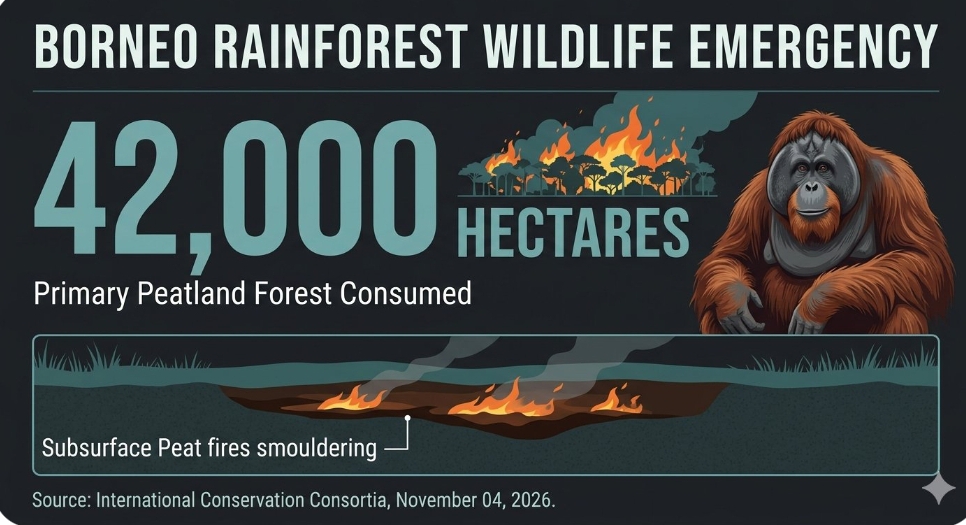
A catastrophic ecological emergency has unfolded across the tropical peatlands of West Kalimantan on November 04, 2026, as uncontained wildfires destroy core biodiversity reserves. Driven by a prolonged, climate-induced El Niño weather cycle, the intense subsurface peat fires have already consumed more than 42000 hectares of primary rainforest canopy. The rapid destruction of critical fruit-bearing habitats has triggered an unprecedented wildlife starvation crisis, forcing critically endangered Bornean orangutans to flee the burning tree canopies. Veterinary rescue teams operating along the agricultural frontiers report that displaced primates are wandering into human settlements in search of food. Specialized wildlife response teams have deployed into the active smoke zones to rescue trapped maternal pairs and stabilize severely malnourished animals facing imminent mortality.
The Breakdown of Canopy Continuity and Trophic Collapse
The structural mechanics of the Bornean peatland fires introduce an exceptionally complex threat to the survival of the region's remaining wild primates. Unlike typical surface vegetation fires, tropical peat fires burn deeply into the underground layers of decayed organic matter, generating toxic plumes of carbon monoxide and thick white haze. This subsurface smouldering destabilises the root structures of giant dipterocarp trees, causing massive forest stands to collapse completely.
Field biologists note that the loss of canopy continuity paralyzes the arboreal movements of orangutans, effectively trapping them on the forest floor where they are exposed to ground predators and intense heat. Local agricultural corporations expanding commercial oil palm estates have compounded the crisis by establishing deep drainage canals that systematically dry out the surrounding peatlands, transforming historical wetland buffers into highly volatile tinderboxes. With local food networks entirely obliterated by the heat, teams are discovering young orangutans suffering from acute respiratory distress and severe gastrointestinal infections caused by eating ash-covered bark and toxic weeds.
Regional Response Operations and Expert Perspectives
The scale of the ecological displacement has forced international conservation consortia, regional forestry departments, and veterinary groups to coordinate immediate field triaging and medical evacuations.
"We are witnessing a complete and irreversible collapse of the local canopy infrastructure in these peat segments," stated Dr Inger Andersen, Executive Director of the United Nations Environment Programme, during a joint emergency briefing. She emphasised that international financial assistance must shift rapidly from passive monitoring to direct, localized habitat shielding, warning that if these fires are permitted to cross into the core conservation zones of Gunung Palung National Park, a foundational genetic stronghold for the species will be permanently erased.
This warning is backed by frontline veterinary surgeons who are currently treating rescued primates inside temporary field hospitals. Commenting on the anatomical condition of the animals, Dr Karmele Llano Sanchez, Program Director for International Animal Rescue Indonesia, remarked that the level of nutritional deprivation seen in the arriving infants is unprecedented. She explained that mothers are abandoning their young because their mammary glands have dried up due to starvation, forcing rescue crews to establish intensive, round-the-clock hydration and milk-supplement networks. She argued that tranquilising and translocating these fragile, smoke-inactivated animals from the burning fringes represents an exceptionally high-risk procedure, yet it stands as the absolute final barrier preventing total species extirpation across the fragmented agricultural divisions.
Community Enforcement and the Defense of Migratory Boundaries
To mitigate the escalating human-wildlife friction on the edges of the burning concessions, community-led forest patrol teams are establishing temporary feeding stations inside unburnt forest pockets. By systematically distributing papayas, bananas, and clean water along known migratory boundaries, organizers hope to deter desperate orangutans from entering hostile village territories.
Concurrently, local environmental groups are demanding that administrative agencies implement immediate legal blocks against commercial entities that utilize the seasonal drought to clear protected land illegally. While emergency services focus on suppressing the subterranean hotspots using specialized high-pressure water pumps, the long-term survival of the displaced populations remains entirely dependent on restoring the natural hydrological levels of the deforested peat basins.
Editor's Note
The environmental crisis in the Bornean rainforest highlights the dangerous synergy between global industrial agriculture and localized climatic anomalies. To secure a permanent stabilization pathway for the Bornean orangutan, international conservation policies must move beyond temporary animal rescues and instead enforce a binding legal framework that mandates the immediate re-wetting of drained industrial peatlands alongside severe international trade penalties for supply chains linked to fire-cleared lands.



Leave a comment