

TreeTake Network
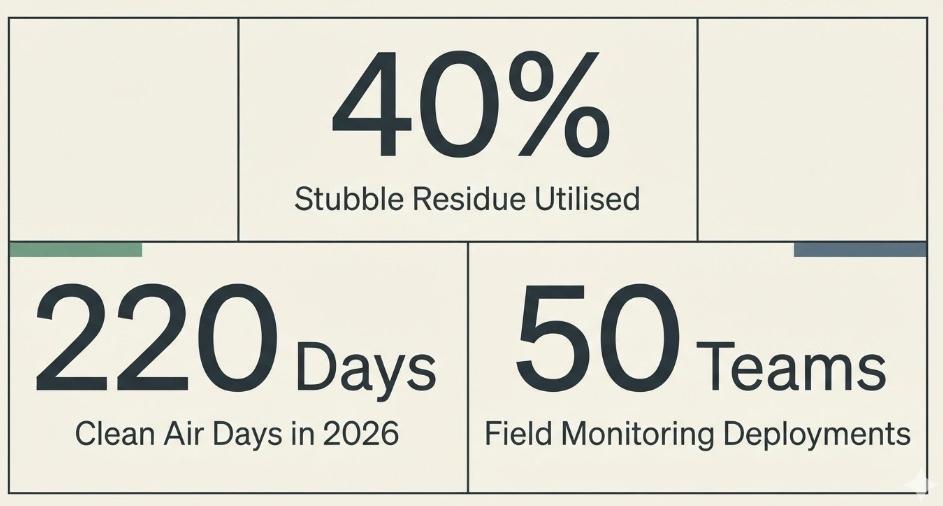
Union Environment Minister Bhupender Yadav announced on November 03, 2026, that approximately 40 per cent of paddy stubble has been successfully utilised through extensive ex-situ management strategies during the current harvesting season. This targeted intervention has driven a measurable reduction in agricultural fires across the northern agrarian corridors compared with previous fiscal cycles. Amidst deteriorating atmospheric conditions across the National Capital Region, the Commission for Air Quality Management has activated a centralized digital tracking dashboard to oversee the strict enforcement of emergency environmental mitigation protocols across rural sectors.
Meteorological Supervision and Regulatory Orders
The Commission for Air Quality Management is conducting continuous assessments of shifting meteorological data, focusing primarily on wind velocity, atmospheric drift patterns, and mixing heights. "The deployment of real-time spatial mapping allows our enforcement cells to identify specific clusters within hours of ignition," stated Dr Laxmi Raghuvanshi, Senior Scientist at the regional monitoring cell. Administrative directives have been issued to state departments in Punjab, Haryana, Rajasthan, and Uttar Pradesh to ensure absolute alignment with the statutory air quality frameworks. Simultaneously, Delhi Environment Minister Manjinder Singh Sirsa reported that the metropolitan region recorded 220 clean-air days across 2026, representing the highest atmospheric efficiency metric registered within the past decade.
The Central Pollution Control Board has deployed 50 additional field teams to track localized emissions sources, whilst Stage-II of the Graded Response Action Plan remains actively enforced across all regional sectors to suppress particulate matter accumulation. "We are witnessing a structural transition in farm residue handling, but meteorological adversity requires absolute vigilance," observed Rajesh Kumar Verma, Director of Agricultural Sustainability Initiatives.
Editor's Note
The measurable transition towards ex-situ crop residue management reflects a positive shift in agricultural environmental compliance, yet the persistence of severe air quality episodes underscores the limitations of incremental interventions. Future atmospheric protection frameworks must look to standardise complete bio-enclosure systems and mandate absolute enforcement timelines across state boundaries to decouple seasonal harvesting from urban air crises.



Leave a comment