

TreeTake Network
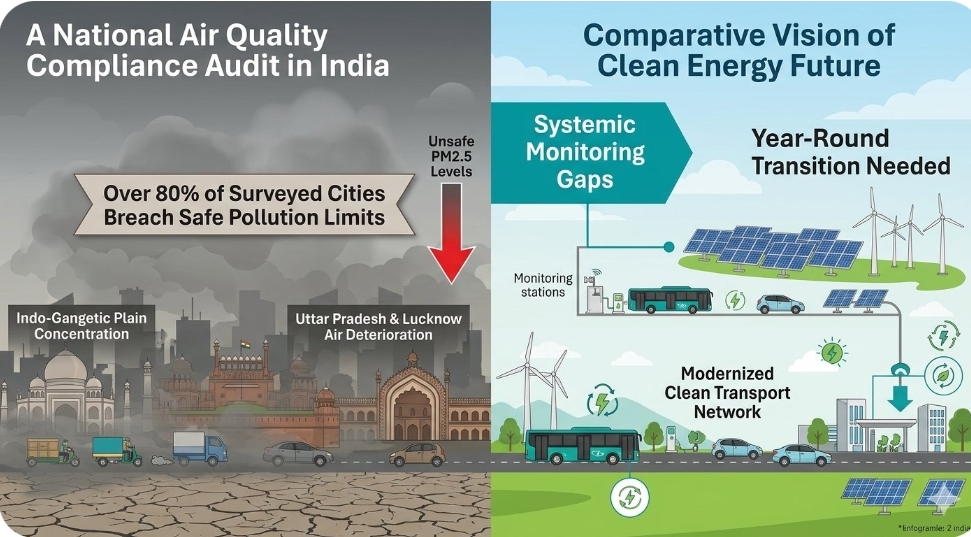
A comprehensive environmental audit released by the "Centre for Research on Energy and Clean Air" (CREA) has revealed a stark decline in urban air quality across India. The independent analysis, which tracked ambient air quality across 293 cities over a multi-month baseline period, concluded that 255 urban clusters consistently breached both national and international safe limits for fine particulate matter (PM2.5).
The detailed findings highlight that cities across the Indo-Gangetic plain continue to bear the heaviest environmental burden as the winter atmospheric cooling pattern sets in. According to the data, industrial emissions, construction dust, and vehicular traffic remain the primary drivers of this widespread deterioration, outstripping seasonal factors like biomass burning. The report notes that despite multi-year investments through national clean air initiatives, most Tier-2 and Tier-3 urban clusters lack the automated monitoring infrastructure needed to trigger emergency localised containment protocols.
Severe atmospheric inversion across Uttar Pradesh
The data layers show that the state of Uttar Pradesh remains one of the most critically impacted regions in the national landscape, with major urban sectors consistently recording baseline concentrations far above safe limits. In the state capital, Lucknow, monitoring stations have recorded a sharp deterioration in the Air Quality Index, as atmospheric inversion traps heavy emissions close to the ground. This regional drop in air quality spreads across multiple key cities, including Noida, Ghaziabad, Meerut, and Kanpur, where concentrated industrial activity, massive commercial transport corridors, and unpaved road dust prevent localised airsheds from dispersing fine particulates.
Systemic monitoring gaps and regional failures
The core of the environmental crisis rests on a profound disparity in data collection and regulatory enforcement. While major metropolitan areas have expanded their continuous ambient air monitoring stations, smaller industrial hubs are left relying on manual sampling methods that frequently underreport peak pollution spikes. Environmental engineers warn that this data gap leaves millions of residents exposed to hazardous PM2.5 concentrations without active public health warnings or mitigation strategies.
The analysis shows that only a tiny fraction of the surveyed municipalities—specifically 38 out of 293 cities—managed to maintain air quality profiles within the annual national standard of 40 micrograms per cubic metre. Meanwhile, none of the studied locations met the more stringent World Health Organisation guideline of 5 micrograms per cubic metre.
Public health warnings and analytical assessments
The release of the compliance data has prompted immediate calls for structural reform from environmental scientists and public health advocates. Sunil Dahiya, a lead analyst who has exhaustively tracked regional emission inventories across South India and the northern plains, emphasised that current municipal action plans are failing to address systemic industrial non-compliance.
"The persistently high pollution levels, which are more than twice the national standards for PM10 and about 2.5 times for PM2.5, reflect that the emission load across the wider airshed has long exceeded the region's carrying capacity," Dahiya stated. He noted that without fixing strict, legally binding emission targets on heavy industries and thermal power plants, cities will continue to experience severe air quality degradation every winter regardless of temporary emergency restrictions.
Policy researchers have strongly backed these findings, emphasising the societal acceptance of toxic baselines. In a public expert brief assessing the data, leading economic infrastructure analyst Mitali Nikore pointed directly to a broader institutional complacency: "We have accepted poor air the way we accepted poor roads and poor water, and that acceptance is the real crisis".
Editor's Note
This extensive national audit exposes the limits of temporary, reactionary measures in combating air pollution, highlighting that sustainable urban air quality can only be achieved through permanent, year-round transition frameworks for industrial and transport sectors.



Leave a comment