

TreeTake Network
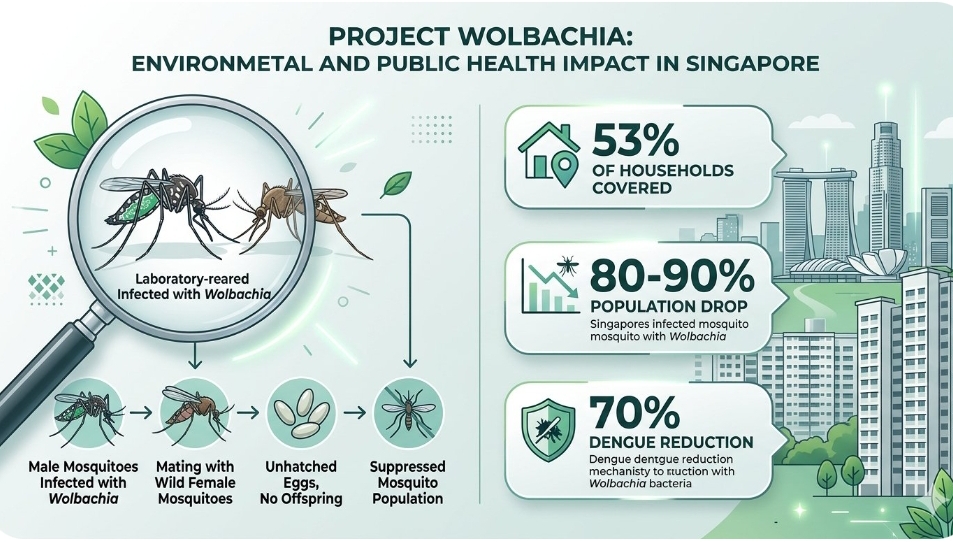
A decade after its pioneering launch, Singapore’s biological dengue suppression initiative now protects more than half of all residential properties in the country. The milestone, marking the expansion of Project Wolbachia to cover approximately 840,000 households—or 53 per cent of the island nation's domestic dwellings—was officially announced at a community anniversary event held at Our Tampines Hub on October 31, 2026.
Managed by the National Environment Agency (NEA), the program releases laboratory-reared male Aedes aegypti mosquitoes carrying the naturally occurring Wolbachia bacterium. When these non-biting males mate with urban wild female mosquitoes that do not carry the bacteria, the resulting eggs fail to hatch. Over the past ten years, this high-density urban experiment has scaled from a localised trial across three pilot estates into a primary tier of national public health and ecological defence.
Peer-reviewed results and population drops
The statistical efficacy of the long-term biological rollout was recently validated by comprehensive multi-site field data published in The New England Journal of Medicine. The landmark study concluded that the sustained weekly releases successfully suppressed target wild Aedes aegypti mosquito populations by 80 to 90 per cent within active deployment sectors. Crucially, this ecological suppression translated into a direct public health victory, reducing the overall risk of dengue transmission for residents living in those neighbourhoods by over 70 per cent.
The impact has been starkly visible in early high-risk zones. During a severe national dengue outbreak in 2020, the Tampines district recorded nearly 1,200 individual cases. Following progressive, automated updates to the Wolbachia deployment grid, annual infections in the same township dropped to just 77 cases. Nationally, reported dengue cases reached a seven-year low of 4,036, marking a significant drop from the 13,651 cases documented in previous peak cycles.
Navigating community anxieties and public trust
The project’s expansion has required overcoming significant psychological and communicative hurdles. Convincing urban communities to accept the deliberate, mass release of millions of mosquitoes directly into high-rise residential corridors required intensive transparency and community engagement.
Initial community anxiety in pilot areas like Braddell Heights gradually gave way to acceptance as residents recognised the public health benefits. Grassroots outreach reassured citizens regarding the harmless nature of male mosquitoes, which do not bite humans.
Scientific limits and the dual-enforcement perspective
Despite these successes, officials emphasise that biological control complements rather than replaces traditional vector control. Senior Minister of State Dr Janil Puthucheary stressed at the anniversary event that dengue prevention remains a collective duty and that residents must continue eliminating stagnant water. Because Wolbachia specifically targets Aedes aegypti, maintaining household hygiene remains essential to guard against other disease-carrying mosquito species. Following further expansions into estates like Ang Mo Kio and Toa Payoh, the NEA continues monitoring the initiative's long-term efficiency.
Editor's Note
Project Wolbachia demonstrates how biological vector suppression can effectively combat urban health risks when paired with transparent public engagement and sustained environmental hygiene.



Leave a comment