

Tree Take Network
The Two Lungs of Our Planet
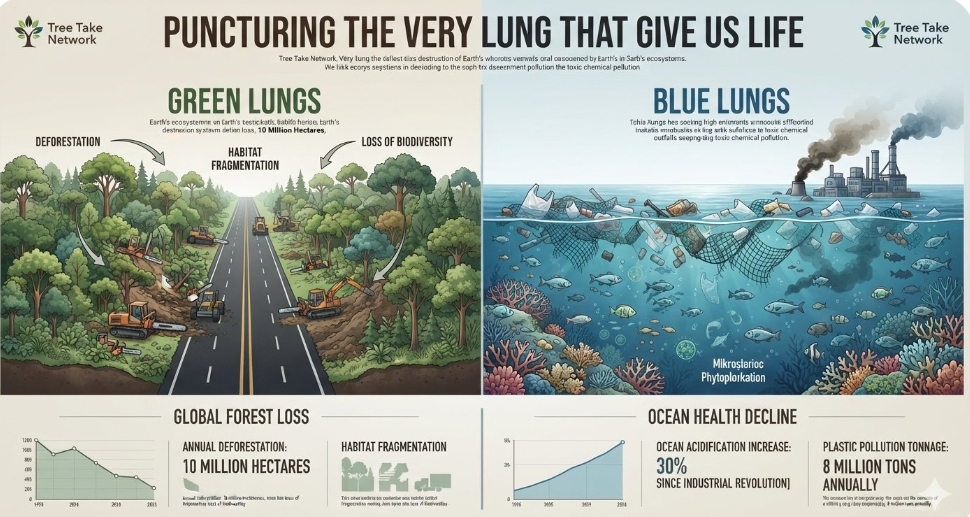
Our planet relies on two massive breathing systems to stay alive: the green lungs and the blue lungs. The green lungs are the vast forests, like the Amazon and India's Western Ghats, which breathe in carbon dioxide and breathe out life-giving oxygen. The blue lungs are our oceans and water bodies, filled with tiny marine plants called phytoplankton that actually generate more than half of the oxygen we breathe. As the pioneering scientist Rachel Carson famously warned in her writings: "In every outthrust headland, in every curving beach, in every grain of sand there is the story of the earth." Together, these systems act exactly like human lungs, filtering out dangerous gases and keeping the global climate stable. Just like a human body cannot survive without healthy organs, Earth is choking because these two systems are under extreme, unnatural stress.
Smoking the Earth: The Pollution Crisis
When a person smokes, their lungs fill with toxic tar and chemicals, making it hard to breathe. We are doing the exact same thing to Earth's lungs through relentless, unchecked pollution. Industrial smokestacks and vehicle exhausts pump millions of tons of greenhouse gases into the air, forcing the green lungs to absorb more carbon than they can naturally handle. Meanwhile, our blue lungs are being choked with millions of tons of plastic waste and chemical runoff every year. Highlighting this toxic choking of our atmosphere, the renowned British naturalist Sir David Attenborough warned: "The truth is: the natural world is changing. And we are totally dependent on that world. It provides our food, water and air. It is the most precious thing we have, and we need to defend it." According to major scientific studies, this chemical overloading causes severe ocean acidification, which kills marine life and stops the blue lungs from producing oxygen efficiently.
Butchering the Greenery Without Feeling
Instead of protecting these vital organs, humanity is treating them with complete apathy, essentially butchering them without feeling any remorse. Deforestation is the physical cutting away of Earth’s lung tissue. Every single minute, we lose forest areas equivalent to 27 football fields globally. When we clear these forests, we do not just remove trees; we destroy complex ecosystems that took thousands of years to build. To make matters worse, critical biodiversity hotspots are being cleared worldwide for commercial gains. Commenting on this mindless destruction of India's own natural treasures, legendary ecologist Dr Madhav Gadgil stated: "The Western Ghats are the water tower of Peninsular India. To treat them as a mere source of immediate commercial profit is to commit ecological suicide." As the famous marine biologist Dr Sylvia Earle brilliantly put it: "No water, no life. No blue, no green, no life." Yet, despite these chilling facts, the destruction accelerates every single day.
India’s Concrete Craze: High-Speed Destruction
In India, the madness for rapid economic development has turned into a direct, violent assault on the environment. The country is rushing to build massive networks of highways, expressways, and pathways at an alarming speed. While connectivity is important, the execution has been devastatingly short-sighted. Chopping down pristine ecosystems for entirely new paths is an unsustainable trade-off.
The Heavy Price of Upcoming Pipelines
The devastation is set to worsen as a barrage of approved, upcoming megaprojects are pushing further into the pipeline. Globally, China has broken ground on the staggering Yarlung Tsangpo mega-dam project on the Tibetan Plateau, which threatens downstream water security and critical river ecosystems across South Asia. Similarly, Saudi Arabia's multi-trillion-dollar NEOM greenfield expansion continues to reshape fragile desert and marine topographies. In India, the destructive pipeline includes the massive Parandur Greenfield Airport project in Tamil Nadu, which risks wiping out local wetlands, farmlands, and natural water channels. Deep in the Northeast, the upcoming 1,000 MW Naying Hydroelectric Project in Arunachal Pradesh has drawn fierce protests, as its planned concrete dams and underground tunnels require the diversion of pristine forest lands and the felling of tens of thousands of native trees. Expressing deep concern over this blind rush, India's pioneer environmentalist and Chipko Movement leader Chandi Prasad Bhatt stated: "The mindless and indiscriminate exploitation of resources is being done in the name of so-called development due to which life on earth is in danger." Thousands of kilometres of tar and concrete are cutting directly through ecologically sensitive zones, permanently fracturing India's remaining green cover.
The Terrible Toll of "Suicide Development"
The cost of this development craze is terrifyingly high. Cutting down centuries-old trees and replacing them with tiny saplings somewhere else is an incredibly stupid and flawed strategy, as young saplings take decades to match the carbon-absorbing power of a mature forest. Scientists constantly warn that cutting into steep mountain terrains causes deadly landslides, severe soil erosion, and disrupts local water cycles, yet the digging never stops. Commenting on the ecological devastation caused by such aggressive mountain roads, the environmental scientist Dr Ravi Chopra, who headed the Supreme Court's high-powered committee on the Char Dham project, bluntly noted that such fragmented projects are executed to "evade responsible and sustainable development." It is deeply foolish to destroy the very air and water systems we need to survive just to make travel a few minutes faster. Building wide concrete pathways while choking our green and blue lungs is like a person selling their own lungs to buy a faster car—without a healthy environment, economic wealth becomes entirely meaningless.
The Paradox of Broken Solutions
The true tragedy is not that we lack answers; we already have brilliant, scientifically proven solutions to heal these lungs. Engineers have designed "Green Infrastructure" methods, such as constructing elevated eco-ducts and wildlife corridors that allow highways to pass over or under forests without cutting them to pieces. We have advanced methods for green pavement that absorbs rainwater, and strict laws can be made to mandate the use of existing, degraded land for development instead of entering pristine forests. For our blue lungs, marine protected areas (MPAs) can be established to completely ban plastic dumping and industrial fishing in critical zones. As the visionary architect and sustainability theorist Buckminster Fuller once said: "We are called to be architects of the future, not its victims." The science is ready, the blueprints are drawn, and the paths to survival are perfectly clear.
The Illusion of Government Action
The real crisis lies in the fact that no one in power is actually bothered enough to implement these solutions. Governments worldwide, including in India, treat environment ministries as mere rubber stamps to clear industrial projects. High-ranking leaders give grand speeches at global climate summits, promising carbon neutrality and massive tree-plantation drives. However, these promises are hollow. In reality, authorities count tiny, fragile saplings planted on the sides of highways as "replacement forests," completely ignoring that a sapling cannot replace a 150-year-old banyan tree. As the world-renowned linguist and activist Noam Chomsky observed on political inaction: "Changes are not going to come from the top. They're going to come from the pressure of mass popular movements." Development budgets get billions of dollars instantly, while environmental protection agencies are left underfunded, toothless, and entirely ignored.
The Failure of Judiciary and Global Leaders
Even the institutions built to protect life have failed us. The judiciary—including specialised bodies like India’s National Green Tribunal—frequently prioritises economic growth over ecological survival. Courts often allow destructive highway and mining projects to proceed under the guise of "national interest," imposing minor fines on polluting corporations that are treated as just the cheap cost of doing business. Reflecting on how the legal system struggles to hold authorities accountable, retired Supreme Court Justice RF Nariman pointedly observed in an environmental judgment: "The environment is not a luxury... if we do not safeguard it, our future generations will pay an irreversible price for our immediate economic greed." On the global stage, international bodies hold lavish conferences where world leaders sign historic treaties, take photos, and then return home to approve more coal plants and oil pipelines. As activist Greta Thunberg famously summarised to global leaders: "All we hear from our so-called leaders is words. Words that sound great but so far have led to no action... Our hopes and dreams drown in their empty words and promises."
Choking in the Name of Progress
Ultimately, the global community is trapped in a state of deep, systemic blindness. Consumers demand cheaper goods delivered faster, politicians demand higher GDP numbers for the next election, and judges rule based on outdated laws that treat nature as property rather than life support. Everyone notices the worsening air pollution, the drying rivers, and the scorching heatwaves, yet no one works on the actual solutions. We are collectively watching our green and blue lungs fail, nodding our heads in temporary concern, and then going right back to building the concrete cages that are suffocating us. As the indigenous Native American proverb powerfully warns us: "Only when the last tree has died, and the last river has been poisoned, and the last fish has been caught will we realise we cannot eat money." It is a terrifying reality where humanity prefers a fast road to economic wealth, even if that road leads directly off a cliff.
Editor's Note: Everywhere, and particularly in India, planners rely very heavily on greenfield technology—which carves entirely new roads through completely untouched, vacant land—causing an irreversible loss to nature. Instead of this destructive approach, brownfield technology—which focuses on widening, upgrading, and rehabilitating existing highway networks—should be adopted. Though brownfield technology is highly complicated due to traffic management, design integration, and existing structures, it is a necessary shift for an agrarian country like India. India is a small nation geographically relative to its massive, dense population, leaving it with very limited actual green cover.



Leave a comment