

TreeTake Network
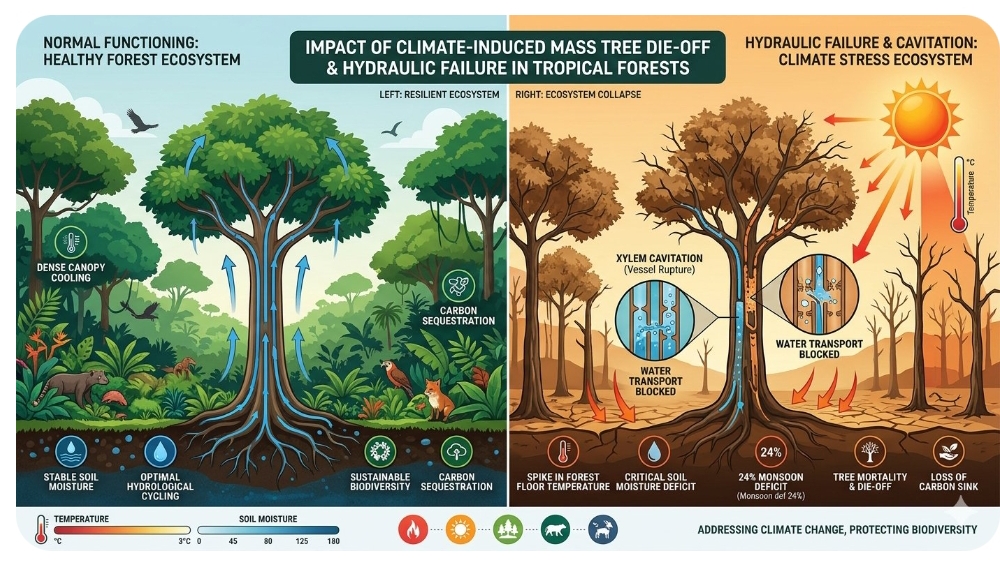
Forest departments and atmospheric scientists have launched an emergency ecological investigation following an unprecedented, widespread mass die-off and drying up of millions of native trees across sensitive forest ecosystems. The crisis, driven by a combination of severe hydraulic failure, prolonged heat stress, and a massive 24 per cent deficit in southwest monsoon rainfall, has caused vast swathes of continuous forest canopies to turn completely brown, brittle, and dry within a matter of weeks.
The scale of the ecological disaster came to light following a comprehensive multi-station satellite and ground-truthing survey concluded on October 29, 2026. Field teams from state forest departments alongside the Kerala Forest Research Institute (KFRI) mapped vast tracts of affected vegetation stretching across thousands of hectares of crucial biodiversity hotspots. The die-off has hit native species exceptionally hard—including commercially valuable teak (Tectona grandis), rosewood, and endemic evergreen understorey trees. Soil moisture profiles across the affected divisions have plummeted to historic lows, causing the trees to suffer irreversible cavitation, a fatal condition where the internal water-transporting xylem vessels rupture under intense atmospheric demand, completely blocking the flow of nutrients.
Severe physiological strain
Local forest guards and tribal communities first raised the alarm when mature trees began shedding their leaves entirely out of season, followed by the rapid peeling of bark and structural wood splitting. Forensic plant pathologists have ruled out parasitic insect attacks or fungal epidemics, confirming that the mortality is a direct result of extreme environmental and physiological strain.
The rapid loss of living canopy cover has triggered secondary environmental crises. Without the natural cooling effect of dense foliage, forest floor temperatures have spiked by up to 4.5 degrees Celsius, drying out forest litter and creating highly volatile fuel loads that drastically increase the risk of unseasonal, catastrophic wildfires.
Scientific and administrative findings
The sudden collapse of these forest blocks has stunned regional scientists who are rushing to establish long-term monitoring plots. Dr T. V. Sajeev, Senior Principal Scientist at the Kerala Forest Research Institute, expressed deep concern over the vulnerability of these ecosystems. His full scientific observations regarding the mechanisms of hydraulic failure can be found in the official KFRI briefing papers.
State administrators are treating the canopy collapse as a major climate emergency. Senior forest officials noted that the unprecedented speed of the drying poses immediate ecological risks. Their complete administrative statements regarding emergency habitat interventions are detailed in the departmental logs.
The Ministry of Environment, Forest and Climate Change has ordered a joint task force to submit a comprehensive mitigation framework by 12 November 2026.
Editor's Note
This unprecedented canopy collapse serves as a stark warning that climate change is outpacing the natural resilience of our most vital carbon sinks, requiring immediate shifts toward climate-resilient forestry practices.



Leave a comment