

TreeTake Network
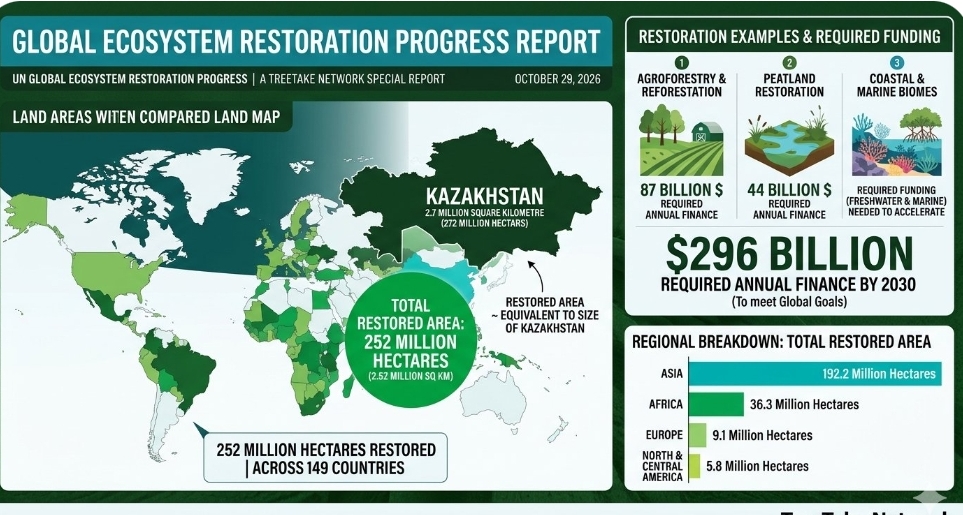
An unprecedented global assessment published jointly by the United Nations Environment Programme, the Food and Agriculture Organisation, and the Secretariat of the Convention on Biological Diversity on October 29, 2026, has revealed that coordinated international ecosystem restoration efforts have successfully brought 252 million hectares of degraded land under active management. This massive footprint, roughly equivalent to the entire geographic landmass of Kazakhstan, spans 149 countries. The flagship publication, titled Restoration Progress Report: Nature's Comeback, marks the most comprehensive data audit conducted since the launch of the United Nations Decade on Ecosystem Restoration, highlighting an extraordinary scaling up of nature-based solutions worldwide.
The report tracks commitments and physical progress across terrestrial, freshwater, and marine biomes, showing that public and private initiatives are finally converting high-level political promises into measurable ground-level recovery. Terrestrial restoration has successfully reached nearly half of its global target. However, the data reveals a stark variation across ecosystems, with progress remaining heavily limited in freshwater, marine, and coastal environments, which continue to degrade at the fastest rates globally. Of the total recorded area, Asia leads the progress with 192.2 million hectares—driven heavily by extensive programmes in China—followed by Africa at 36.3 million hectares, Europe at 9.1 million hectares, and North and Central America at 5.8 million hectares.
Financial commitments toward these planetary repair initiatives have also reached historic thresholds, though critical gaps remain. The report states that global annual restoration finance must more than quadruple, rising from the current 64 billion dollars to 296 billion dollars by 2030 to meet overarching planetary stability targets. This required funding includes 87 billion dollars specifically for agroforestry, 52 billion dollars for restorative reforestation, and 44 billion dollars for peatland restoration.
Global leaders emphasised the socio-economic necessity of these targets, with FAO Director-General Dongyu Qu stating that "restoration works" and must be integrated into sustainable resource management and agrifood transformation. UNEP Executive Director Inger Andersen noted that active measures must accelerate—particularly in marine and coastal biomes—to shift toward restoration economies. Furthermore, CBD Executive Secretary Astrid Schomaker warned that managing land cannot substitute for halting destruction, calling for robust monitoring, while UNEP's Natalia Alekseeva stressed that healthy ecosystems are vital for addressing climate change, food security, and biodiversity loss.
Editor's Note
While achieving a restored area matching Kazakhstan is a major milestone, active management does not automatically equate to pristine biodiversity recovery. Experts stress the ongoing risk of greenwashing and the necessity of transitioning from raw hectare tracking to high-resolution ecological integrity verification. Conservation of remaining primary wilderness must remain absolute alongside active healing.



Leave a comment