

TreeTake Network
In a landmark step for corporate biodiversity management, automotive giant Honda Motor Company announced on October 30, 2026, that the vast majority of its massive Takasu Proving Ground in Hokkaido, Japan, has been officially designated as a Nationally Certified Sustainably Managed Natural Site. Popularly known as a "Shizen Kyosei Site" or Nature Symbiosis Site, the certification was jointly approved by Japan's Ministry of the Environment, Ministry of Agriculture, Forestry and Fisheries, and Ministry of Land, Infrastructure, Transport and Tourism. The decision is grounded firmly in the nation's Act on Promoting Activities to Enhance Regional Biodiversity, positioning this top-secret vehicle-testing facility as a vital contributor to global conservation targets.
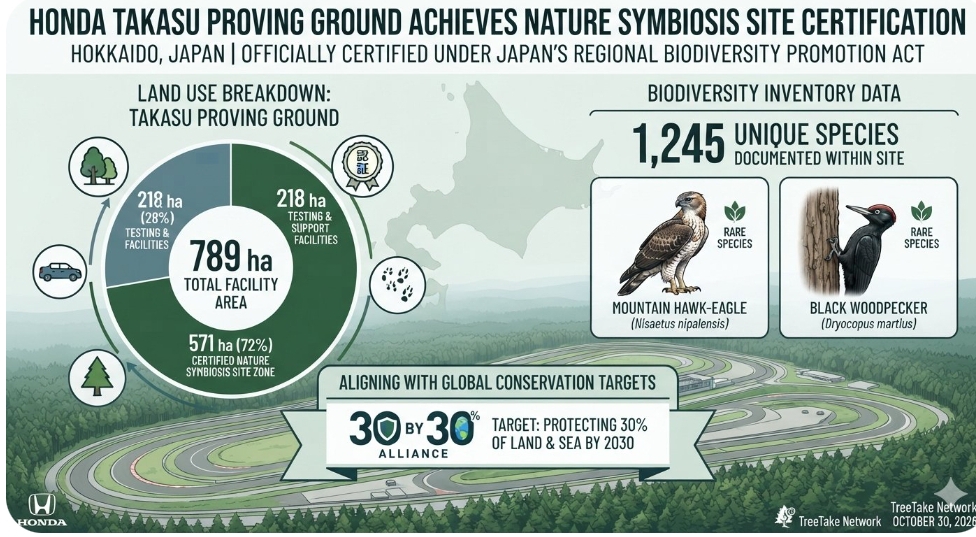
The certified zone encompasses 571 hectares, representing roughly 70 per cent of the total 789-hectare testing facility located in Takasu-town, Kamikawa-district. By isolating facilities like high-speed circuits and winter test tracks, Honda has successfully ring-fenced an expansive wilderness area from external public disruptions. This milestone makes it the largest single-facility ecosystem reserve within Honda’s corporate network and its very first dedicated research and development facility to secure the title. The initiative aligns directly with the "30 by 30 Alliance for Biodiversity" framework, which aims to protect at least 30 per cent of terrestrial and marine ecosystems globally by 2030.
Long-term ecological monitoring at the proving ground has yielded striking results. A comprehensive biodiversity inventory completed during a 2025 survey confirmed the presence of 1,245 distinct species of flora and fauna within the facility's boundaries. Crucially, this includes 58 rare and endangered species, such as the mountain hawk-eagle, the black woodpecker, and Hilgendorf's tube-nosed bat. The facility’s strict security protocols—including a three-metre-high outer perimeter fence designed to keep large mammals off the high-speed tracks—have inadvertently generated an accidental sanctuary, entirely shielded from human encroachment, poaching, and urban development.
To ensure minimal human disruption inside the reserve, Honda has designated a pristine Japanese elm and Manchurian ash woodland as a zero-intervention core conservation zone. Environmental management teams focus exclusively on removing aggressive, non-native invasive species, conducting regular anti-pollution water quality testing, and gathering baseline ecosystem health data. The company has also historically planted over 35,000 trees on the property to heal fragmentation caused by track construction.
"This massive certification proves that industrial research and robust wilderness preservation do not have to be mutually exclusive," stated a representative from Japan's Ministry of the Environment during the official announcement. "By systematically cataloguing and protecting over fifty rare species, Honda's managed closed-facility model sets a strong benchmark for how private corporations can actively meet international OECM conservation parameters without halting specialised technological development."
Editor's Note
The official certification of Honda's Takasu Proving Ground marks a critical psychological shift in how global heavy industries perceive their physical land footprints. Historically, high-security corporate testing grounds were viewed strictly as ecological dead zones or high-pollution testing hazards. However, when managed under structural biodiversity guidelines, their extreme isolation and heavily restricted human access can turn them into highly effective, involuntary nature reserves. The way forward for heavy industry requires integrating international frameworks, like the Taskforce on Nature-related Financial Disclosures, into early factory design. Governments must continue to incentivise major corporations to log their corporate land holdings into the World Database on Other Effective Area-based Conservation Measures. Private property, when heavily guarded and ecologically managed, might just become one of the most reliable shields we have against regional habitat loss.



Leave a comment