

TreeTake Network
A severe groundwater contamination crisis has emerged across prominent industrial neighbourhoods, forcing regulatory bodies and environmental advocates to demand immediate remediation strategies on October 29. Recent ecological assessments have revealed that toxic industrial runoff, primarily containing carcinogenic hexavalent chromium, has infiltrated local aquifers, systematically compromising municipal water security and triggering acute health alarms for thousands of local residents.
Industrial effluent breaches regional aquifers
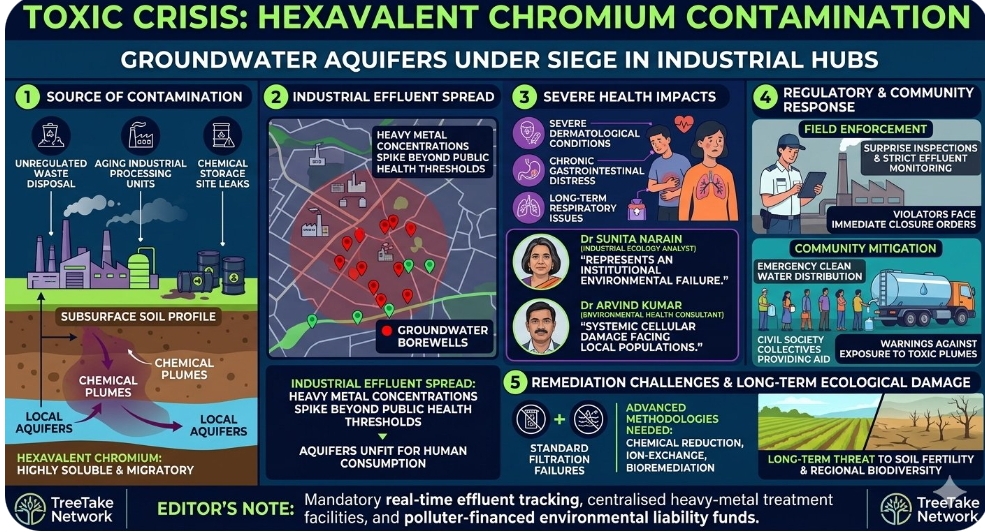
The contamination has been traced back to unregulated hazardous waste disposal and structural leaks from ageing industrial processing units, chemical storage sites, and metallurgical facilities. According to recent hydrological assays, heavy metal concentrations in regional tube wells have spiked far beyond permissible public health thresholds. Environmental monitors noted that hexavalent chromium—a toxic byproduct heavily utilised in electroplating, leather tanning, and corrosion-control operations—has thoroughly stained local groundwater reservoirs, rendering them entirely unfit for human consumption, domestic utility, or agricultural irrigation.
The environmental crisis is particularly severe in low-income clusters surrounding the industrial zones, where families rely exclusively on shallow borewells for daily water access. Local civil society collectives have initiated emergency clean water distribution networks, warning that prolonged exposure to the chemical plumes poses an existential threat to long-term soil fertility and regional biodiversity.
Extensive expert projections and official testimonies
The rapid escalation of this industrial footprint has driven comprehensive analysis from environmental scientists, public health professionals, and regulatory officers who are tracking the movement of the heavy metal concentrations.
"The presence of hexavalent chromium in local aquifers represents an institutional environmental failure that requires an immediate, localised response," stated Dr Sunita Narain, a prominent industrial ecology analyst. "Unlike trivalent chromium, this specific hexavalent variant dissolves easily in water, allowing it to migrate rapidly through subsurface soil profiles and systematically accumulate within regional agricultural food chains."
Public health supervisors have reported a sharp, verifiable rise in clinical pathologies across the affected geographic belts, urging swift interventions from regional medical associations.
"Our clinical monitoring teams have registered an alarming increase in severe dermatological conditions, chronic gastrointestinal distress, and long-term respiratory issues directly matching heavy metal toxicity profiles," confirmed Dr Arvind Kumar, a leading regional environmental health consultant. "The local population is facing systemic cellular damage, and without immediate medical tracking and clean water alternatives, the chronic disease burden will escalate exponentially."
In response to the expanding public outcries, state pollution control monitors have deployed specialized field enforcement units to pinpoint the primary offending facilities.
"We have restructured our regional compliance squads to execute surprise inspections and strict effluent monitoring across all adjacent chemical and manufacturing plants," stated a senior official from the State Pollution Control Board's hazardous waste division. "Any manufacturing enterprise found systematically discharging untreated industrial sludge into unlined storage pits or municipal drainage systems will face immediate closure orders, heavy financial penalties, and criminal environmental prosecution."
Remediation challenges and long-term ecological damage
The complex nature of heavy metal contamination presents profound challenges for municipal restoration infrastructure, as traditional water filtration systems are entirely incapable of neutralising hexavalent chromium.
"Standard chlorination and physical filtration networks cannot separate heavy metals from deep groundwater layers," explained Dr Rashmi Aslam, a senior hydrologist specialising in industrial wastewater treatment. "Reversing this level of aquifer degradation requires advanced chemical reduction methodologies, specialised ion-exchange columns, or long-term bioremediation systems. This process will inevitably require substantial public capital and years of focused engineering to fully rehabilitate the local microclimate."
Editor's Note : The unfolding chromium contamination crisis emphasizes the dangerous systemic flaws inherent in unmonitored industrial expansion and outdated waste management protocols. Moving forward, industrial policy must be radically modernised by mandating real-time effluent tracking sensors at source points, establishing centralised heavy-metal treatment facilities, and creating a legally binding national environmental liability fund to ensure that industrial polluters entirely finance the complex ecological restoration of affected subcontinental aquifers.



Leave a comment