

TreeTake Network
A major climate modelling breakthrough has mapped out a comprehensive blueprint for maximising the structural efficiency of renewable energy networks inside high-emission grids. In a peer-reviewed research study published directly in Nature on October 27, 2026, international climate scientists and energy systems engineers unveiled critical spatial coordination strategies for China's power grid. The comprehensive investigation demonstrates that the raw installation of renewable capacity is fundamentally insufficient, establishing that the precise geographical placement and cross-regional balancing of wind and solar installations are the absolute keys to successfully displacing coal-fired generation and avoiding catastrophic transmission gridlocks.
Operational bottlenecks and spatial coordination strategies
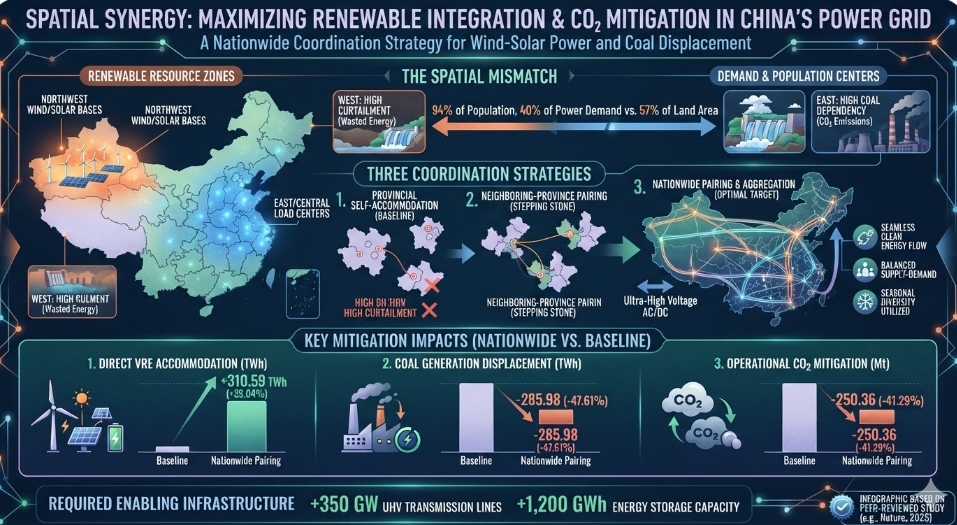
The updated analytical models address a structural vulnerability in rapid clean energy expansions: the high rate of energy curtailment caused by geographical mismatches between production zones and consumption hubs. China's massive wind and solar capacities are concentrated within the remote northern and western provinces, such as Xinjiang and Inner Mongolia, whereas primary industrial power consumption remains heavily clustered along the dense eastern seaboard.
The study's spatial data establishes that without highly synchronised regional deployment strategies, expanding solar arrays and wind corridors frequently saturate local grids during peak generation hours, forcing grid operators to waste vast amounts of clean energy. The research team utilised advanced machine learning models to track historical hourly generation profiles against national consumption curves. The resulting data proves that by systematically combining decentralised solar networks near urban centres with long-distance, high-voltage direct current (HVDC) transmission lines originating from western wind corridors, the grid can displace up to three times more coal-fired thermal generation per gigawatt than under current uncoordinated expansion pathways.
Expert scientific and systemic assessments
Detailing the core mechanics of the spatial modelling framework, lead researchers at the global energy summit emphasised that green transition policies must evolve beyond tracking simple generation metrics. In an official briefing released on October 27, 2026, the study's coordination panel stated: "The true measure of a successful energy transition is not how many gigawatts of solar panels are manufactured, but how effectively those clean assets actively force the retirement of fossil-fuel baseloads. Our models show that spatial synchronisation and regional load sharing are absolutely vital to maximise carbon dioxide mitigation across heavily stressed industrial grids."
Validating these scientific findings, independent international grid infrastructure analysts noted that the financial investments required to construct these ultra-high-voltage cross-border connections face steep logistical constraints. The Nature research teams further clarified that while national climate frameworks frequently finance localised wind farms, energy policy planners must aggressively pivot global capital toward systemic grid-balancing architectures—including massive cross-regional battery hubs and dynamic demand-response infrastructure—to achieve real, uncurtailed emission reductions across the global industrial sector.
Editor's Note
The extensive spatial grid modelling highlights an essential evolution in global environmental management: the shift from simple green technology accumulation to advanced systemic optimisation. For years, international environmental tracking has celebrated raw capacity numbers, allowing governments to claim climate progress based entirely on the volume of solar panels deployed. This study exposes that approach as a dangerous simplification. If clean energy generation cannot be efficiently routed to industrial hubs precisely when baseload demands peak, fossil-fuel plants will continue to run unchecked. The way forward requires an aggressive transition toward integrated regional grid planning. Environmental ministries must align energy manufacturing policies with advanced spatial tracking, building cross-provincial transmission lines that can seamlessly balance diurnal solar cycles with nocturnal wind flows. Maximising the displacement efficiency of every single renewable asset is the single most definitive way to ensure national carbon neutrality targets are reached before climate tipping points collapse.



Leave a comment