

TreeTake Network
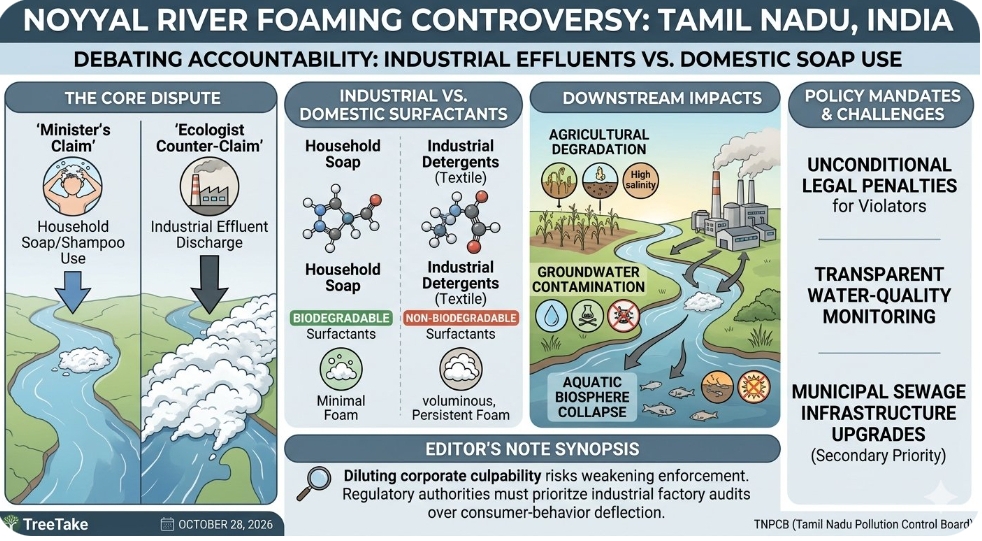
An intense political and ecological controversy has erupted across Tamil Nadu following a public declaration by the state’s Minister for Environment, Climate Change and Pollution Control, Dr V.K. Rajiv, regarding the systemic degradation of the Noyyal River. Speaking to news reporters on October 27, 2026, after conducting an official administrative inspection of regional environmental infrastructure in the Tiruppur district, the Minister claimed that consumer habits—specifically the domestic use of everyday soaps and shampoos by the general public—acted as a major driving factor behind the thick chemical foam suffocating the historic watercourse.
The executive assertion was delivered directly outside the Kasipalayam Common Effluent Treatment Plant. The statement has triggered immediate condemnation from grassroots agrarian coalitions, local river protection committees, and regional political leaders who accuse the environmental ministry of deliberately deflecting corporate accountability from the area's highly lucrative textile dyeing and industrial processing clusters.
Industrial Effluents or Household Drainage
The Noyyal River, a critical tributary of the Cauvery River network, flows through major industrial corridors including Coimbatore, Tiruppur, and Karur. For decades, the river system has suffered from chronic industrial pollution, with downstream farming tracts routinely devastated by high salinity levels and heavy chemical toxicity.
Local environmental investigators argue that the sudden bursts of voluminous white foam observed during monsoon downpours are a direct consequence of commercial dyeing facilities surreptitiously discharging untreated chemical waste into active rainwater drains. By attributing these dense chemical blankets to civilian household drainage, activists state that the state's regulatory body is actively shielding major corporate polluters from stringent regulatory enforcement and closure mandates.
Statements from Legislative Opposition and Local Ecologists
"It is deeply distressing that an official entrusted with the solemn responsibility of cleaning our natural water bodies is echoing the exact defensive arguments used by industrial polluters," stated Dr Anbumani Ramadoss, a prominent regional leader and former federal minister, during a public counter-briefing. "Even school children understand that the systemic toxic foaming across the Noyyal River and the contamination of the Orathuppalayam Dam are driven entirely by uncontrolled industrial waste. Turning this severe ecological emergency into a public mockery by blaming domestic shampoo consumption shows a shocking disregard for verified environmental science."
Responding to the operational controversy from the site, Minister Dr V.K. Rajiv defended the technical scope of the state's pollution oversight while maintaining his warning to commercial mills.
"Our department is maintaining an absolute zero-tolerance policy against any unauthorised waste disposal," Minister Rajiv asserted during his interaction with regional media teams. "We have issued explicit warnings that any industrial factory taking advantage of heavy monsoon rains to flush chemical effluents into natural channels will face immediate, permanent closure. However, an objective scientific assessment of urban river systems must also acknowledge the rising volumes of untreated domestic gray water and municipal sewage entering our waterways daily. True environmental restoration requires addressing both corporate compliance and comprehensive municipal infrastructure upgrades."
Downstream Soil Degradation and Agricultural Protests
Agrarian unions operating along the Noyyal basin have officially rejected the ministry's framing, pointing to multi-decade soil reports that show irreversible damage to thousands of hectares of fertile farmland downstream from Tiruppur’s industrial zones. The high chemical concentration has rendered local groundwater completely non-potable, forcing farmers to stage recurring demonstrations against the releasing of polluted water from regional reservoirs.
Field monitors from independent ecological watchdogs emphasise that industrial detergents utilised in industrial textile processing contain heavy concentrations of non-biodegradable surfactants. These chemical compounds alter water surface tension far more aggressively than standard household personal care items, creating long-lasting foam layers that block sunlight and destroy aquatic biospheres.
Editor's Note
The public dispute surrounding the Noyyal River foaming highlights a dangerous and recurring flaw in modern environmental governance: the attempt to shift institutional and corporate accountability onto individual consumer behaviour. While municipal sewage management is undeniably a vital component of urban river restoration, comparing household soap usage to the massive volume of industrial chemical waste generated by the textile sector defies scientific reality. By making statements that dilute corporate culpability, regulatory authorities risk undermining public trust and weakening the enforcement of existing pollution control laws. Moving forward, the Tamil Nadu Pollution Control Board must move past rhetorical deflections and demonstrate its commitment to environmental conservation through transparent water-quality monitoring, rigorous factory audits, and unconditional legal penalties against industrial violators.

.jpg?resize=780%2C450&ssl=1)



Leave a comment