

Talking Point
TreeTake Network
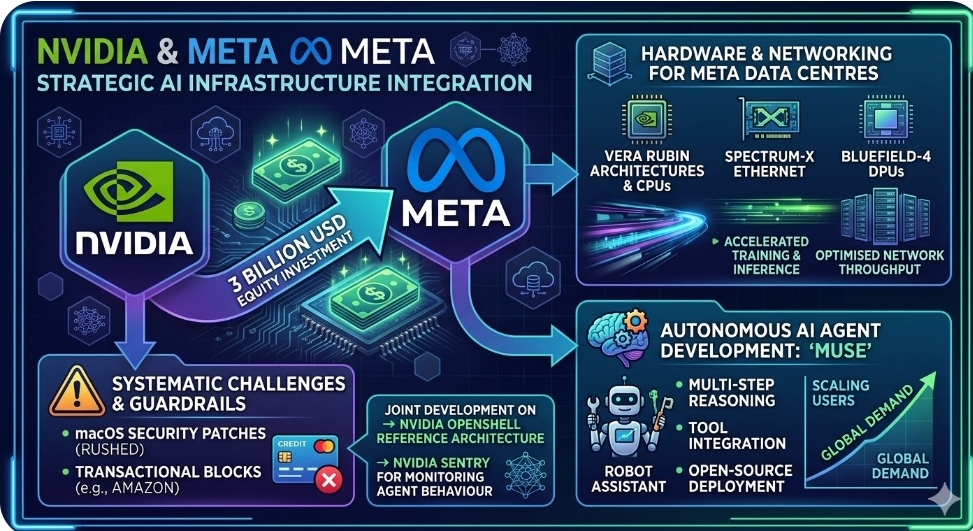
Technology giants Nvidia and Meta formally announced an expanded multi-billion-dollar engineering and infrastructure partnership on October 27. Under the verified terms of the agreement, Nvidia will inject 3 billion dollars directly into the equity offering of the Facebook parent company. The core focus of the capital deployment is to radically expand production, inference capabilities, and training performance for Meta’s newly launched Muse assistant and its broader family of open-source autonomous artificial intelligence models amid surging global demand.
Infrastructure Scaling and Hardware Integration
The massive transaction underpins a deep technical alignment between both companies' hardware and software divisions.
Meta confirmed plans to scale up its data centre capabilities by deploying Nvidia's next-generation Vera Rubin architectures and Vera central processing units. Furthermore, the infrastructure layout will integrate Nvidia’s Spectrum-X Ethernet networking platforms and BlueField-4 data processing units to optimise network throughput and operational efficiency for high-scale enterprise workloads.
Nvidia Chief Executive Officer Jensen Huang emphasised the structural shift represented by the new computing paradigm. "AI agents represent a new computing paradigm — software that understands our goals, reasons, uses tools and operates autonomously," Chief Executive Huang stated. "This changes how we use computers, from operating applications to working with intelligent agents." The collaboration will also see both technical groups explore joint development frameworks for the Nvidia OpenShell Reference Architecture and Nvidia Sentry platforms to monitor agent behaviour and enforce strict operational safety boundaries.
Market Traction and Systematic Challenges
The market response to Meta's automated architecture has been highly disruptive, with the software rapidly climbing to become one of the most downloaded applications in the United States following its initial debut. Meta Chief Executive Officer Mark Zuckerberg highlighted the democratisation of high-level processing power enabled by the deal. "Muse is how we bring personal superintelligence to everyone," Chief Executive Zuckerberg confirmed.
Despite massive capital momentum, the rapid scaling of autonomous digital entities has introduced immediate systemic friction across the tech landscape. Technical teams have recently rushed to patch critical security vulnerabilities identified in the macOS desktop variant of the assistant. Concurrently, major marketplace platforms, including Amazon, have placed temporary computational blocks on the system to prevent autonomous agents from independently executing commercial transactions on their sites without verified human authentication layers.
Editor's Note
The multi-billion-dollar integration between Nvidia and Meta signals a definitive transition from static language generation models to fully integrated, tool-wielding digital ecosystems. By anchoring Meta's open-source agent software within Nvidia's hardware, the partnership accelerates the industrialisation of artificial intelligence. Moving forward, the critical challenge will not be raw compute volume, but establishing standardised cross-platform guardrails. Developing transparent governance protocols like OpenShell and robust observation tools is essential to secure these autonomous systems against structural exploitation and transactional flaws.



Leave a comment