

TreeTake Network
The environmental policy landscape underwent a thorough structural synthesis as international monitors compiled the foundational daily record of the concurrent climate interventions launched across Yerevan, Armenia, and Westminster, London. Released on October 28, 2026, the unified compendium integrates the policy directives, scientific briefs, and structural framework agreements established during a landmark day of cross-border ecological legislation, building a comprehensive database for nature-inclusive global governance.
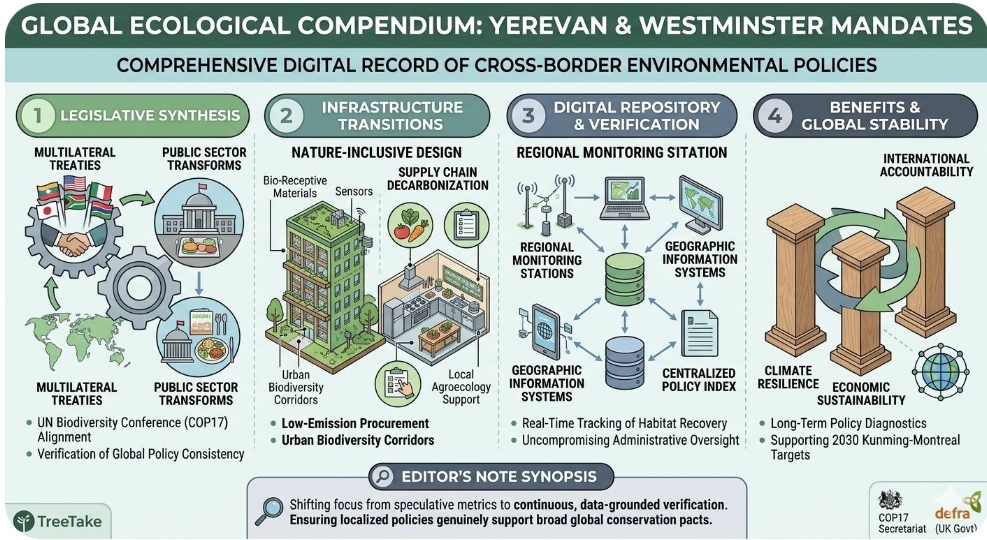
The compilation occurs as conservation institutions struggle to reconcile fragmented climate data across disparate administrative jurisdictions. By binding the legislative outcomes of the United Nations Biodiversity Conference (COP17) with individual state-level environmental frameworks, this documentation effort seeks to provide international analysts with a transparent mechanism to verify global policy alignment, preventing administrative delays in the race to achieve the 2030 Kunming-Montreal targets.
Synthesising Multilateral Treaties and Public Sector Transformations
The digital ledger successfully categorises the diverse operational scale of the day’s ecological landmarks. The documentation spans from high-altitude catchment treaties aimed at restoring vulnerable mountain biospheres to innovative urban design protocols utilising bio-receptive building materials in municipal engineering.
Furthermore, the database records the precise infrastructure shifts initiated by public procurement modifications, mapping out the supply chain transitions required to convert institutional food networks into low-emission operations. By providing a single point of reference for these distinct environmental pillars, the compendium demonstrates the deep operational overlap between international treaty commitments and sovereign, domestic infrastructure overhauls.
Statements from Editorial Directors and International Policy Evaluators
"We are executing a thorough documentation strategy designed to bridge the persistent communication gap between global climate summits and frontline conservation networks," stated Saumya Misra, the Managing Editor and Founder of the TreeTake publication framework, during a presentation at the regional editorial office. "Fragmented reporting routinely dilutes the systemic significance of environmental policy. Through this comprehensive compilation, our network provides the verified, data-grounded infrastructure analysis required to hold institutional actors fully accountable to their publicised ecological mandates."
Analysing the long-term utility of the unified digital index, Dr Arthur Green, a senior international environmental archivist tracking global governance trends, emphasised the need for centralised reporting.
"The real-world effectiveness of international environmental law relies entirely on absolute transparency and seamless verification," Dr Green noted following the system's deployment. "When global treaties, regional extreme weather disruptions, and urban architectural innovations are documented as isolated occurrences, policy-makers miss the broader atmospheric picture. This collaborative database functions as a vital diagnostic tool, demonstrating exactly how local municipal regulations must evolve to support broad, international ecological preservation pacts."
Constructing the Future Policy Repository
Operational teams have confirmed that the next developmental phase of the digital registry involves linking regional ecological monitoring stations with independent geographic information systems. This technical integration will allow researchers to track how the implementation of the newly signed treaties physically alters habitat recovery rates over the next decade.
Administrative boards emphasize that maintaining an archive completely free from commercial promotion or speculative metrics remains the foundational pillar of the reporting network. This rigorous approach ensures that international institutions can confidently utilize the repository to guide future investments in resilient climate infrastructure.
Editor's Note
The final compilation of these diverse environmental reports provides a valuable perspective on the true state of global conservation diplomacy. By tracking these distinct policies simultaneously, we can clearly see the intricate dependencies that define our global biosphere. Diplomatic pacts signed in Yerevan have little practical value unless supported by the strict local supply chain reforms observed in London or the resilient disaster management strategies tested along the Indian coastline. Moving forward, the ultimate challenge for environmental journalism will be maintaining this objective, exhaustive oversight. The international community does not need more generalized promises; it requires continuous, uncompromising verification to ensure that these localized environmental policies genuinely translate into long-term global stability.


.jpg?resize=780%2C450&ssl=1)



Leave a comment