

Talking Point
TreeTake Network
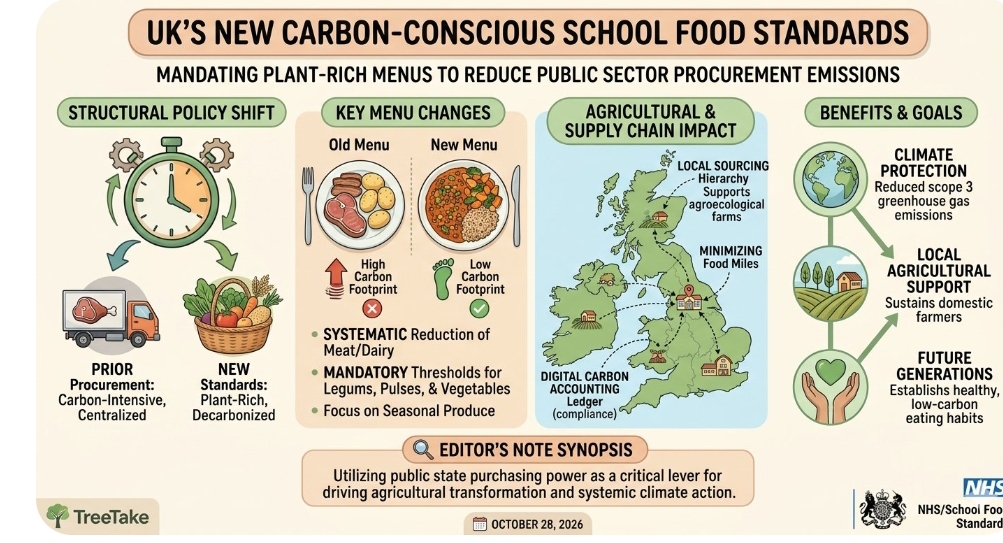
The United Kingdom has officially enacted an aggressive update to its national School Food Standards, legally mandating the integration of plant-rich, low-carbon menus across all state-funded educational institutions. Going live on October 28, 2026, the updated regulatory framework marks a significant policy shift by using public sector supply chains to meet the nation’s legally binding net-zero carbon targets, systematically reducing the climate footprint of institutional food procurement.
The introduction of the new mandates follows intense pressure from domestic environmental consortiums and public health institutions, highlighting the severe carbon costs associated with industrial livestock farming. Public sector procurement accounts for a substantial portion of national food consumption, meaning that shifting school dinner plates toward climate-conscious, plant-derived proteins represents a powerful legislative tool for driving large-scale agricultural and supply chain transformation.
Restructuring Institutional Supply Chains for Climate Action
Under the newly enforced guidelines, academic catering networks must systematically reduce the structural carbon intensity of their weekly ingredient sourcing. The policy introduces mandatory thresholds that replace carbon-heavy meat and dairy options with locally sourced legumes, pulses, and seasonal vegetables multiple days per week, directly lowering Scope 3 greenhouse gas emissions.
Furthermore, the standards establish a strict local-sourcing hierarchy designed to minimise food miles and support domestic agroecological farming networks. School districts must track and report the precise carbon accounting of their catering operations through a centralised digital ledger, ensuring absolute compliance with regional emission-reduction benchmarks.
Statements from Government Ministers and Dietary Scientists
"Our public sector procurement frameworks must reflect our national environmental values," stated Bridget Phillipson, the Secretary of State for Education, during a briefing at a school procurement summit. "By introducing these modernised, carbon-conscious food standards, we are utilising the enormous purchasing power of the state to drive real, measurable reductions in greenhouse gas emissions. This policy not only protects our climate by lowering institutional demand for high-emission food products, but it also supports our local agricultural communities by prioritizing sustainably grown domestic produce."
Emphasising the long-term systemic impact of the update, Dr Susan Jebb, a prominent public health nutritionist specialising in sustainable dietary transitions, welcomed the structural framework.
"This update represents a major step forward for institutional climate policy," Dr Jebb remarked following the framework’s official rollout. "The scientific evidence is entirely clear: shifting toward plant-rich diets is one of the most effective ways to lower environmental strain. Integrating these habits directly into the public education system creates a scalable model for reducing scope 3 procurement emissions while establishing healthy, low-carbon eating habits that will benefit future generations for decades."
Navigating Logistical Transitions and Local Sourcing
Catering administrators have noted that shifting to plant-rich menus requires a thorough redesign of existing distribution networks, which have historically relied on centralised cold-storage facilities for processed meats. Supply chain logistics teams are working alongside regional agricultural cooperatives to build shorter, more flexible distribution channels capable of handling high volumes of fresh, seasonal produce.
Financial officers have confirmed that the transition budget includes specialised training grants for institutional kitchen staff, helping them adapt menu designs to meet the updated carbon-reduction metrics without increasing operational costs.
Editor's Note
The enforcement of the UK's updated School Food Standards marks a crucial advancement in utilising public procurement as a genuine lever for climate action. For too long, governments have urged individuals to reduce their personal carbon footprints while allowing massive state institutions to continue purchasing high-emission food products at an industrial scale. By mandating plant-rich, low-carbon options in state schools, this policy tackles institutional emissions head-on. However, the ultimate success of this program depends entirely on supply chain execution. The government must provide robust financial support to local agroecological farmers to meet this new institutional demand. Without careful management, school districts could end up relying on cheap, highly processed imported alternatives, which would undermine the environmental integrity of the entire policy.


.jpg?resize=780%2C450&ssl=1)



Leave a comment