

Talking Point
TreeTake Network
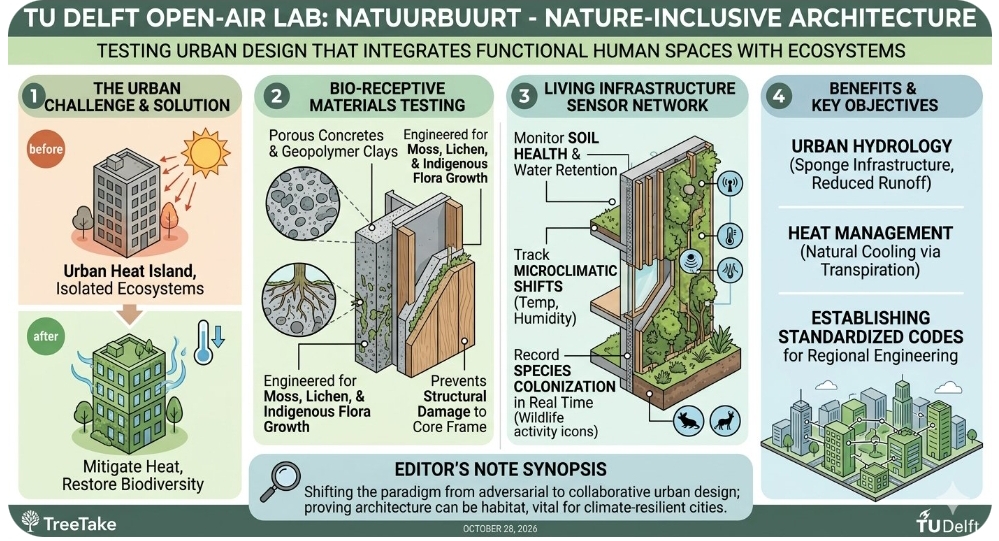
The Delft University of Technology (TU Delft) in the Netherlands has officially opened a state-of-the-art outdoor research site called "NatuurBuurt" dedicated to testing nature-inclusive architecture and urban design. Unveiled on October 28, 2026, the open-air laboratory provides a controlled environment for testing structural methods that integrate functional human spaces with diverse, thriving ecosystems to mitigate the urban heat island effect and improve biodiversity.
The launch occurs as European municipalities face growing regulatory pressure to meet the climate adaptation mandates set by the European Union's Nature Restoration Law. Urban areas present unique challenges for biodiversity because concrete and asphalt routinely isolate wilderness pockets, preventing species migration and worsening local ecological degradation. The new living laboratory unites structural engineers, landscape architects, and urban ecologists to assess how buildings can actively support local wildlife rather than displace it.
Testing Living Infrastructure Under Real-World Stresses
Unlike typical green roofs or decorative vertical gardens, the NatuurBuurt installation features full-scale structural mock-ups built from innovative, bio-receptive materials. These porous concretes and geopolymer clays are chemically engineered to support mosses, lichens, and indigenous flora without damaging the building's core frame.
The facility features complex sensor arrays that monitor soil health, water retention, microclimatic shifts, and species colonisation in real time. By tracking these variables across changing seasons, the research team aims to establish the first standardised code for nature-inclusive civil engineering in the region.
Statements from Architecture Authorities and Ecology Experts
"We are moving far beyond the concept of sustainable buildings that simply reduce environmental damage," stated Professor Andy van den Dobbelsteen, the Coordinator of Sustainability at TU Delft, during the opening ceremony. "The NatuurBuurt laboratory is designed to prove that our future buildings can function as active, living components of the regional biosphere. Through meticulous tracking of these structural microclimates, we are establishing the engineering baselines required to turn urban spaces into thriving ecological corridors that naturally cool our cities."
Reflecting on the biodiversity monitoring capabilities of the new site, Dr Machiel de Jong, a senior researcher specialising in urban avian populations, emphasised the importance of real-world testing.
"Laboratory models cannot replicate the complex biological pressures of an outdoor urban environment," Dr de Jong noted following the initial tour. "By integrating diverse nesting cavities, bat roosts, and insect hotels directly into the structural masonry of the test walls, NatuurBuurt allows us to observe exactly how local wildlife interacts with human architecture over extended periods. This research is vital if we want to design urban centres that prevent regional species extinction."
Addressing Urban Hydrology and Heat Management
The installation also includes integrated water retention systems modelled after natural wetlands, allowing researchers to evaluate how green walls can reduce stormwater runoff during heavy rainfall. The experimental facades are designed to act as sponge infrastructure, storing excess water and slowly releasing it through plant transpiration to naturally lower surrounding temperatures.
Local city planners attending the launch noted that if these living facades can consistently lower microclimatic temperatures by even two degrees Celsius, the corresponding reduction in urban air conditioning demands could fundamentally alter municipal energy projections.
Editor's Note
The opening of the NatuurBuurt outdoor laboratory at TU Delft represents an essential paradigm shift in how we approach urban development. For generations, civil engineering has treated human architecture and natural ecosystems as inherently adversarial concepts. This living laboratory challenges that outdated view by proving that our buildings can serve as functional habitats. However, the true test for nature-inclusive design lies in moving these methods out of academic testing sites and into commercial zoning laws. Unless municipal governments translate these scientific insights into mandatory building codes, green architecture will remain a premium novelty rather than becoming a structural foundation for climate-resilient cities.



Leave a comment