

TreeTake Network
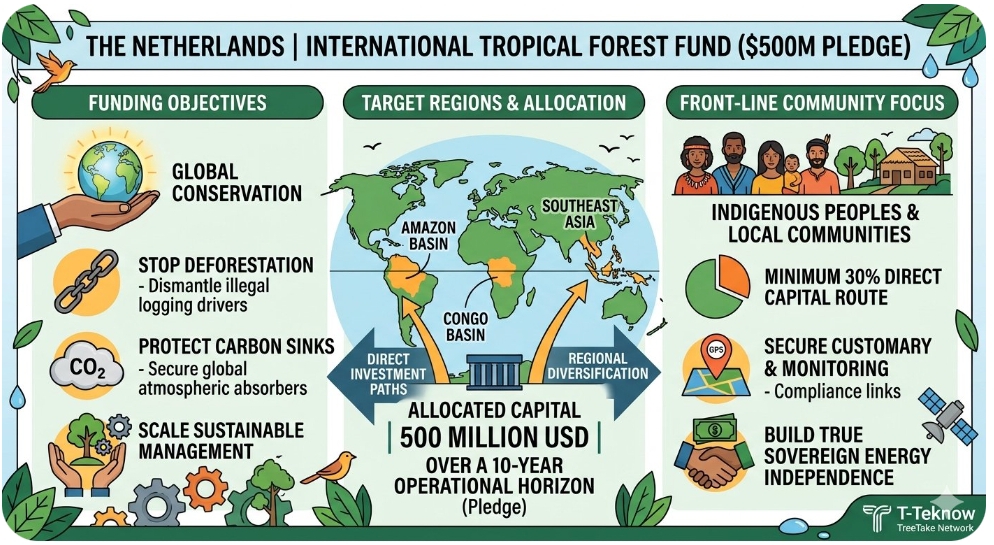
The Dutch government has formalised a massive environmental commitment to insulate the planet's most vulnerable tropical biomes from commercial degradation. In an official declaration delivered on October 27, 2026, the Netherlands Ministry of Foreign Affairs announced the establishment of a dedicated international conservation fund, pledging up to 500 million US dollars over the next decade. The multi-year capital injection is specifically engineered to halt accelerating deforestation rates, protect critical carbon sinks across equatorial regions, and partner directly with local communities to scale up sustainable forest management frameworks.
Targeted capital allocation and international partnerships
The primary operational directive of the fund is to dismantle the economic drivers of illegal logging and unsustainable land conversion in high-risk tropical zones. Instead of relying on traditional short-term grants, the Dutch fund will deploy long-term impact investments and blended finance mechanisms. This strategic capital structure is designed to attract private sector investment into sustainable forestry, agroforestry networks, and verifiable carbon credit initiatives. The fund will concentrate its resources across three primary geographical battlegrounds: the Amazon Basin, the Congo Basin, and the hyper-diverse tropical forest corridors of Southeast Asia.
Crucially, the administrative roadmap stipulates that a minimum of 30 per cent of all allocated funds must be channelled directly to indigenous peoples and local forest communities. This legal provision addresses a long-standing criticism of global environmental funding, ensuring that frontline populations—who serve as the primary guardians of global biodiversity—have direct access to financial resources without navigating dense bureaucratic bottlenecks. The capital will fund real-time satellite monitoring systems, community-led anti-poaching patrols, and the formal legal mapping of customary tribal territories.
Ministerial and conservationist executive assessments
Detailing the geopolitical strategy behind the financial commitment during the announcement, the Dutch Minister for Foreign Trade and Development Cooperation, Liesje Schreinemacher, emphasised the global necessity of preserving primary forests. In a formal statement broadcast on October 27, 2026, Schreinemacher stated: "Tropical forests are our strongest natural defence against catastrophic climate change and unparalleled biodiversity loss. This 500 million dollar commitment represents a solid, long-term investment in global stability, clean air, and sustainable economic alternatives for the frontline communities who protect these precious resources."
Validating the structural design of the initiative, senior climate policy analysts at the World Resources Institute (WRI) noted that backing indigenous autonomy is statistically the most effective way to secure carbon stability. Regional ecological coordinators at the summit added that the fund's heavy emphasis on private-sector capital mobilisation will provide the structural financial runway required to make sustainable forest protection more economically viable than commercial agricultural clearing.
Editor's Note
The launch of this 500 million dollar international fund by the Dutch government marks a crucial advancement in how wealthier nations approach international conservation financing. Historically, wealthy nations have issued abstract carbon credits or short-term assistance packages that fail to outcompete the immediate financial rewards of industrial logging or cattle ranching. By committing to a stable, ten-year financial horizon and mandating direct funding for indigenous communities, the Netherlands has established a highly actionable template for international biodiversity preservation. However, the long-term success of this fund depends entirely on enforcing strict supply-chain transparency and monitoring protocols. European regulatory bodies must ensure that these environmental investments are matched by aggressive trade restrictions on commodities linked to global deforestation. Without binding legal policies that penalise corporations importing goods derived from cleared tropical lands, this half-trillion-dollar preservation fund will constantly clash with overwhelming market demands. Securing global supply chains is the single most definitive way to ensure these forest conservation goals endure.



Leave a comment