

TreeTake Network
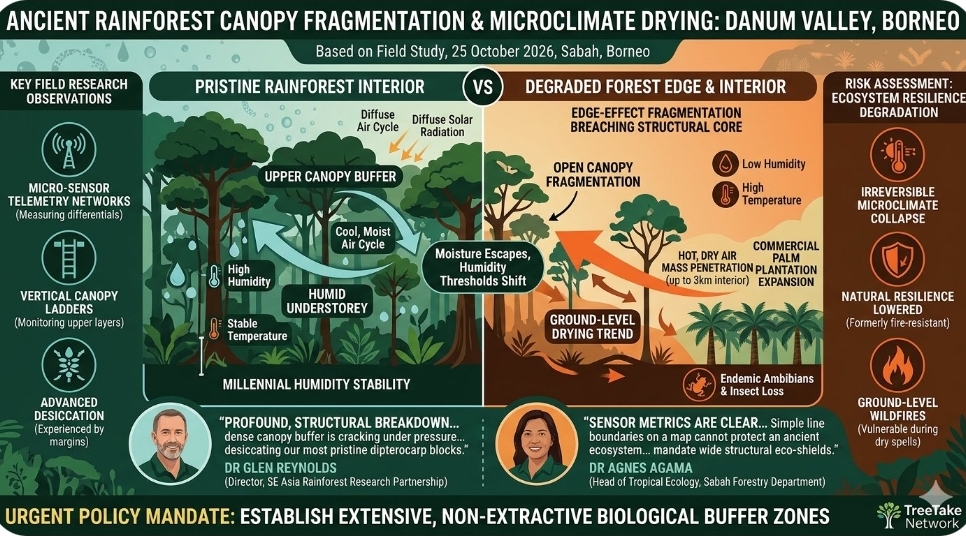
An intensive tropical ecology study conducted across the Danum Valley Conservation Area in Sabah, Borneo, on October 25, 2026, has revealed that microclimate modifications caused by adjacent commercial palm plantation expansion are severely drying out primitive, protected forest blocks. The field assessment demonstrates that edge-effect fragmentation is actively breaching the structural core of old-growth dipterocarp rainforests. The breakdown of the upper canopy buffer is allowing moisture to escape, structurally altering the humid understorey microclimate that has remained stable for millennia.
Edge effects and canopy degradation in primitive zones
The field research relied on micro-sensor telemetry networks and vertical canopy ladders to measure temperature and relative humidity differentials across varying depths of the forest boundary. The findings indicate that the structural clearance of land for commercial plantations creates severe thermal microclimate gradients. Hot, dry air masses originating from the cleared plantation zones are penetrating up to three kilometres into the deep, primary forest interior, systematically stripping the lower vegetative layers of essential moisture.
As the primitive dipterocarp trees along the margins experience advanced desiccation, the upper canopy loses its dense foliage. This structural fragmentation allows direct solar radiation to reach the forest floor. The resulting ground-level drying trend eliminates the specialised micro-habitats required by endemic bryophytes, sensitive amphibians, and specialised understorey insect species, effectively unravelling the baseline biodiversity of the reserve.
Tropical ecologists warn of irreversible ecosystem drying
During an emergency research briefing held at the Danum Valley Field Centre on the afternoon of October 25, 2026, conservation scientists presented their atmospheric data to regional land-use planners. The ecological models prove that the localised understorey drying is lowering the natural resilience of the rainforest, rendering formerly fire-resistant primary ecosystems highly vulnerable to ground-level wildfires during dry spells.
Dr Glen Reynolds, Director of the South East Asia Rainforest Research Partnership, stated during the operational briefing: "We are documenting a profound, structural breakdown of the forest interior. The dense canopy buffer that historically sealed the internal humidity is cracking under the pressure of external edge effects. The data shows that boundary fragmentation is actively desiccating our most pristine dipterocarp blocks, shifting the internal humidity thresholds far past safe biological baselines."
Stressing the immediate policy implications for Bornean biodiversity corridors, Dr Agnes Agama, Head of Tropical Ecology at the Sabah Forestry Department, noted: "The sensor metrics are clear. Simple line boundaries on a map cannot protect an ancient ecosystem if the surrounding buffer zones are entirely cleared for commercial agriculture. If we do not mandate wide, multi-layered structural eco-shields between plantations and primary reserves immediately, these ancient canopy structures will suffer irreversible microclimate collapse."
Editor's Note
This alarming assessment proves that primary rainforest reserves cannot survive as isolated ecological islands amid aggressive commercial expansion. Forest management policies must immediately evolve to require extensive, non-extractive biological buffer zones around pristine habitats, legally restricting intensive canopy clearance at the immediate borders of protected conservation networks.



Leave a comment