

TreeTake Network
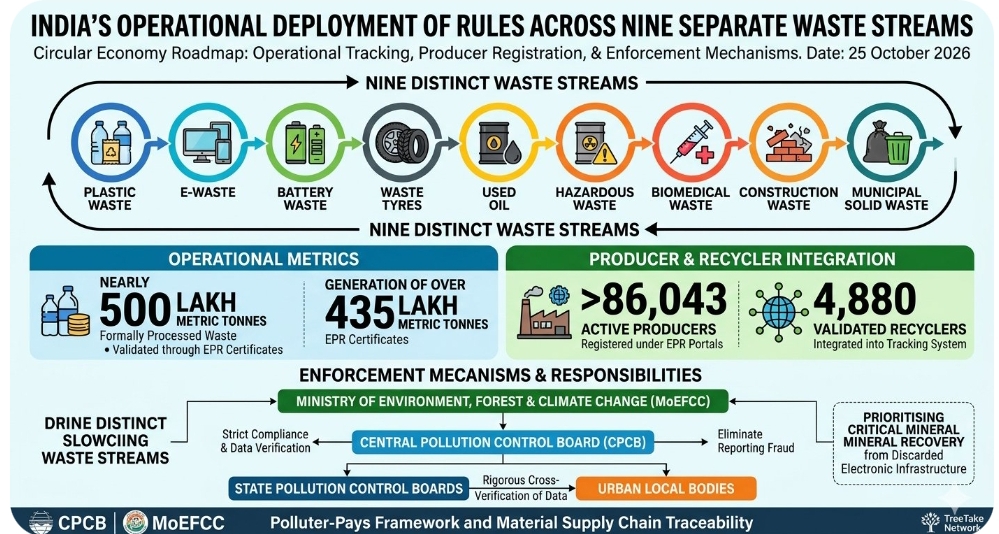
Addressing the Circular Economy Conference in New Delhi, the Union Minister for Environment, Forest and Climate Change, Bhupender Yadav, announced that the government has successfully structured and legalised sector-specific frameworks for nine distinct waste streams. The strategic framework focuses on resource recovery, recycling, and waste prevention across the entire lifecycle of industrial and consumer goods. Government database logs reveal that nearly 500 lakh metric tonnes of waste have been formally processed across these regulated channels.
Operational tracking and producer registration metrics
The structural implementation relies heavily on the active registration of industrial stakeholders under Extended Producer Responsibility (EPR) portals. Environmental agency metrics confirm that more than 86,043 producers and 4,880 recyclers have been integrated into the central tracking system. This network has facilitated the generation of over 435 lakh metric tonnes of validated EPR certificates, forming a transparent domestic market for secondary raw materials.
The regulatory body confirmed that the targeted waste streams include plastic waste, battery waste, e-waste, waste tyres, and used oil. To protect the domestic manufacturing sector, the Ministry is prioritising the extraction and recovery of critical minerals from discarded electronic infrastructure.
Enforcement mechanisms and local board responsibilities
During the ministerial address, administrative heads emphasised that the ongoing phase must focus on strict compliance and physical data verification to eliminate reporting fraud. The Central Pollution Control Board (CPCB) has been directed to coordinate directly with regional Urban Local Bodies to ensure tracing mechanisms remain robust.
Union Environment Minister Bhupender Yadav stated during the conference: "We have established the enabling legal architecture under our circular economy roadmap. The operational focus must now pivot toward translating this policy intent into ground-level action. There must be absolute coordination between materials producers and industrial recyclers to address discrepancies in localised processing capacities."
Stressing the necessity of localised municipal integration, the administrative directive noted: "We are directing state pollution control boards to carry out rigorous cross-verification of data, matching corporate GST filings with actual physical processing output. Any entity found fabricating recovery certificates or operating without digital registration will face severe environmental compensation penalties under the polluter-pays framework."
Editor's Note
: The formal finalisation of rules across nine waste streams marks a major transition toward systematic resource preservation in India. To ensure long-term efficacy, the Ministry must aggressively strengthen the financial sustainability of local municipal boards and establish ironclad supply-chain traceability to protect the secondary raw-material framework from data fraud.



Leave a comment