

TreeTake Network
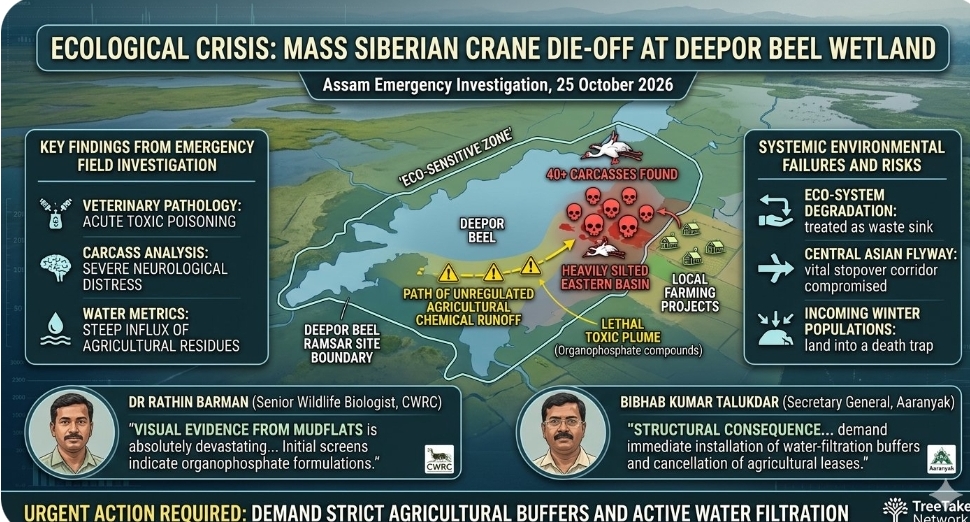
Conservation biologists in Assam launched an emergency field investigation on October 25, 2026, following the sudden discovery of over forty migratory Siberian crane carcasses across the ecologically degraded Deepor Beel Ramsar site. The localised wildlife tragedy marks the largest single-day mortality event of protected avian visitors recorded in the region. Preliminary field assessments conducted by veterinary pathology teams strongly point to acute toxic poisoning triggered by unregulated chemical runoff entering the wetland boundaries from adjacent agricultural zones.
Wetland contamination threatens protected global corridors
Deepor Beel, a vital perennial wetland patch located on the southwestern fringes of Guwahati, serves as an indispensable stopover node along the Central Asian Flyway for thousands of migratory waterfowl. The sudden die-off occurred in the lake's heavily silted eastern basin, an area closely bordered by local farming projects. Field telemetry and observation data indicate that the water bodies have experienced a steep influx of agricultural residues following recent heavy rainfall events, which washed concentrated compounds straight into the avian feeding grounds.
The physical inspection of the carcasses revealed classic indicators of severe neurological distress and immediate metabolic collapse. Conservationists warn that if the toxic plume continues to spread throughout the connected network of waterways, it could compromise the entire incoming winter migratory population, threatening vulnerable species that rely on the wetland for seasonal foraging.
Conservation authorities demand strict agricultural buffers
During an emergency administrative assembly at the Assam State Secretariat on the afternoon of October 25, 2026, wildlife protection directors presented preliminary laboratory data to municipal planners. The scientific groups demanded the immediate enforcement of a temporary prohibition on pesticide applications within a five-kilometre radius of the primary bird sanctuaries.
Dr Rathin Barman, Senior Wildlife Biologist at the Centre for Wildlife Rehabilitation and Conservation, stated during the operational brief: "The visual evidence from the mudflats is absolutely devastating. The birds are experiencing rapid, acute paralysis within minutes of feeding. Our initial toxicology screens indicate lethal concentrations of organophosphate formulations in the gastrointestinal tracts. If we do not completely isolate these contaminated channels immediately, the incoming waves of migratory flocks will land straight into a death trap."
Emphasising the systemic failure of local environmental protections, Bibhab Kumar Talukdar, Secretary General of the regional conservation collective Aaranyak, remarked: "Deepor Beel has been treated as a waste sink for urban and agricultural runoff for years, and this catastrophe is the direct structural consequence. We are demanding the immediate installation of active water-filtration buffers and the permanent cancellation of commercial agricultural leases along the designated eco-sensitive zone boundaries."
Editor's Note
The avian mass die-off at Deepor Beel underscores the fatal gap between urban-agricultural expansion and international wetland preservation mandates. State authorities must immediately upgrade the legal status of the Ramsar site to a strictly enforced sanctuary zone, establishing permanent biosecurity infrastructure to shield global migratory flyways from chemical contamination.



Leave a comment