

TreeTake Network
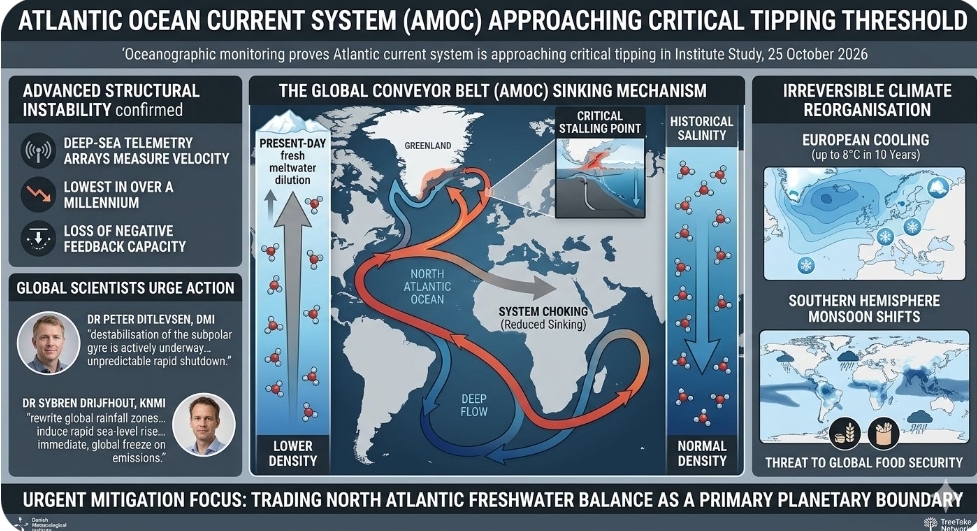
A definitive oceanographic modelling study published by the Danish Meteorological Institute on October 25, 2026, has confirmed that the Atlantic Meridional Overturning Circulation (AMOC) is showing advanced signs of structural instability. The comprehensive international research project reveals that the massive ocean current network, which acts as a global conveyor belt transporting heat from the tropics to the North Atlantic, is slowing down much faster than previously estimated. The acceleration is driven entirely by an unprecedented influx of fresh meltwater from the collapsing Greenland ice sheet, which dilutes the high salinity required to drive the global marine circulation cycle.
Irreversible climate reorganisation and regional impacts
The breakthrough tracking data relies on deep-sea telemetry arrays and sub-surface temperature monitors deployed across the subpolar North Atlantic. The findings indicate that the current has weakened to its lowest operational velocity in over a millennium. When the density of northern waters drops due to freshwater dilution, the water loses its ability to sink, effectively choking the thermodynamic engine that regulates Northern European climates and global weather patterns.
Oceanographers warn that a complete collapse of this circulation system would trigger catastrophic global climate reorganisation. Meteorological models prove that the failure of the system would abruptly drop European average temperatures by up to eight degrees Celsius within a single decade, while simultaneously shifting tropical monsoon belts southward, threatening food security for billions of people across the Southern Hemisphere.
Global climate scientists urge immediate emissions freeze
During an emergency oceanographic assembly held in Copenhagen on the afternoon of October 25, 2026, the study's primary authors presented their data to international policy advisers. The structural modelling proves that the AMOC system has entered a highly volatile transition phase, placing the projected tipping point well within the current century.
Dr Peter Ditlevsen, Lead Oceanographer at the Danish Meteorological Institute, stated during the panel presentation: "We are no longer looking at a distant, theoretical threat. The destabilisation of the subpolar gyre is actively underway. Our tracking metrics show that the system is losing its negative feedback capacity, meaning that even a minor additional influx of freshwater could trigger an abrupt, irreversible shutdown of the entire heat transport network."
Emphasising the scale of the global emergency, Dr Sybren Drijfhout, Professor of Physical Oceanography at the Royal Netherlands Meteorological Institute, remarked: "The atmospheric modelling is absolute. A collapse of the Atlantic current cannot be mitigated by standard local measures. It would fundamentally rewrite global rainfall zones and induce rapid sea-level rise along the eastern coast of North America. We must enforce an immediate, global freeze on industrial carbon emissions to protect this foundational planetary baseline."
Editor's Note
This alarming assessment confirms that the stability of global ocean currents is reaching a point of no return. International climate pacts must immediately shift focus toward treating the North Atlantic freshwater balance as a primary planetary boundary, requiring aggressive emissions reduction targets far exceeding current diplomatic goals to prevent a catastrophic breakdown of global heat transport systems.



Leave a comment