

TreeTake Network
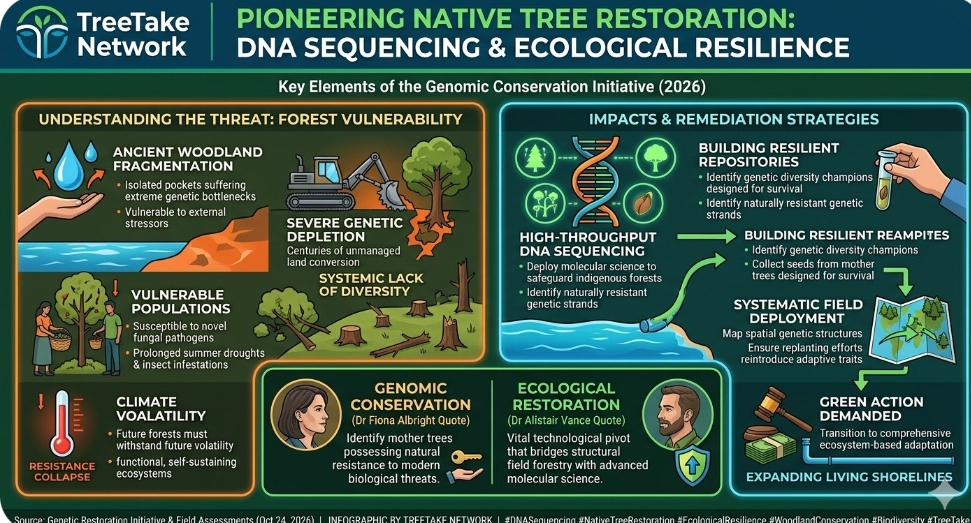
A groundbreaking ecological initiative has been officially launched across ancient woodland sites, where conservation geneticists are deploying high-throughput DNA sequencing to safeguard the future of indigenous forests. The scientific project aims to identify, map, and propagate the last remaining genetically resilient strands of rare native tree species that have managed to survive centuries of habitat fragmentation and escalating climate pressures.
The analytical data generated by forest laboratories indicate that historical deforestation has left many isolated native woodlands suffering from extreme genetic bottlenecks. This systemic lack of genetic diversity leaves ancient oak, ash, and elm populations highly vulnerable to accelerating threats, including novel fungal pathogens, prolonged summer droughts, and intense insect infestations. By mapping the entire genomic architecture of trees that demonstrate natural resistance to these environmental stressors, researchers are locating key genetic markers associated with resilience.
Detailing the long-term strategic vision of the scientific intervention, lead conservation geneticist Dr Fiona Albright stated during a laboratory briefing:
"We are no longer simply planting trees at random and hoping for their survival in a changing world. The genomic data allows us to actively identify individual mother trees that possess specific, naturally selected variations that resist modern biological threats. By collecting seed crops from these genetically diverse champions, we are building a robust repository of resilient saplings designed to withstand the climate volatility of the next century."
The field project involves systematic tissue sampling from isolated old-growth forest pockets across multiple regions. Furthermore, specialised bioinformatic models are being used to map spatial genetic structures, ensuring that subsequent replanting efforts avoid inadvertent inbreeding depression and successfully reintroduce missing adaptive traits back into the wider landscape.
Emphasising the broader ecological necessity of preserving ancient woodland heritage, forest ecologist Dr Alistair Vance noted:
"The baseline diversity of our native canopy has been severely depleted by centuries of unmanaged land conversion. This genetic restoration initiative represents a vital technological pivot that bridges structural field forestry with advanced molecular science. We are racing to secure these rare genetic lineages before the oldest remaining trees succumb to environmental pressures, ensuring our future forests are functional, self-sustaining ecosystems."
Editor's Note
The launch of the native tree genomic restoration project marks a crucial transition from passive preservation to proactive, science-driven ecological adaptation. The way forward requires scaling up public and private investment in regional forest nurseries equipped with basic molecular testing capabilities to verify the genetic health of all restoration stocks. Long-term woodland expansion must prioritize structural biodiversity over simple monoculture timber counts, integrating advanced genomic insights to restore ancient forest networks that are inherently capable of adapting to future environmental challenges.



Leave a comment