

TreeTake Network
A broad legal and social coalition of indigenous tribal representatives, conservation biologists, and environmental advocates has formally escalated its opposition against the massive 81,000-crore Great Nicobar Island Development Project. The coalition has filed an exhaustive petition specifically contesting the planned environmental clearance that allows the felling of nearly ten lakh pristine, tropical rainforest trees on the ecologically sensitive island.
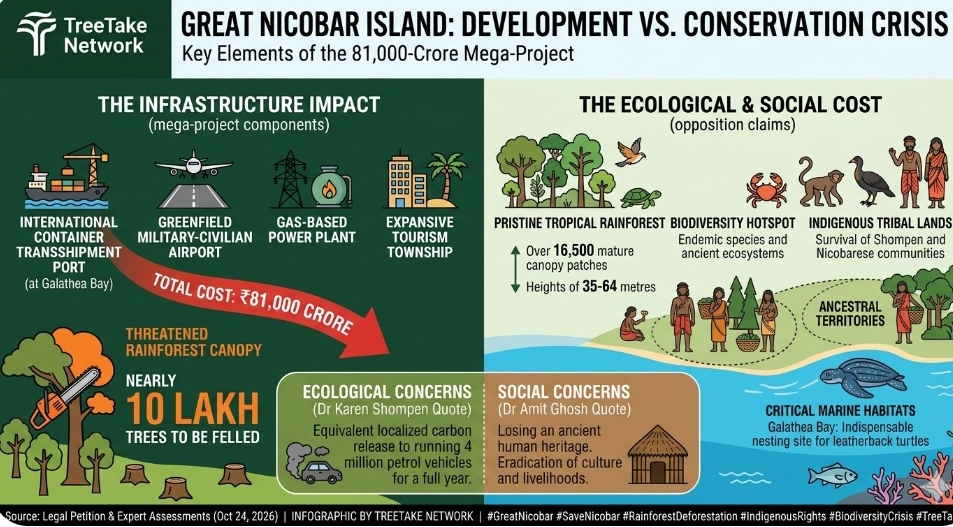
High-resolution satellite data covering 166 square kilometres reveals that the infrastructure footprint directly threatens over 16,500 mature canopy patches. These patches contain ancient, endemic trees reaching heights of 35 to 64 metres, which act as primary carbon sinks and weather buffers for the region. The comprehensive mega-project incorporates a massive international container transhipment port at Galathea Bay, a greenfield military-civilian airport, a gas-based power plant, and an expansive tourism township.
Presenting their argument, tribal advocacy leaders emphasised that the physical scale of the project directly compromises ancestral lands and hunting grounds critical to the survival of the indigenous Shompen and Nicobarese communities. These communities have maintained a symbiotic, sustainable relationship with the forest for generations. The planned destruction of old-growth timber stands will permanently alter the hydrology of the island, leading to the rapid siltation of pristine freshwater streams.
Dr Karen Shompen, a lead ecological coordinator supporting the legal petition, issued a detailed assessment of the localised environmental destruction:
"The sheer scale of this forest diversion threatens giant, centuries-old trees that form the irreplaceable core of this island ecosystem. Felling these ancient canopies promises a localised carbon release equivalent to running over four million petrol vehicles for a full year. We cannot modernise this fragile landscape by completely erasing a biological treasury that took millions of years to stabilise."
Furthermore, marine biologists have raised alarms over the impact on Galathea Bay, which is globally recognised as an indispensable nesting site for the giant leatherback sea turtle. The construction of the deep-sea port will alter coastal wave patterns and induce heavy sedimentation, rendering the beaches completely unviable for sea turtle propagation.
Highlighting the structural risk to indigenous livelihoods and local biodiversity, senior anthropologist Dr Amit Ghosh stated:
"To push forward with massive industrial installations in a bioculturally unique zone is an act of ecological blindness. The local indigenous populations are entirely dependent on these canopy systems for their food security, traditional medicine, and cultural identity. If these forests are industrialised, we are not just losing rare flora and fauna; we are witnessing the institutionalised eradication of an ancient human heritage."
Editor's Note
The escalating confrontation over the Great Nicobar development project underlines the critical friction between national strategic expansion and fragile ecological preservation. The way forward requires an immediate suspension of all canopy clearing and site preparation until transparent, completely independent environmental and social impact assessments can be completed. Policymakers must explore alternative, lower-impact strategic options that establish rigid, legally binding protections for critical indigenous zones and ensure that irreplaceable old-growth forestry remains completely undisturbed.



Leave a comment