

TreeTake Network
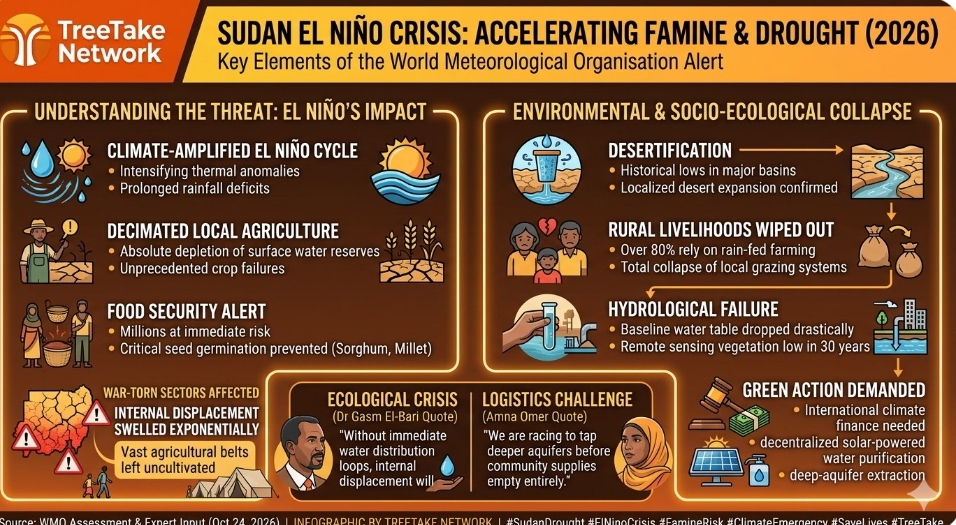
The World Meteorological Organisation has issued an emergency drought and food security alert, warning that an intensifying, climate-amplified El Niño cycle has placed millions of lives at immediate risk across war-torn regional sectors. The comprehensive meteorological assessment outlines that prolonged, unprecedented rainfall deficits have completely decimated local agricultural production, leaving vulnerable communities facing an absolute depletion of surface water reserves and critical crop failures.
The analytical data indicates that the current seasonal dry spell has severely compromised traditional farming regions, where over eighty per cent of the domestic population relies entirely on rain-fed agriculture for daily survival. International climate specialists warn that the compounding effects of severe thermal anomalies and extended structural blockages have left vast agricultural belts entirely uncultivated. The baseline water table across major basins has dropped to historic lows, leading to localised desertification and the total collapse of local livestock grazing systems.
Detailing the severity of the expanding ecological crisis, regional climate coordinator Dr Gasm El-Bari stated during the presentation of the assessment:
"The compounding intersection of a prolonged El Nino drought and non-existent rural infrastructure has triggered an absolute collapse in regional food security. We are observing vast expanses of agricultural land that have completely dried up, leaving smallholder farmers with zero crop yields. Without immediate international intervention to establish emergency water distribution loops, the scale of internal displacement will swell exponentially."
The document explains that the lack of soil moisture has prevented traditional sorghum and millet seeds from germinating across millions of hectares. Furthermore, specialised remote sensing analysis shows that vegetation health indicators have dropped to their lowest levels in thirty years, confirming that the natural pasture lands are no longer capable of sustaining local livestock populations.
Emphasising the structural challenges of rendering immediate relief to the affected agricultural sectors, humanitarian logistics expert Amna Omer remarked:
"The meteorological data confirms our worst fears regarding the complete failure of the seasonal rains. This is no longer a localized water shortage; it is a systematic, widespread environmental shock that is actively wiping out rural livelihoods. We are racing against time to transport basic drilling equipment into these parched zones to tap deeper aquifers before community water supplies empty entirely."
Editor's Note
The escalating environmental emergency in Sudan demonstrates the catastrophic intersection of extreme climate oscillations and regional structural vulnerability. The way forward requires an immediate mobilisation of international climate finance to deploy decentralised solar-powered water purification systems and deep-aquifer extraction infrastructure. Long-term stabilisation demands that regional policies transition away from absolute reliance on unpredictable rain-fed farming towards climate-resilient agricultural practices, localised water harvesting networks, and robust ecological safety nets to protect vulnerable populations from future thermal shocks.



Leave a comment