

TreeTake Network
Emergency environmental tracking teams and marine conservation scientists have been deployed along the frontline coastal zones as severe Typhoon Champi sweeps past Taiwan, heading directly north toward the East Asian mainland. The meteorological event has triggered immediate concern regarding the extensive mechanical destruction of natural maritime barriers, severe tree-fall damage across vulnerable forest fringes, and structural impacts on low-lying estuarine buffers.
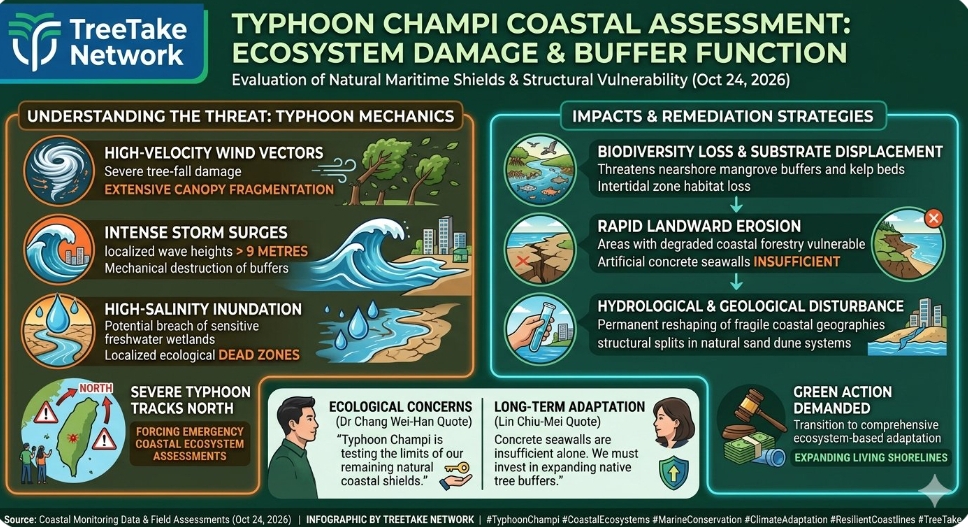
Oceanographic data point to a dangerous combination of high-velocity wind vectors and intense storm surges that threaten to permanently reshape fragile coastal geographies. Initial satellite imaging indicates that vulnerable forest belts, which serve as natural windbreaks, have suffered extensive canopy fragmentation. Ecologists are particularly alarmed by the potential for high-salinity marine inundation to breach sensitive freshwater wetlands, a crisis that could trigger localised ecological dead zones and alter soil chemistry for years.
Outlining the complex environmental pressures on the maritime habitats, marine ecologist Dr Chang Wei-Han stated during a field monitoring briefing:
"Typhoon Champi is testing the physical limits of our remaining natural coastal shields. The structural integrity of our nearshore mangrove buffers and kelp beds is under immense strain from these sustained storm surges. If these natural wave attenuators collapse under the mechanical force of the waves, the subsequent inland erosion will be catastrophic for coastal biodiversity."
Coastal monitoring stations have recorded localised wave heights exceeding nine metres, causing severe substrate displacement along the intertidal zones. Conservation teams are utilizing specialized drones to map the exact scale of the forest loss and evaluate structural splits in natural sand dune systems that protect agricultural borders.
Emphasising the necessity of preserving native coastal vegetation networks, climate adaptation specialist Lin Chiu-Mei noted:
"The immediate data collected from our offshore sensors confirms that areas with degraded coastal forestry are experiencing far higher levels of rapid landward erosion. This severe storm demonstrates why artificial concrete seawalls are insufficient on their own. We must invest heavily in expanding our living shorelines and native tree buffers to absorb these accelerating climate shocks before the coastal edge recedes entirely."
Editor's Note
The trajectory of severe Typhoon Champi highlights the acute vulnerability of coastal zones to intensifying tropical cyclones. The way forward requires an immediate transition away from hard engineering projects toward comprehensive ecosystem-based adaptation strategies. Coastal planning bodies must legally protect and aggressively restore native mangrove systems, coastal sand dunes, and maritime forest buffers, ensuring a resilient, living barrier capable of mitigating the structural impacts of future climate-driven marine emergencies.



Leave a comment