

TreeTake Network
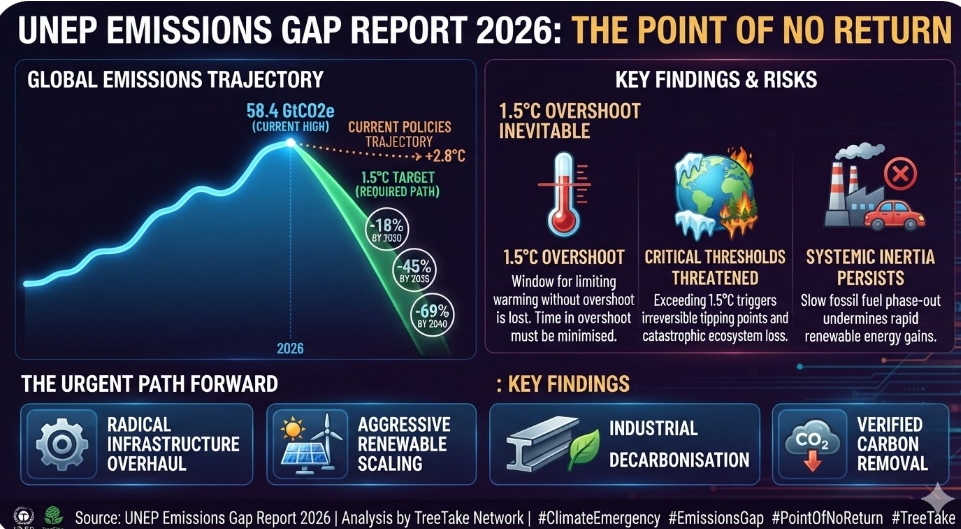
The United Nations Environment Programme has officially launched the seventeenth edition of its flagship scientific assessment, sounding the most severe alarm in the history of international climate negotiations. The comprehensive report reveals that global greenhouse gas emissions have stagnated at a historic high of approximately 58.4 billion tonnes of carbon dioxide equivalent. This persistent volume of atmospheric pollution has officially closed the window for keeping global temperature rise strictly below the 1.5 degrees Celsius threshold without experiencing a major, decades-long thermal overshoot.
The data indicates that the opportunity to bridge the emissions gap with no or limited overshoot has now been entirely lost due to prolonged domestic policy delays. Under existing country-level frameworks, the planet remains locked on a trajectory heading toward an estimated 2.8 degrees Celsius of warming by the turn of the century. To mitigate the duration and magnitude of this looming overshoot, the report establishes a strict new timeline. Global greenhouse gas emissions must be aggressively reduced by 18 per cent by 2030, 45 per cent by 2035, and 69 per cent by 2040, relative to current operational baselines.
During the global presentation of the findings, Executive Director of the United Nations Environment Programme, Inger Andersen, delivered a blunt message regarding the structural inertia:
"The opportunity to limit global warming to 1.5 degrees Celsius with no or limited overshoot has been lost, leaving us on track to only limit warming this century to 2.6 degrees Celsius unless immediate, dramatic sectoral cuts are deployed. Overshoot is not surrender, but we must now race to keep the exceedance as short-lived and as low as possible. Every fraction of a degree avoids catastrophic tipping points, and every year we delay systemic infrastructure transformation escalates the human and economic toll."
The document details how the rapid deployment of clean energy has vastly outpaced initial projections, with solar capacity expanding sevenfold faster than estimated a decade ago. However, these clean energy gains are being thoroughly undermined by the continuous combustion of fossil fuels and rising state-backed subsidies for traditional energy infrastructure. Climate scientists emphasise that the lowest remaining overshoot pathway relies heavily on removing approximately 320 billion tonnes of carbon dioxide from the atmosphere over the century, a strategy fraught with technical and ecological uncertainties.
Detailing the systemic burden facing upcoming international climate talks, Tasneem Essop, Executive Director of Climate Action Network International, stated:
"The world is hurtling towards 1.5 degrees Celsius of warming and an overshoot looks certain. At current emission levels, the remaining carbon budget for 1.5 degrees Celsius will be completely exhausted in less than three years. This report sends yet another alarm bell for why governments must act more urgently than ever, and just how far they are from delivering on their fair share of global mitigation efforts."
Editor's Note
The latest global dataset marks an historic administrative failure in country-level climate pledges. Navigating this reality requires nations to immediately pivot toward radical domestic infrastructure overhauls, aggressive renewable scaling, and rigid industrial decarbonisation to curtail the length of the inevitable atmospheric thermal overshoot. The way forward demands that the upcoming climate summits transition immediately away from voluntary targets and enforce legally binding, rapid reductions in fossil fuel dependency while scaling up verified carbon dioxide removal systems under strict global oversight.



Leave a comment