

TreeTake Network
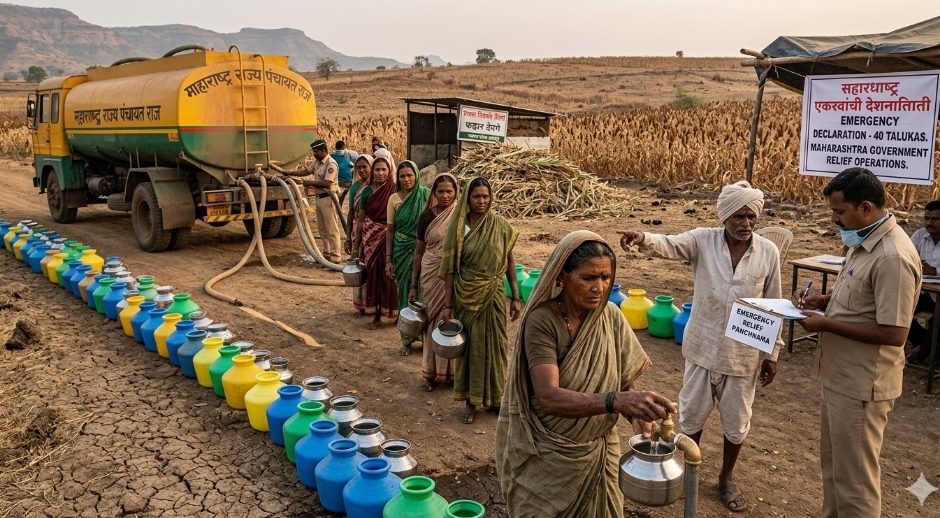
The State Relief and Rehabilitation Department of Maharashtra has officially issued an emergency crisis declaration across 40 critical talukas, designating them as severe drought zones due to a total failure of the late-monsoon rainfall sequence. The administrative intervention follows a comprehensive multi-tier groundwater and moisture evaluation showing that an intensifying regional meteorological pattern has entirely depleted localized water tables, leaving lakhs of farming families facing acute agricultural water scarcity.
The official field inventories indicate that the worst-hit areas are concentrated heavily across the arid swathes of Marathwada and parts of Western Maharashtra, including districts like Jalna, Chhatrapati Sambhajinagar, and Solapur. Ground monitoring confirms that reservoir capacities in these belts have plummeted below 15 per cent of their normal winter baseline. In response, local district collectors have activated strict emergency protocols, ordering the immediate suspension of revenue collection, mandating the execution of comprehensive panchnamas to quantify crop loss, and initiating massive livestock fodder distribution networks to prevent widespread distress migration across rural communities.
State administrative authorities and water policy experts have voiced profound concern over the escalating domestic and agricultural crisis. Confirming the implementation of immediate relief operations, State Relief and Rehabilitation Secretary, Sonia Sethi, emphasized the necessity of targeted administrative support, stating that while the physical parameters of this drought are exceptionally severe, our primary focus remains on safeguarding rural livelihoods through direct cash relief and localized water tanker management. She added that administrative teams are working around the clock to streamline the panchnama damage verification process, concluding that ensuring clean drinking water access and fodder availability across these forty identified sub-districts is our immediate structural priority before the peak summer heat worsens.
The water conservation division noted that the current groundwater depletion has been severely worsened by the unchecked over-extraction of deep aquifers for water-intensive cash crops like sugarcane. However, local farming collectives warn that the financial assistance frameworks currently available under standard state disaster response funds are fundamentally insufficient to cover the staggering cost of input investments lost to dry topsoils. In response, regional environmental groups are urging the state government to completely overhaul its cropping policies, arguing that unless Maharashtra institutes long-term, statutory restrictions on groundwater irrigation in drought-prone blocks, seasonal atmospheric anomalies will continue to push the state’s agricultural backbone into a cycle of permanent economic collapse.
Editor's Note
The emergency drought declaration across forty talukas in Maharashtra highlights a fatal flaw in the state’s climate adaptation model: treating a chronic, systemic water crisis as an unpredictable, short-term disaster. Deploying water tankers and distributing fodder are essential humanitarian interventions, but they merely patch over the symptoms of a deep-seated hydrological bankruptcy caused by cultivating water-guzzling crops in naturally semi-arid zones. Moving forward, the state government must transition from reactive emergency relief to mandatory, climate-resilient water auditing. Agricultural subsidies must be decoupled from sugarcane cultivation in drought-prone blocks and redirected toward climate-smart millets and micro-irrigation systems, ensuring that rural water security is built on real-world ecological carrying capacities rather than cyclical political bailouts.


Leave a comment