

TreeTake Network
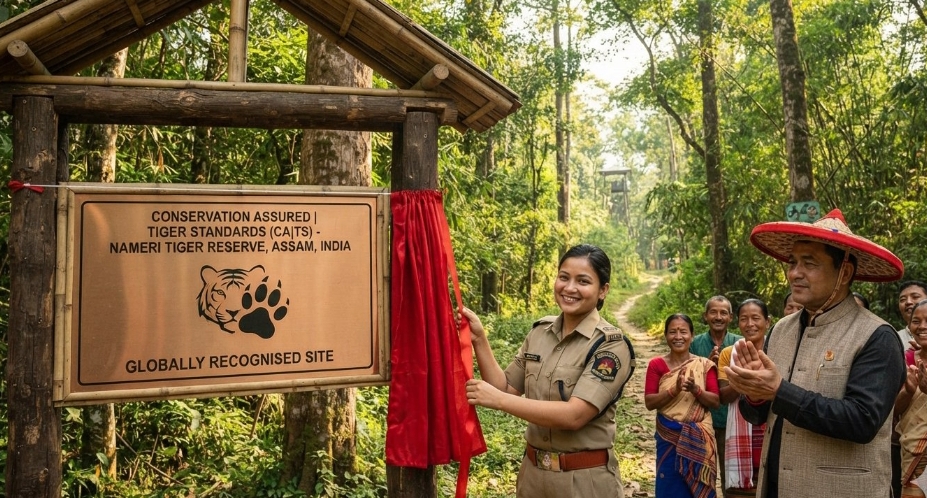
The Nameri Tiger Reserve, situated in the foothills of the eastern Himalayas in Sonitpur district of Assam, has formally secured the globally recognised Conservation Assured | Tiger Standards accreditation. The international distinction, approved by a global coalition of conservation agencies, international field inspectors, and the National Tiger Conservation Authority, confirms that the protected habitat meets rigorous international benchmarks for apex predator management, community-inclusive engagement, and anti-poaching infrastructure.
The announcement follows a comprehensive multi-phase field assessment that meticulously evaluated the reserve's anti-poaching infrastructure, ecological monitoring, and population stability. Field data from the latest monitoring cycle indicates that Nameri, which serves as a vital ecological corridor linking the plains of the Brahmaputra Valley to the forests of Pakke Tiger Reserve in Arunachal Pradesh, has maintained a stable breeding population whilst successfully mitigating human-wildlife conflict along its boundary villages.
Local forest officials highlighted that integrating satellite-based patrol-tracking systems and community-led protection units played a decisive role in meeting strict global criteria. Applauding the milestone, Assam Field Director of Tiger Conservation, Dr Sandeep Kumar, stated that this global recognition is a direct testament to the structural reforms implemented across our frontline operations. He added that our foot patrols are now armed with real-time digital tracking systems that allow us to deploy anti-poaching units dynamically to vulnerable sectors within minutes, concluding that the true heroes are our frontline forest guards who protect these challenging sub-Himalayan terrains under extreme seasonal conditions.
Wildlife biologists emphasise that Nameri's success provides a critical blueprint for multi-species preservation, as the reserve also shelters highly endangered populations of the white-winged wood duck, the capped langur, and the Asian elephant. Commending the localised approach, Wildlife Institute of India Senior Biologist Dr Ramesh Krishnamurthy noted that Nameri demonstrates how targeted apex predator management naturally creates a protective umbrella for co-predators and highly endangered avian species. He stated that the international committee was deeply impressed by the park's systematic grassland restoration strategy, particularly the targeted eradication of invasive weed species like Chromolaena odorata, which historically choked out native fodder grasses.
The official international citation specifically lauded the active involvement of indigenous fringe communities in community-based eco-tourism initiatives, a strategy that has substantially reduced local economic dependency on illegal forest resource extraction. Emphasising the human element of the conservation matrix, Sonitpur Divisional Forest Officer, Jasmine Shrikant, stated that conservation cannot succeed in isolation from the people who live on the margins of the wilderness. She added that by directly channelling eco-tourism revenue to village conservation committees, we have transformed erstwhile poachers and wood-cutters into active guardians of the reserve boundaries, proving that economic stability and ecological preservation are mutually reinforcing goals.
Editor's Note
The global accreditation of the Nameri Tiger Reserve marks a critical milestone in decentralised wildlife governance. By shifting the conservation paradigm from aggressive exclusion to community-centric integration, Nameri demonstrates that apex predator protection is entirely compatible with local economic stability. Moving forward, the international community must utilise these verified frameworks to modernise surrounding ecological corridors. Safeguarding isolated reserves is no longer sufficient; global policy must focus on cross-border habitat continuity to prevent genetic fragmentation whilst ensuring direct, sustained funding for frontline conservation workers.



Leave a comment