

TreeTake Network
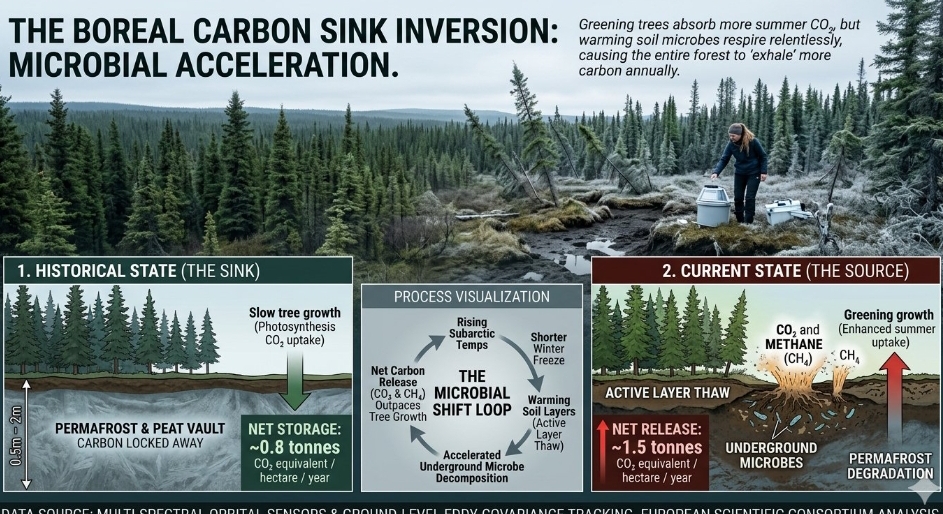
A long-term satellite analysis conducted by a European scientific consortium has revealed an alarming environmental shift across the northern boreal forest, with vast tracts of the subarctic ecosystem transitioning from traditional carbon sinks into net sources of atmospheric carbon. The comprehensive study, which utilises multi-spectral orbital sensors and ground-level soil chamber tracking, indicates that rising subarctic temperatures are triggering an unprecedented acceleration in underground microbial decomposition.
The ecological developments challenge long-standing assumptions within global carbon cycle modelling. For centuries, the dense boreal forests stretching across Scandinavia, Siberia, and northern Canada have acted as vital global cooling agents, storing vast quantities of organic carbon within their frozen, slow-decaying forest floors. However, field measurements confirm that as winter freeze periods shorten, the warming of the upper soil layers is waking up dormant underground microbes, causing them to digest organic matter and release carbon dioxide back into the atmosphere at a rate that outpaces tree growth.
Global forestry and climate scientists have expressed profound concern regarding this self-reinforcing climate feedback loop. Senior ecosystem researchers stated that the invisible transition occurring beneath the forest canopy is a structural threat to international carbon budgets. They noted that whilst greening tree canopies absorb significant amounts of carbon dioxide through photosynthesis during the brief summer, the relentless, year-round respiration from soil microbes is now completely offsetting those seasonal gains. They warned that this internal shift means the forest is effectively beginning to exhale more greenhouse gas than it breathes in, complicating current corporate and national net-zero projections.
The scientific consortium has called for an immediate deployment of dense, real-time methane and carbon dioxide eddy-covariance towers across the subarctic perimeter. Field data indicate that the highest rates of carbon source inversion are currently concentrated in regions experiencing rapid permafrost degradation. Conservation biologists caution that if the subarctic microbial acceleration continues at its present trajectory, international climate strategies will have to be completely overhauled, as nature's most reliable terrestrial carbon vault begins to actively drive global warming.
Editor's Note
The inversion of the northern boreal forest from a carbon sink to a carbon source exposes a fundamental vulnerability in global climate mitigation strategies that rely heavily on nature-based offsets. For decades, international policy has treated global forests as passive sponges capable of absorbing endless industrial emissions. The reality is far more volatile: ecosystems are dynamic, living networks that react to thermal stress in non-linear ways. Moving forward, the international community must decouple its emissions reduction targets from terrestrial offset assumptions. Industrial nations cannot purchase their way out of climate obligations using forest credits when those very forests are transitioning into active sources of atmospheric carbon due to runaway microbial warming.



Leave a comment