

TreeTake Network
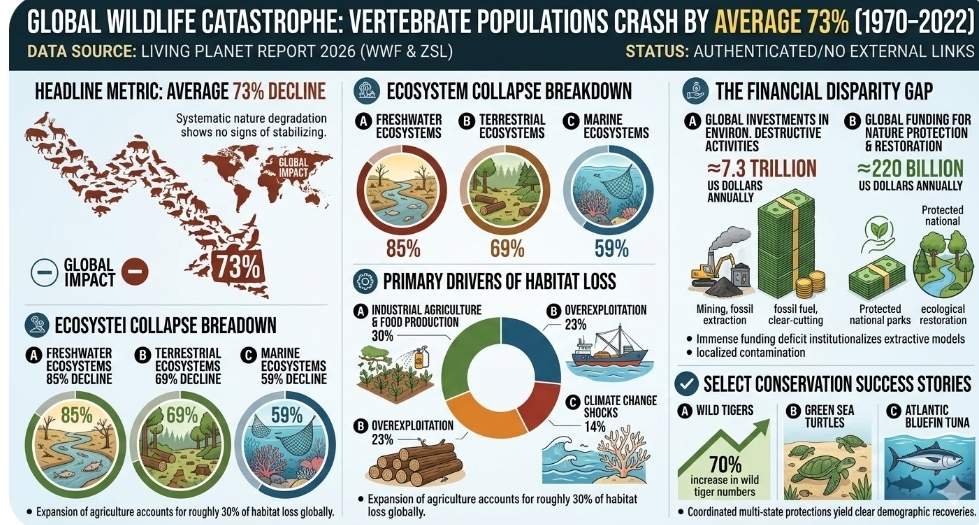
A catastrophic global ecological collapse is accelerating as the World Wildlife Fund and the Zoological Society of London released their definitive planet assessment. The landmark database, compiling telemetry and scientific field observations for nearly 36,000 distinct vertebrate animal populations spanning over 5,000 species, indicates that the sheer scale of global nature degradation shows absolutely no signs of stabilising or slowing down.
Food Production Systems Drive Severe Ecosystem Decay
The comprehensive metrics reveal that the sharpest demographic collapses have occurred within freshwater ecosystems, experiencing an average population destruction rate of 85 per cent. Terrestrial wildlife populations closely followed with an alarming 69 per cent decline, while marine ecosystems recorded a 59 per cent reduction since the 1970 baseline tracking era.
The primary catalyst behind this systematic eradication of biological diversity is the aggressive expansion of industrialised human agriculture and food production networks, which account for roughly 30 per cent of all documented habitat loss globally. Overexploitation of resources accounts for 23 per cent, while direct climate change shocks account for 14 per cent. Commenting on the findings, Dr Louise McRae, a chief scientific supervisor behind the Living Planet Index, emphasised that behind these bleak global statistics sits an immediate, structural requirement for rapid cross-sectoral action to arrest biodiversity declines before irreversible ecosystem failures occur.
Industrialised Subsidies Outpace Global Nature Protection
The financial mechanics underlying the global ecological crisis expose a profound disparity in international resource allocation. Global economic studies accompanying the biodiversity report reveal that approximately 7.3 trillion US dollars in public and private capital flowed directly into environmentally destructive industrial activities in a single year, contrasted against a meagre 220 billion US dollars assigned for proactive habitat protection and restoration. This immense funding deficit has effectively institutionalised extractive developmental models across resource-limited continents like Africa and Latin America, where localised populations suffer from rapid topsoil erosion, collapsing fish stocks, and severe groundwater contamination.
Despite the overwhelming pattern of systemic natural decline, targeted scientific interventions have delivered narrow, fragile success stories. Coordinated multi-state protections have yielded clear demographic recoveries for select high-profile species, including wild tigers, alongside incremental gains for Atlantic bluefin tuna and green sea turtles. However, chief scientific advisers warn that traditional localised conservation strategies are utterly insufficient to withstand the overarching pressures of global economic systems, demanding a total transformation of energy, food distribution, and international financial architecture.
Citizens Demand Rigid Safeguards Amid Policy Deregulation
The publication of the report comes at a moment of deep geopolitical friction as regional regulatory frameworks face aggressive watering-down attempts under the guise of increasing economic competitiveness. In Europe, environment ministries are facing growing public pushback against proposals to dilute statutory nature protection codes.
Ester Asin Martinez, a senior European environmental policy director, issued a sharp statement on the political manoeuvring, noting that the assessment serves as a stark reality check that nature is in dangerous decline. The director added that instead of dismantling much-needed environmental safeguards, regional administrators must heed the calls of citizens to protect foundational nature laws and keep their hands off intact ecosystems.
Editor's Note
The dramatic 73 per cent collapse of global vertebrate wildlife serves as a final warning that modern economic structures are drawing down the literal life-support systems of the planet. Treating biodiversity loss as an isolated wildlife concern rather than a core systemic threat to food security, water supplies, and macroeconomic stability is a dangerous form of political denial. The way forward requires international ministries to completely eliminate the 7.3 trillion dollars in nature-negative subsidies and to implement legally binding financial systems to cross-verify all development capital against strict non-deforestation criteria before approval. Global conservation works when funded, but it cannot fix a world where destruction remains heavily subsidised.



Leave a comment