

TreeTake Network
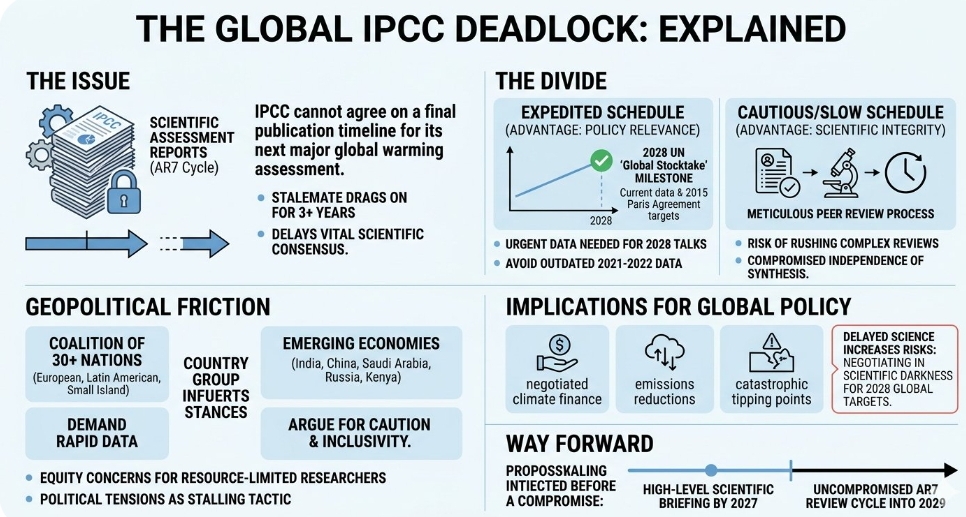
Negotiators and scientists from across the globe remain locked in an unprecedented procedural impasse as the United Nations Intergovernmental Panel on Climate Change (IPCC) struggles to agree on a definitive timeline for its next comprehensive assessment of the warming planet. The deep divide, which has dragged on for nearly three years, threatens to delay the release of critical scientific consensus until after the pivotal global climate evaluations scheduled for 2028.
Science Caught in Diplomatic Gridlock
The ongoing disagreement centres on whether the IPCC should accelerate its scientific reporting to directly inform the United Nations second Global Stocktake in 2028, when governments must formally assess their progress under the 2015 Paris Agreement.
A coalition of more than 30 countries—including European, Latin American, and small-island states—is aggressively advocating for an expedited schedule. They warn that a failure to complete the next review by 2028 would force international negotiators to rely on outdated reports published back in 2021 and 2022. Authoritative voices in the scientific community, including Belgian IPCC author Joeri Rogelj, have highlighted that the primary value of the IPCC rests on these definitive assessments being available to guide active policy decisions. Climatologist Jozef Pecho of GoSpace Labs similarly warned that without an updated assessment for the 2028 UN talks, "the room for cherry-picking and distorting science would grow".
Conversely, emerging economies and developing nations—including India, Kenya, Saudi Arabia, Russia, and China—are urging extreme caution. They oppose rushing the peer-reviewed assessment process, arguing that compressing the timeline threatens to compromise the meticulous independent nature of the body's scientific synthesis. Opponents want the primary reports spaced out to provide adequate time for thoroughly reviewing thousands of complex studies and ensuring scientists from less-resourced nations can make meaningful contributions.
Geopolitical Friction Over Inclusivity
The unprecedented deadlock has exposed profound concerns regarding equity and structural representation in global climate science. Developing nations emphasise that rapid, truncated timelines disproportionately penalise researchers from resource-limited regions. These scientists frequently face higher institutional barriers to publishing new research quickly and struggle to secure leave from their regular jobs to perform unpaid volunteer work as IPCC authors.
Political manoeuvres have added intense friction to the procedural debate. Swedish IPCC editor Lisa Schipper observed that the core issue has shifted from science to diplomacy, highlighting that the underlying political tensions often transform the timeline debate into a stalling tactic. Meanwhile, the environment ministries of major industrialised economies are pushing emerging markets for deeper emission cuts, arguing that modern emissions data must be clear. Russia has strongly rejected allegations that its stance is designed to protect fossil fuel interests, calling such claims a deliberate misrepresentation. In contrast, the Chinese delegation has stated it will maintain a constructive approach to find a resolution that respects the scientific process.
Implications for Global Policy
The stakes for resolving the schedule are historically high. The year 2024 marked the first time global average temperatures exceeded 1.5 degrees Celsius above pre-industrial levels for an entire year. The upcoming assessment reports are intended to fill critical knowledge gaps regarding this atmospheric overshoot, including the long-term consequences of technical interventions like carbon dioxide removal.
Representatives from 195 member states are convening in Addis Ababa, Ethiopia, for the critical 65th Plenary Session from 12 to 16 October 2026. Many delegates view this session as the absolute final opportunity to resolve the scheduling impasse before the 2028 global targets are set. If the stalemate continues, countries may have to negotiate critical emissions reductions and multi-billion-dollar climate finance targets in total scientific isolation from current data.
Editor's Note
The escalating gridlock within the IPCC exposes a structural vulnerability where diplomatic friction can actively delay essential environmental communication. Rushing scientific synthesis threatens its rigour, yet delaying it leaves policymakers operating in data isolation during a decade of accelerating global warming. The way forward requires a definitive compromise at the Addis Ababa plenary. Member states should establish an accelerated, high-level transitional synthesis report focusing exclusively on critical warming thresholds by 2027, while preserving the full, unhurried timeline into 2029 for the deeply technical working group reviews. Science must remain both robustly comprehensive and politically relevant if global environmental governance is to succeed.



Leave a comment