

TreeTake Network
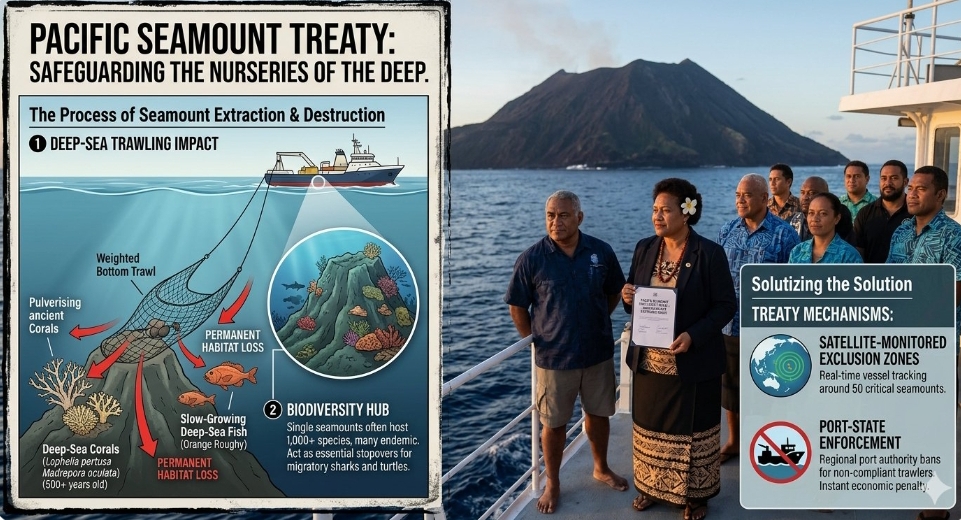
A coalition of Pacific island states, working in direct coordination with leading international marine biologists, has formally launched a binding treaty framework to ban deep-sea bottom trawling across fifty critical seamounts. The sudden diplomatic mobilisation aims to safeguard exceptionally rare, slow-growing deep-sea coral ecosystems from permanent structural destruction caused by heavy commercial fishing gear.
The environmental framework targets specific underwater volcanic mountains that serve as vital biodiversity hubs in the open ocean. Oceanographic data collected during recent deep-sea research expeditions reveals that commercial trawlers are dragging massive, weighted nets across these fragile seamounts, pulverising centuries-old coral forests to catch aggregate deep-sea fish species. Scientists warn that these deep-sea coral structures grow by only fractions of a millimetre each year, meaning that damage inflicted in a single afternoon will take hundreds of years to recover.
Marine conservation specialists have expressed immense support for this localised legal intervention. Championing the collaborative treaty, Pacific Islands Forum Secretariat Senior Marine Policy Advisor, Dr Alisi Keshwar, stated that for generations, our nations have watched foreign distant-water fleets extract wealth from our waters whilst systematically demolishing the fragile ecological foundations of the deep ocean. She added that this framework represents the first time that small island developing states have unilaterally drawn a hard line in the high seas, concluding that we are no longer waiting for global consensus when our underwater volcanic sanctuaries face immediate, irreversible annihilation from industrial gear.
The unique hydrodynamics of these ecosystems mean that their destruction reverberates across entire oceanic corridors. Highlighting the long-term biological cost of bottom trawling, International Union for Conservation of Nature Ocean Team Lead, Dr David Obura, noted that seamounts are not isolated geological anomalies; they are the literal engine rooms of pelagic biodiversity across the vast Pacific basin. He stated that dragging heavy metal doors and rollers across slow-growing deep-sea corals like Lophelia pertusa completely strips the complex structural architecture that migratory sharks, turtles, and commercially vital pelagic fish species rely upon for breeding and nursery stopovers.
The treaty framework establishes strict, satellite-monitored exclusion zones around the designated seamounts. Under the new legal mechanism, any commercial fishing vessel found operating within the protected parameters will face immediate international maritime penalties, including blacklisting from major regional ports. Emphasising the economic enforcement mechanisms built into the accord, Fiji Maritime Authority Enforcement Director, Commander Sitiveni Rokomalani, declared that whilst policing millions of square kilometres of open high seas is a steep logistical hurdle, our true leverage lies at the dock. He added that by closing every single major regional port across the South Pacific to non-compliant vessels, we are imposing an immediate, crippling financial penalty on illegal syndicates, proving that port-state controls can successfully safeguard high-seas nurseries without needing massive naval deployment.
Editor's Note
The launch of the Pacific seamount treaty marks a refreshing shift towards proactive, frontline marine governance. For decades, international waters have been treated as a legal vacuum where commercial extraction overrides ecological survival. By utilising localised port enforcement to protect high-seas biodiversity, these small island states are effectively bypassing the historic paralysis of larger global bodies. Moving forward, the international community must formalise and financially support these regional maritime coalitions. Protecting the open ocean cannot depend solely on voluntary compliance; it requires real-world economic consequences for environmental degradation, ensuring that the foundational nurseries of the deep sea remain unbroken.



Leave a comment