

TreeTake Network
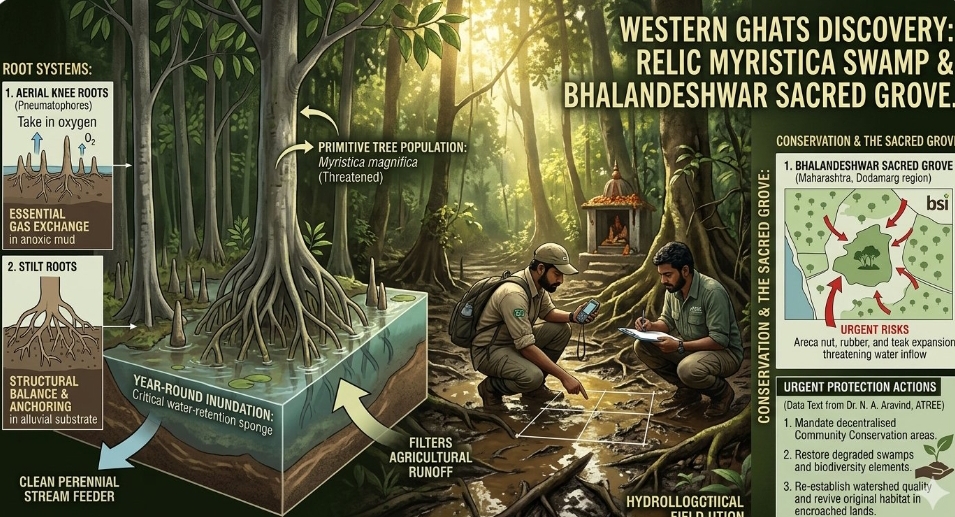
Field researchers and plant taxonomists have completed the first comprehensive ecological mapping of a previously undocumented, ancient relic Myristica swamp pocket hidden inside the Bhalandeshwar Sacred Grove at Kumbral Bagwadi, within the Dodamarg region of Maharashtra. The systematic field documentation, conducted through rigorous seasonal quadrat surveys, confirms that this isolated freshwater wetland is dominated by highly threatened, primitive tree populations of Myristica magnifica. The pristine enclave represents only the second verified Myristica swamp ever recorded in the state of Maharashtra, proving that these prehistoric "living fossil" ecosystems survive in fragmented, uncharted pockets further north along the Western Ghats than previously assumed.
The localised habitat is defined by a dense, waterlogged alluvial floor inundated throughout the year. The ancient flora relies on highly specialised root systems, featuring intricate stilt roots for structural balance and prominent aerial knee roots that grow vertically out of the mud to exchange vital gases in oxygen-starved soils. Beyond their evolutionary significance, the mapping team verified that this minuscule swamp functions as an invaluable local hydrologic engine, actively storing water, filtering agricultural chemical runoff via its root matrix, and feeding clean perennial streams that nearby rural communities depend upon entirely for their seasonal water supply.
Ecological researchers from the Ashoka Trust for Research in Ecology and the Environment (ATREE) have issued an urgent appeal for strict legal protections to prevent immediate habitat collapse. Highlighting the acute vulnerability of the site, ATREE ecology expert Dr N. A. Aravind strongly urged a shift toward decentralised conservation models, stating that swamps should be declared as community conservation areas, and conservation work must focus on the restoration of degraded swamps and their biodiversity elements. He added that the encroached land that is currently under alternative land use must be restored to its original habitat, and watershed quality revived in these regions to prevent the remaining micro-habitats from drying up entirely.
The survey teams noted that the swamp has survived exclusively because local villagers have traditionally shielded the surrounding sacred grove due to deep-rooted cultural and religious beliefs. However, regional conservationists warn that the site faces severe long-term pressures from the expansion of commercial areca nut, rubber, and teak plantations that threaten to divert the fragile inflow channels. In response, cooperative recovery programs are being mobilised alongside forestry students to propagate native saplings, reinforcing the protective buffer zone to preserve the micro-climate before agricultural runoff or canopy fragmentation permanently alters the water table.
Editor's Note
The documentation of the Kumbral Bagwadi swamp reinforces a critical conservation truth: our most irreplaceable evolutionary treasures often survive in fragments smaller than a standard playground. Treating forest preservation as a macro-level exercise that only protects expansive national parks completely ignores these ultra-localized, highly sensitive edaphic ecosystems. Moving forward, state forest departments must partner with indigenous communities to build legal, community-managed buffers around all remaining sacred groves. Protecting the regional water table requires safeguarding the unique stilt-root networks that sustain our perennial rivers at their very source.



Leave a comment