

TreeTake Network
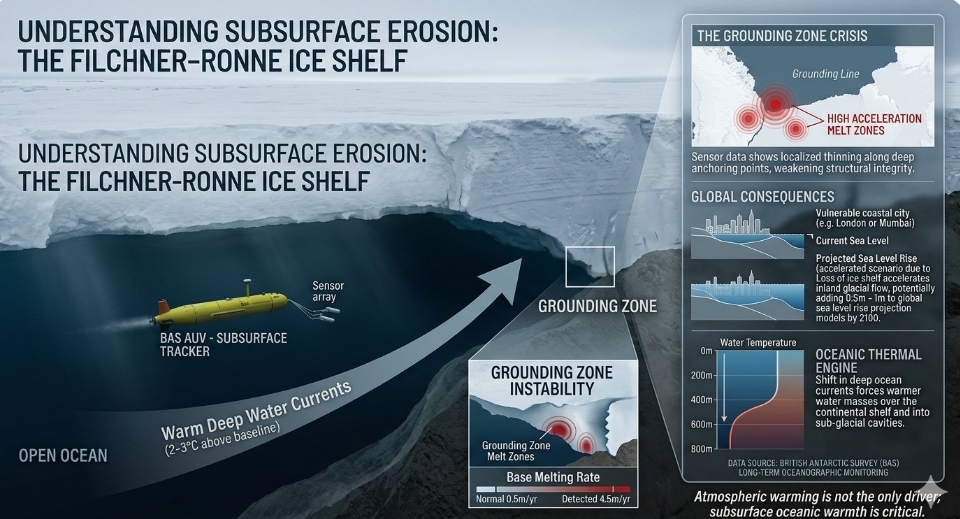
Polar oceanographers from the British Antarctic Survey have detected an unexpected phase of localised melting beneath the massive Filchner-Ronne Ice Shelf in Antarctica. Advanced sub-glacial sensors and deep-water satellite tracking systems indicate that shifting deep-ocean thermal currents are actively channelling warm, dense saltwater into previously stable marine cavities beneath the floating glacial mass, accelerating baseline melting rates from below.
The structural developments have caused concern among polar research teams monitoring global sea-level rise indicators. The Filchner-Ronne Ice Shelf acts as a vital protective barrier, holding back vast inland glaciers from sliding directly into the Southern Ocean. Field data collected from deep-borehole sensors reveal that the temperature of the incoming marine currents has risen by fractions of a degree, a shift that is sufficient to destabilise the delicate grounding zones where the ice shelf anchors firmly to the continental bedrock.
Polar ice dynamics experts emphasised the global significance of this sub-shelf thermal disruption. Senior oceanographers stated that what happens beneath these massive ice shelves dictates the future timeline of global coastal vulnerability. They noted that the current observations suggest that changing atmospheric wind patterns over the Southern Ocean are actively driving deeper, warmer water masses upward over the continental shelf. They warned that this mechanism bypasses surface air temperatures entirely, meaning that the ice shelf is experiencing severe structural erosion even during periods of intense surface freezing.
The research consortium has initiated an emergency deployment of autonomous underwater vehicles to map the precise internal architecture of the sub-glacial cavities. The field data show that the localised thinning is currently concentrated along the deep grounding lines, creating structural weaknesses that could eventually trigger widespread calving events. Glaciologists caution that if these interior pathways continue to expand, the long-term stability of the entire West Antarctic Ice Sheet will be severely compromised, altering current climate models.
Editor's Note
The discovery of accelerated sub-shelf melting beneath the Filchner-Ronne Ice Shelf highlights a critical blind spot in current international climate projection models. Most mitigation frameworks focus heavily on atmospheric warming, yet the most immediate threat to global coastline stability is an unseen oceanic thermal engine operating miles beneath the polar ice. Moving forward, the global scientific community must prioritise the funding and deployment of permanent sub-glacial monitoring networks. Relying on superficial satellite observations is no longer sufficient. If the world is to accurately project sea-level rise, international policy must be grounded in real-time, deep-ocean interior metrics before these critical marine anchors reach a point of irreversible fracture.



Leave a comment