

TreeTake Network
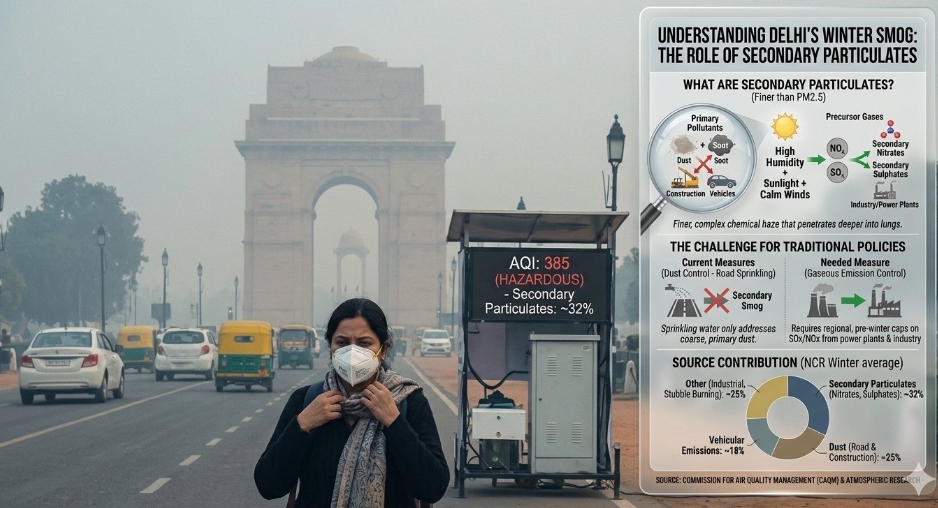
Atmospheric monitoring networks across the National Capital Region have detected a severe shift in the structural composition of Delhi's toxic winter smog, with secondary particulates now comprising nearly one-third of the city’s total PM2.5 pollution load. Official data compiled by the Commission for Air Quality Management reveals that these complex chemical compounds, formed through atmospheric reactions involving precursor gases under specific humidity conditions, are severely undermining traditional municipal dust-suppression initiatives.
The scientific findings indicate that whilst primary pollutants like construction dust and vehicular soot are successfully intercepted by local emergency measures, secondary particles remain largely unaffected. These secondary particulates originate when sulphur dioxide and nitrogen oxides—emitted from coal-fired power plants, heavy industries, and vehicular traffic—undergo rapid chemical transformations in the dense winter air.
Environmental scientists have voiced profound concern over the public health implications of this changing chemical profile. Senior atmospheric researchers stated that secondary particulates are incredibly fine and chemically complex, allowing them to penetrate deep into the human respiratory system. They noted that the current focus on mechanical road sweeping and water sprinkling only addresses coarse surface dust, leaving the far more dangerous chemical haze completely unmitigated. They urged immediate, cross-border regional coordination to curb the gaseous emissions feeding this chemical transformation.
Air quality data collected during the initial phase of the winter tracking period shows that the concentration of secondary nitrates and sulphates spikes dramatically during calm, cold mornings when wind speeds drop below five kilometres per hour. Public health bodies have issued urgent advisories, warning that the complex toxic cocktail increases the incidence of acute respiratory distress across vulnerable urban demographics. Conservation experts warn that without an immediate revision of the Graded Response Action Plan to aggressively target gaseous industrial precursors, the capital's air quality index will remain locked in the hazardous zone throughout the season.
Editor's Note
The emergence of secondary particulates as a dominant factor in Delhi's winter crisis exposes the systemic limitations of city-centric, reactive environmental planning. Sprinkling water on urban roads to control dust is an exercise in futility when the true threat is a complex chemical factory operating directly within the cold atmospheric boundary layer. Moving forward, environmental authorities must transition from localised dust mitigation to comprehensive regional airshed management. Policy frameworks must mandate immediate, stringent caps on industrial sulphur and nitrogen emissions across the entire economic corridor, rather than penalising urban activities whilst letting large-scale industrial polluters operate unchecked.



Leave a comment