

TreeTake Network
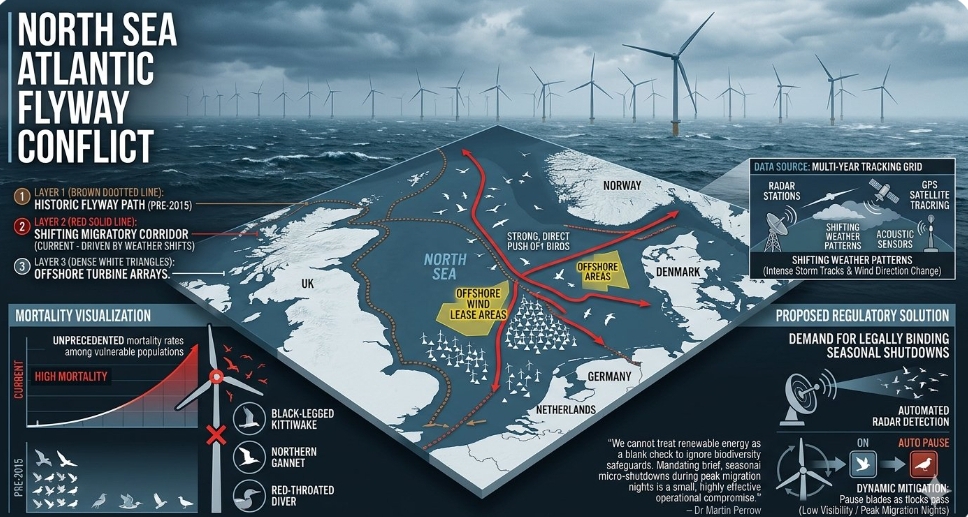
A coalition of European marine biologists and avian tracking experts has submitted a formal regulatory mandate to the European Commission, demanding legally binding, seasonal operational shutdowns of offshore wind energy infrastructure across the North Sea. The urgent policy intervention follows the compilation of comprehensive multi-year tracking data showing that changing global atmospheric conditions are forcing critical migratory bird corridors to shift directly into active offshore turbine arrays, leading to unprecedented mortality rates among vulnerable populations.
The systematic monitoring project, which combines high-resolution marine radar grids, satellite telemetry data, and automated acoustic tracking sensors, has revealed that key migratory species—including the black-legged kittiwake, red-throated diver, and northern gannet—have significantly altered their historic flight paths along the East Atlantic Flyway. Marine scientists discovered that shifting transcontinental wind patterns and intense autumn storms are pushing these migratory flocks further out into open marine sectors, directly intersecting with the dense corridors of the world’s largest offshore renewable energy grids.
Avian conservation specialists and energy policy analysts have expressed profound concern over the escalating collision risks and habitat displacement. Presenting the core findings of the scientific consortium, Dr Martin Perrow, a leading marine ornithologist and senior ecological consultant at Econ Ecological Consultancy, emphasised the necessity of dynamic mitigation frameworks, stating that while the rapid expansion of offshore wind is essential to meet global net-zero targets, we cannot treat renewable energy as a blank check to ignore biodiversity safeguards. He added that automated radar systems now provide the real-time capacity to detect approaching flocks miles away, concluding that mandating brief, seasonal micro-shutdowns during peak migration nights is a small, highly effective operational compromise that saves thousands of avian lives without compromising grid stability.
The scientific coalition noted that the highest collision threats occur during low-visibility, calm winter nights when birds lower their flight altitudes to escape dense cloud cover. However, regional energy syndicates are strongly resisting the mandatory shutdown framework, citing potential financial losses and the complexity of pausing multi-gigawatt power grids. In response, environmental legal experts are leveraging international wildlife treaties to enforce compliance, arguing that unless wind farm operators incorporate real-time biological data into their operational software, the accelerating expansion of marine turbines will trigger an irreversible collapse of the region's apex seabird populations.
Editor's Note
The regulatory battle over North Sea wind turbine shutdowns exposes a critical paradox at the heart of the modern green transition: the conflict between macro-level climate mitigation and micro-level biodiversity preservation. Erecting massive industrial structures across prehistoric migratory flyways whilst ignoring the dynamic, weather-driven behaviour of wildlife is a form of short-sighted environmental engineering. Moving forward, the international community must discard the rigid division between renewable energy generation and wildlife conservation. Power grids must be designed to be biologically smart, using real-time radar networks to automatically pause turbine blades as migratory flocks pass, ensuring that our pursuit of clean energy does not hollow out the marine ecosystems we are trying to save.



Leave a comment