

TreeTake Network
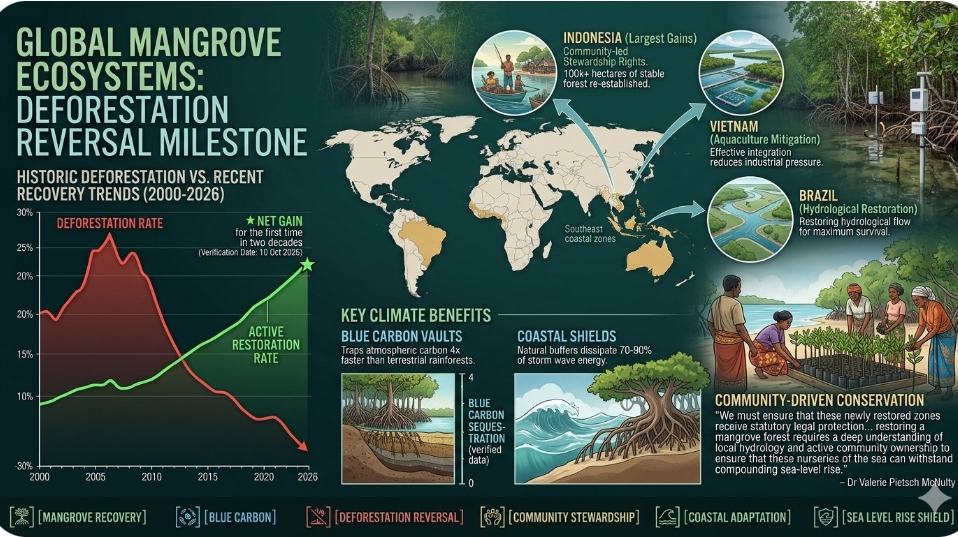
A comprehensive multinational satellite assessment published by a consortium of global marine research institutions has revealed a historic environmental milestone, confirming that global mangrove regrowth has successfully outpaced deforestation rates for the first time in twenty years. The expansive monitoring study, which synthesises high-resolution orbital imagery with localised coastal field data, indicates that intensive community-led restoration projects across Southeast Asia have fundamentally altered the trajectory of these vital blue carbon ecosystems.
The systematic field findings show that decades of severe coastal wetland degradation—driven heavily by aggressive commercial aquaculture expansion, urban encroachment, and logging—are finally being reversed. The data highlight that extensive, decentralised replanting programmes in countries such as Indonesia, Vietnam, and the Philippines have successfully re-established hundreds of thousands of hectares of stable mangrove forests. Oceanographers emphasise that these recovering coastal intertidal zones are already functioning as highly efficient carbon vaults, trapping atmospheric carbon within their waterlogged soils at rates up to four times greater than terrestrial rainforests.
Leading international marine conservation specialists have expressed immense optimism whilst cautioning against premature policy relaxation. Highlighting the global significance of the milestone, Dr Valerie Pietsch McNulty, a senior marine ecologist and global mangrove recovery specialist, emphasised the necessity of permanent institutional backing, stating that while this net positive turnaround is a monumental victory for coastal communities, we must ensure that these newly restored zones receive statutory legal protection. She added that localised conservation work must remain focused on long-term ecological health rather than superficial planting metrics, concluding that restoring a mangrove forest requires a deep understanding of local hydrology and active community ownership to ensure that these nurseries of the sea can withstand compounding sea-level rise.
The satellite mapping teams noted that the most resilient recovery zones are those where local fishing communities have been granted formal land-stewardship rights, directly tying ecosystem health to local economic stability. However, regional marine policy experts warn that these fragile intertidal fringes face emerging threats from intensifying tropical storm tracks and upstream river damming that alters essential freshwater-salinity balances. In response, international conservation bodies are mobilising advanced real-time hydrological monitoring grids to safeguard the restored coastal zones, ensuring that the foundational shields of our coastlines remain unbroken against future climate impacts.
Editor's Note
The historic reversal of global mangrove deforestation rates provides an invaluable blueprint for international climate governance. For decades, environmental policy has been paralysed by top-down, purely defensive conservation strategies that merely track the steady decline of natural habitats. This milestone proves that active, community-driven restoration can successfully tip the ecological balance toward net-positive recovery. Moving forward, the international community must transition its funding mechanisms away from highly bureaucratic corporate carbon credits that treat ecosystems as passive commodities. Financial models must directly incentivise frontline stewardship, ensuring that the coastal populations who bear the brunt of climate displacement are equipped to rebuild the natural shields that protect our planet's margins.



Leave a comment