

TreeTake Network
Marine biologists conducting an intensive multi-week census across the sub-Antarctic islands have confirmed an unprecedented ecological crash, as the world's most populous king penguin breeding grounds have suffered a catastrophic demographic collapse. Telemetry data and physical nest counts reveal that rapid thermal shifts in peripheral ocean currents have decimated local food stocks, driving a massive, unexpected population contraction that threatens to upend the delicate predatory equilibrium of the southern oceanic ecosystem.
Rapid Ocean Warming Starves Fragile Nesting Grounds
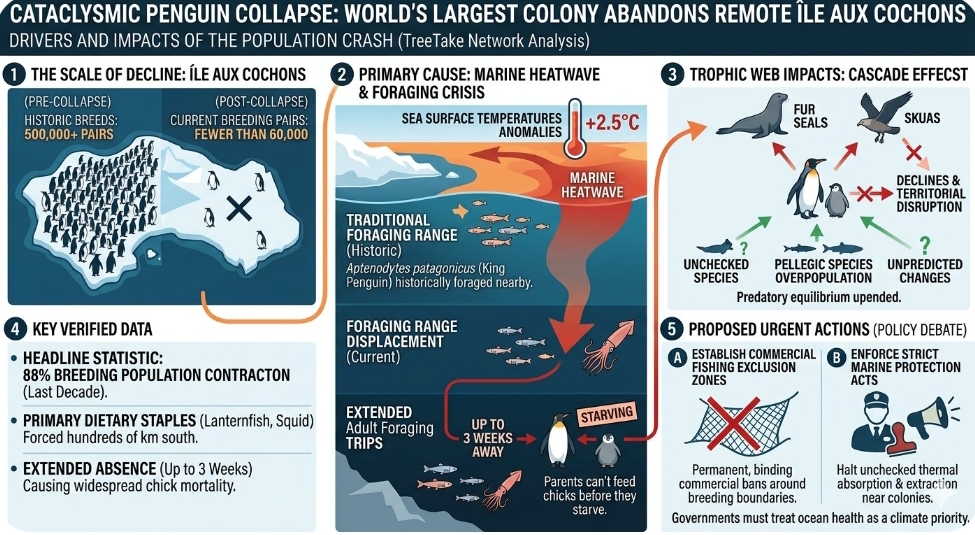
The core metrics of the biological audit indicate that the breeding population on Île aux Cochons, a remote volcanic landmass that historically hosted over half a million breeding pairs, has plummeted by an astonishing 88 per cent over the last decade. This severe contraction is directly linked to an intense marine heatwave pattern that has forced local patches of lanternfish and squid—the primary dietary staples of the penguins—hundreds of kilometres further south toward colder Antarctic shelves.
The extreme distance between the remaining food columns and the terrestrial breeding colonies introduces an impossible energetic deficit for adult foraging birds. Speaking on the telemetry tracking data, Dr Charles-André Bost, a senior chief research ecologist specializing in polar seabird dynamics, explained that the unprecedented foraging trips are keeping parent birds away from their nests for up to three weeks at a time. Bost emphasized that this extended separation is causing widespread starvation among the remaining chicks, pushing the largest colony on Earth into a severe reproductive dead end from which it may take generations to recover.
Polar Ecosystem Shift Triggers Wider Ecological Collapse
The biological fallout of the penguin crash is reverberating through the wider sub-Antarctic trophic web with immediate force. Comprehensive tracking assessments accompanying the avian report show that secondary marine predators, including fur seals and predatory skuas, are experiencing immediate territorial disruptions. The sudden absence of millions of foraging birds has left local marine shelf zones highly vulnerable to overpopulation by smaller, unmonitored pelagic species, triggering rapid, unpredicted changes in the local food web structure.
Despite the sweeping patterns of demographic decline, targeted international monitoring groups are attempting to establish emergency protective buffers. Marine research teams are deploying autonomous underwater gliders to continuously monitor real-time thermal boundaries and track the movement of remaining fish schools. However, chief scientific advisers warn that monitoring tools are merely a temporary observation method against macro atmospheric trends, demanding immediate global compliance with strict marine protection acts to halt unchecked thermal absorption within the southern currents.
Conservation Coalitions Demand Permanent Marine Exclusion Zones
The publication of the census data coincides with intense administrative friction as polar nations prepare for upcoming international maritime commission rounds. Across multiple maritime jurisdictions, conservation coalitions are mounting aggressive campaigns demanding that regional administrators establish permanent, legally binding commercial fishing bans around vulnerable sub-Antarctic breeding boundaries.
Dr Henri Weimerskirch, a leading international polar research scientist, issued a sharp statement on the global findings, noting that the data serves as a stark reality check that remote ecosystems are facing immediate, climate-driven collapse. The scientist added that instead of continuing to permit large-scale commercial krill extraction and longline vessels near these historic foraging corridors, state administrators must act decisively to enforce rigid protective mandates and give vulnerable marine life an absolute chance at survival.
Editor's Note
The catastrophic collapse of the world's largest king penguin colony serves as a definitive warning that rapid ocean warming is actively dismantling remote ecosystems far removed from direct human presence. Treating marine heatwaves as a distant polar issue rather than a core systemic threat to global ocean health and biological diversity is a dangerous form of political myopia. The way forward requires international maritime ministries to immediately integrate regional biological stress metrics into mandatory global carbon targets, while legally designating all critical polar foraging corridors as permanent, fully enforced marine sanctuaries by 2027. Technical observation gliders can document the decline, but they cannot save an ecosystem left to starve under unchecked atmospheric warming.



Leave a comment