

TreeTake Network
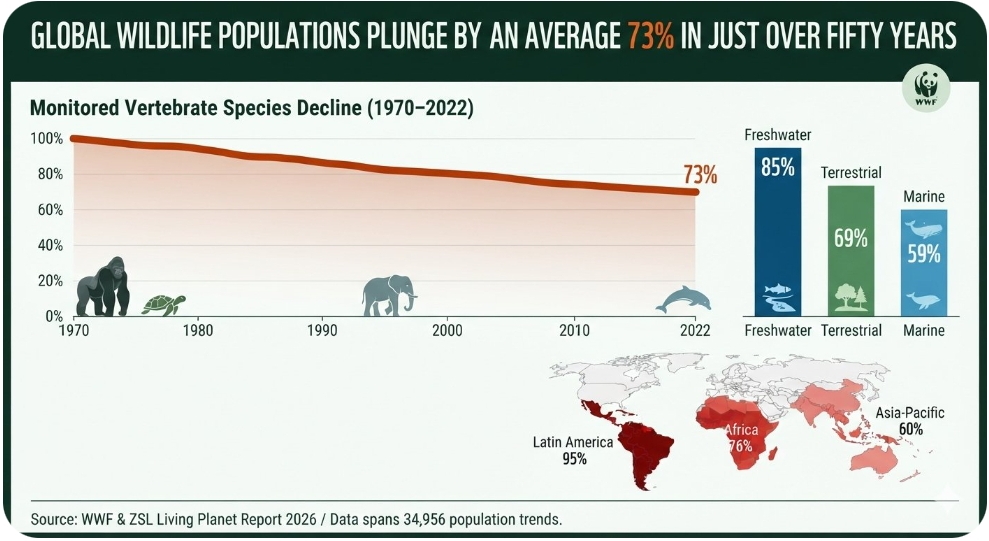
The global natural world is experiencing a catastrophic collapse, with monitored vertebrate wildlife populations declining by an average of 73% between 1970 and 2022. According to the groundbreaking Living Planet Report 2026 published on 8 October 2026, the unprecedented destruction of ecosystems is pushing the planet closer to irreversible environmental tipping points.
The extensive research, compiled by scientists from the World Wildlife Fund (WWF) and the Zoological Society of London (ZSL), analysed data spanning nearly 35,000 population trends across 5,495 species of amphibians, birds, fish, mammals, and reptiles.
Freshwater Systems Facing Total Ruin
The data reveals that freshwater ecosystems have suffered the most devastating onslaught, experiencing an 85% plunge in population sizes over the 52 years. Terrestrial habitats saw a 69% decline, whilst marine wildlife populations dropped by 59%.
Geographically, the crisis is heavily concentrated in the tropical regions. Latin America and the Caribbean recorded the most alarming statistics, with a staggering 95% average drop in wildlife numbers, followed closely by Africa at 76% and the Asia-Pacific region at 60%.
"The statistics are a devastating confirmation of the scale of the ecological crisis we face," stated Dr Kirsten Schuijt, Director General of WWF International, during the global launch. "We are not just losing wildlife; we are dismantling the very life-support systems that sustain human civilisation. The next five years are critical to changing this trajectory."
Grounds for Conservation Hope
Despite the overwhelming grimness of the data, the report explicitly notes that nature possesses an extraordinary capacity to recover when targeted, well-funded conservation measures are put in place.
Experts highlighted several notable successes achieved through coordinated global intervention:
- Wild tiger populations have mobilised a 70% increase globally since 2010.
- Mountain gorilla populations in the Virunga Mountains have steadily risen by about 3% per year.
- European bison populations have successfully rebounded from complete extinction in the wild to self-sustaining herds.
- Green sea turtles and Atlantic bluefin tuna have shown robust signs of stabilisation following strict legal protections.
The Threat of Ecological Tipping Points
Chief Scientist at WWF, Dr Rebecca Shaw, warned that these localised recoveries must be scaled up immediately to prevent systemic biosphere collapse. "The food and agriculture system is the leading cause of habitat destruction, overharvesting, and a major source of greenhouse gas emissions," Shaw explained, detailing the core drivers. "The more we degrade the rainforest, the more we have unfettered deforestation, the more viruses we have spill over into humans, alongside pushing ecosystems toward dangerous tipping points like the Amazon collapse."
Editor's Note
The Living Planet Report 2026 serves as an urgent, final warning that traditional, isolated conservation efforts are no longer sufficient to halt the tide of extinction. The way forward requires a massive, structural transformation in how humanity produces food, manages energy, and finances development. Governments must immediately bridge the massive funding gaps in biodiversity preservation and treat nature loss with the same regulatory urgency as carbon emissions. Failure to integrate ecological restoration into global economic policy will guarantee the collapse of the very natural infrastructure supporting human survival.



Leave a comment