

TreeTake Network
A catastrophic population crash has occurred at the world's most vital seabird sanctuary. The remote volcanic island of Zavodovski, located within the South Sandwich Islands in the sub-Antarctic, has officially lost its title as the home of the world's largest chinstrap penguin colony.
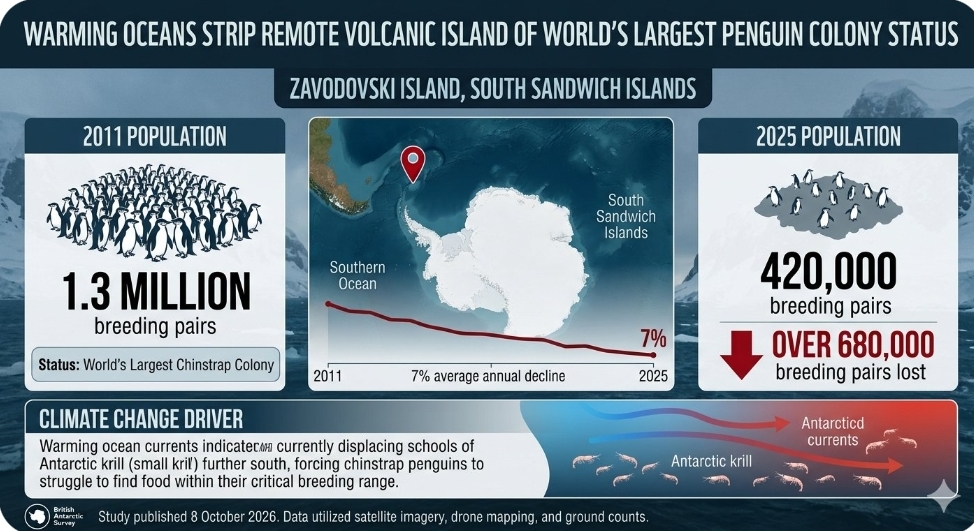
A definitive study published on October 8, 2026, by the British Antarctic Survey (BAS) reveals that the island lost two-thirds of its breeding chinstrap penguins over 14 years. The population plummeted from an estimated 1.3 million breeding pairs in 2011 to fewer than 420,000 pairs by the end of 2025.
Driven by Rapidly Shifting Food Sources
The research team, using high-resolution satellite imagery, drone mapping, and ground-level nest counts, found the colony has been shrinking at an alarming average rate of 7% per year.
The primary catalyst for this decline is the compounding impacts of climate change on the Southern Ocean. Rising sea temperatures have forced massive swarms of Antarctic krill—the fundamental cornerstone of the chinstrap penguin's diet—to migrate much further south into colder waters.
"Zavodovski Island was long considered an unshakeable stronghold for this species," noted Dr Peter Fretwell, a leading remote sensing scientist with the British Antarctic Survey. "To see over 680,000 breeding pairs vanish in less than two decades is highly alarming. The foraging birds are simply running out of food within their critical breeding range."
An Urgent Call for Endangered Status
The dramatic decline on the island reflects a wider, regional trend observed across the maritime Antarctic, where milder winters and retreating sea ice are disrupting historical marine food webs.
As a direct consequence of these findings, marine biologists and international conservation bodies are now mobilising a formal petition to the International Union for Conservation of Nature (IUCN). The experts are demanding that the status of the chinstrap penguin be immediately upgraded from "Least Concern" to "Endangered" on the IUCN Red List.
"Extreme events can alter these habitats at an astonishing rate, where marine heatwaves disrupt food webs and cause widespread breeding failures," warned Dr Gemma Clucas, a seabird ecologist who participated in the data analysis. "The rapid collapse of the Zavodovski colony is a clear bio-indicator that the marine ecosystem is undergoing a profound, climate-driven transformation. If we do not restrict industrial krill fishing in these warming zones, these colonies will face total extinction."
Editor's Note
The tragic decline of the chinstrap penguins on Zavodovski Island highlights a severe disconnect in global marine management. The way forward dictates an immediate, legally binding expansion of Marine Protected Areas (MPAs) across the sub-Antarctic waters, alongside a total moratorium on commercial krill harvesting in regions experiencing thermal stress. This ecological disaster serves as clear evidence that wildlife sanctuaries on land cannot protect species if the surrounding marine environments that feed them are allowed to collapse due to global industrial emissions.



Leave a comment