

TreeTake Network
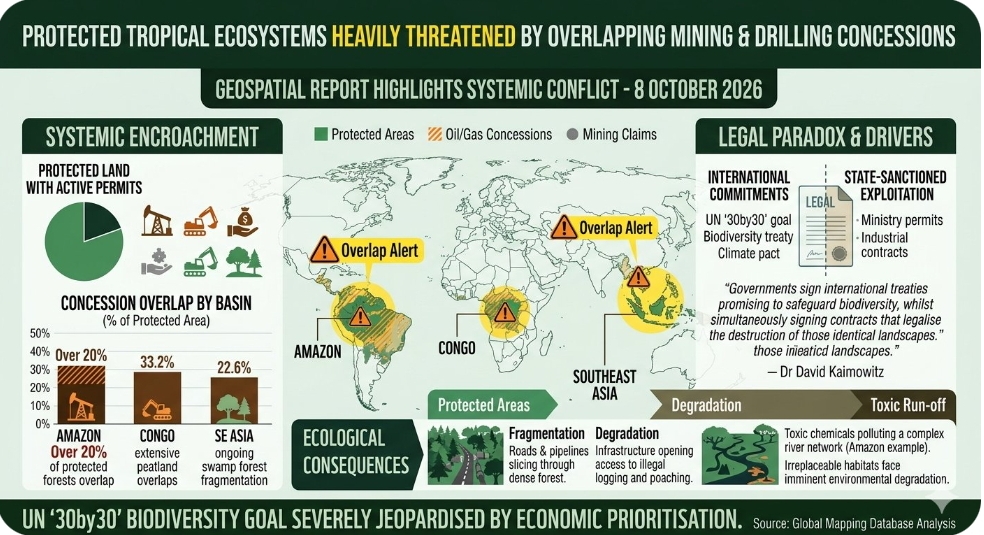
Millions of hectares of legally protected tropical ecosystems are facing imminent environmental degradation due to state-sanctioned industrial exploitation. A comprehensive geospatial report released on 8 October 2026 reveals that governments worldwide are quietly granting oil, gas, and mining concessions that directly overlap with critical nature reserves.
The research highlights a systemic conflict of interest where economic extraction is actively prioritised over international environmental commitments, severely jeopardising the United Nations "30 by 30" biodiversity goal to protect 30% of the Earth's land and sea by 2030.
Widespread Encroachment on Protected Land
The investigation utilised global mapping databases to cross-reference designated conservation zones with active industrial permits.
The findings indicate that industrial concessions now compromise legally protected rainforests, wetlands, and indigenous territories across Latin America, Central Africa, and Southeast Asia.
- Over 20% of the analysed protected forest areas in the Amazon basin overlap with active oil blocks or mining claims.
- In the Congo basin, extensive oil exploration licences have been mapped across critical peatland sanctuaries.
- Southeast Asian peat swamp forests face ongoing fragmentation from adjacent mineral extraction infrastructure.
"We are witnessing a widespread legal paradox," explained environmental analyst Dr David Kaimowitz. "Governments sign international treaties promising to safeguard biodiversity, whilst their ministries of energy and mines simultaneously sign contracts that legalise the destruction of those identical landscapes."
Severe Degradation of Irreplaceable Habitats
The introduction of heavy machinery, roads, and pipelines into protected zones triggers severe ecological fragmentation. Even when extraction is confined to specific sectors, the infrastructure opens up previously inaccessible wilderness to illegal logging, poaching, and systematic deforestation.
Furthermore, toxic run-off from mining operations poses an existential threat to complex river networks. "The long-term economic value of the ecosystem services these forests provide—such as water purification and carbon storage—vastly outweighs the short-term profits gained from resource extraction," warned conservation biologist Dr Julia Fa.
Editor's Note
The overlapping of industrial concessions with protected areas reveals a critical flaw in global environmental governance. The way forward necessitates the immediate establishment of international legal mechanisms that automatically strip protected status areas of any commercial exploitation viability. Financial institutions must categorise projects inside conservation zones as high-risk, uninsurable assets. Without a total, legally binding separation between corporate resource extraction and ecological reserves, global biodiversity goals will remain entirely unachievable.



Leave a comment