

The international black-market smuggling investigation surrounding the five infant orangutans rescued in coastal Odisha has officially converged on the subcontinent’s premier molecular genetics desk. Scientists at the Centre for Cellular and Molecular Biology (CCMB) in Hyderabad have entered the definitive sequence processing phase for the biological samples gathered from the recovering primates. TreeTake presents a critical operational update on this forensic breakthrough, exploring how mitochondrial DNA mapping will establish absolute global accountability, the complex clinical stabilisation protocols managed by the state nursery panel, and the structural enforcement reforms required to shut down trans-continental poaching pipelines.
Mitochondrial DNA Mapping and Cross-Border Extraction Forensics
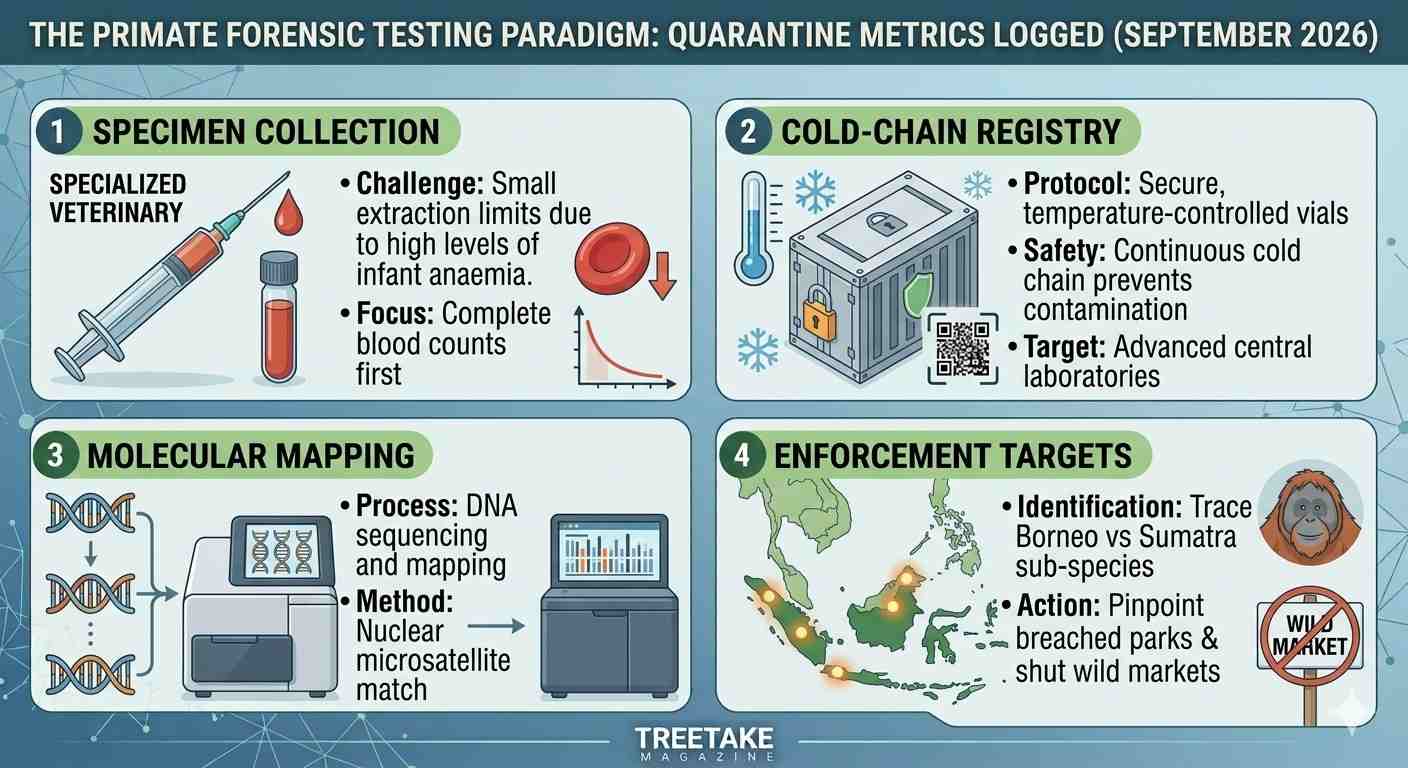
The technological tracking framework regulating the suppression of international exotic wildlife cartels achieved a significant breakthrough today as forensic geneticists initiated the final alignment phase for the primate blood profiles. The scientific intervention, executed inside high-security diagnostic cleanrooms, is designed to extract highly specific genomic markers that remain entirely unaffected by physical transit alterations. By deploying advanced next-generation sequencing protocols to map the complete mitochondrial DNA loop and analyse highly polymorphic nuclear microsatellite markers, the laboratory desk is establishing an immutable biological signature for each of the five juveniles.
The final sequence outputs will be run directly against global great ape genomic databases to resolve the precise subspecies classification of the infants. The forensic matrix focuses on identifying whether the rescued primates belong to the critically endangered Bornean (Pongo pygmaeus) or Sumatran (Pongo abelii) species lines. Pinpointing this exact taxonomic distinction provides the Wildlife Crime Control Bureau and international enforcement networks with absolute empirical proof of the geographic extraction zone, effectively mapping out which specific protected rainforest reserves across Southeast Asia were breached by the poaching rings to capture the infants.
Clinical Stabilisation Metrics and Nursery Acclimatisation
The laboratory progression is running concurrently with intensive medical stabilisation efforts managed by the specialised veterinary panel at the Nandankanan Zoological Park in Bhubaneswar. The technical care committee, which has kept the animals under a strict 30-day mandatory quarantine registry, successfully resolved the initial high-temperature spikes that threatened the youngest primate earlier this week. The latest clinical logs confirm that all five infants are completely stable, alert, and active, with their body temperatures safely regulated within the normal physiological boundaries of 98 to 99 degrees Fahrenheit.
The primary clinical focus for the nursery staff has transitioned to reversing the severe case of systemic anaemia diagnosed in three of the five juveniles during baseline blood screenings. Caretakers are administering customised iron supplements and liquid multivitamin top-ups embedded directly within a rigorous, round-the-clock feeding chart. The primates are hand-reared every two hours with specialised milk formulas, fresh apple extracts, and banana fluids to rebuild base metabolic reserves. To completely eliminate behavioural stress induced by maternal separation trauma, curators have barred all public access from the restricted nursery wing, deploying temperature-regulated air-conditioning, protective netting to block vector-borne monsoon pathogens, and soft background music to simulate a soothing sanctuary environment.
The Enforcement Crisis and Forensic Accountability
The international standoff over the abandonment of non-native great apes within subcontinental forests has sparked intense debate among conservation economists and global environmental jurists regarding the structural deficits defining India’s exotic animal laws. Independent analysts point out that while domestic wildlife laws are exceptionally rigid regarding native fauna, the legal mechanisms to handle, house, and repatriate foreign endangered species remain fragmented and slow, allowing international syndicates to exploit the region as a low-risk transit corridor.
"The molecular data moving through our sequencing platforms represents the definitive evidence needed to transform a localised forest seizure into an international wildlife prosecution," stated a senior molecular biologist specialising in great ape genomics at the central testing facility. He emphasised that establishing origin is the foundational step for legal repatriation under international treaties. "However, molecular speed must be matched by administrative speed. If the state machinery takes months to process these genetic results and negotiate diplomatic clearance channels, the animals will spend their most critical developmental months trapped inside artificial nursery settings. True ecological justice demands that these forensic profiles are uploaded instantly to global digital registries to trigger fast-track repatriation before irreversible behavioural pacing sets in."
Strategic Pathways to Global Resource Security
Dismantling the complex supply networks driving the international exotic pet trade requires moving past slow, post-facto forensic testing toward immediate, frontline molecular enforcement. The Ministry of Environment, Forest and Climate Change must establish permanent, fully equipped Wildlife Forensic Desks at all major international maritime and aerial entry ports, providing customs units with portable genetic testing blocks capable of identifying protected non-native fauna within hours of interception. Second, India must spearhead the creation of a centralised, blockchain-backed Global Primate Registry under the framework of the Convention on International Trade in Endangered Species, ensuring that all seized primates are immediately logged into an immutable cross-border database. Finally, the central government must mandate that all exotic wildlife forensic audits are finalised within a maximum of seven days, providing the judiciary with the definitive data required to execute immediate repatriation protocols to specialised sanctuary networks within their native ranges.



Leave a comment