

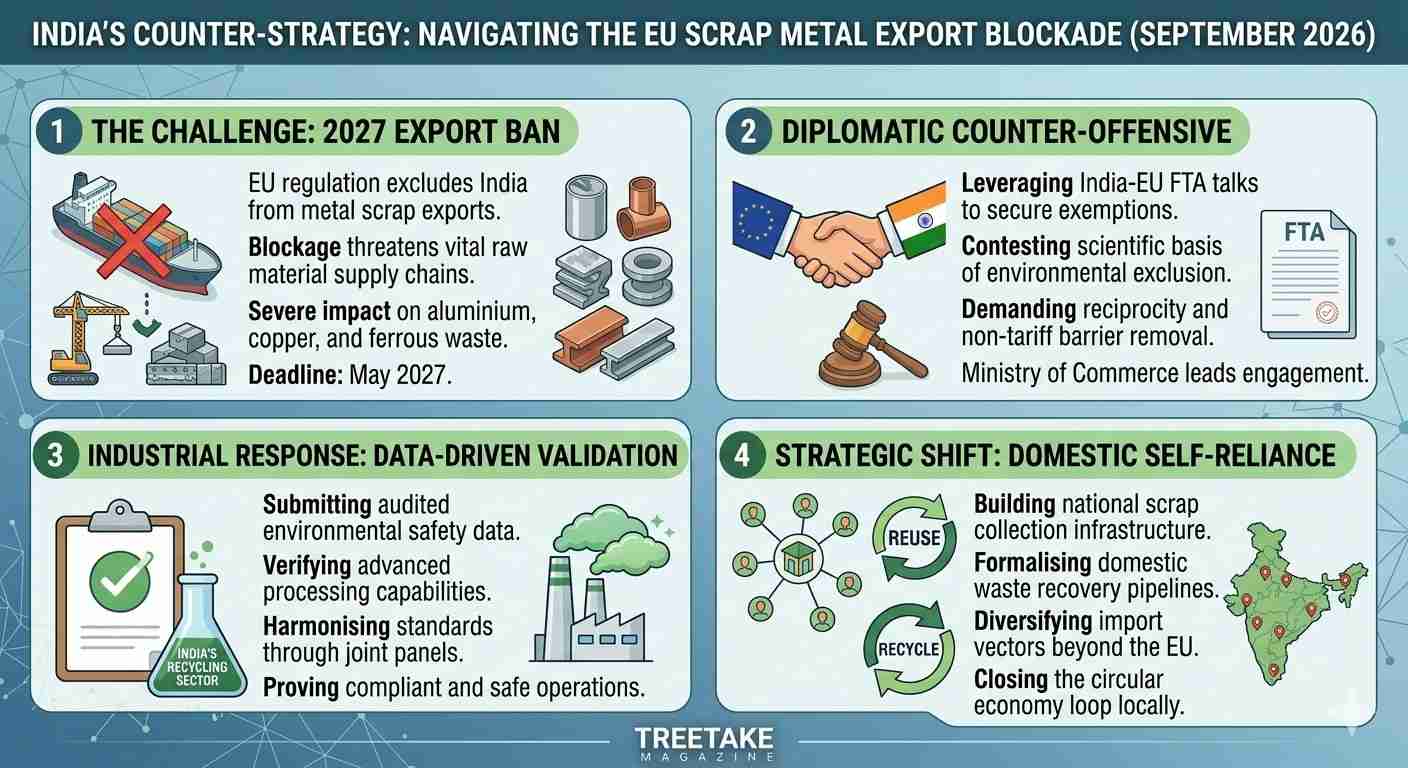
India's aggressive drive toward industrial circularisation is facing a severe regulatory blockade from Western markets. Following the European Commission's publication of a draft list of authorised non-OECD waste destinations under its revised Waste Shipment Regulation, India has been systematically excluded from importing lucrative ferrous and non-ferrous metal scraps, including steel and aluminium waste, from the European Union. TreeTake delivers an in-depth operational analysis of this emerging geopolitical trade conflict, detailing the Ministry of Commerce's multi-layered counter-strategy, the severe supply shocks facing domestic recycling loops, and the institutional stand-off over environmental protectionism.
The Draft Regulation and the Exclusion Shock
The baseline parameters governing how recyclable secondary raw materials move across borders faced a major, structural disruption on Friday, 18 September 2026. The European Commission formally released its draft delegated regulation designating which non-OECD countries are cleared to continue receiving non-hazardous waste streams from the economic bloc. While India successfully secured administrative clearances for less volatile categories—including paper, wood, rubber, glass, and textiles—its application for ferrous and non-ferrous metal waste was completely rejected. The European executive asserted that New Delhi had not sufficiently demonstrated the implementation of all necessary measures to ensure that hazardous-prone metal scraps are managed in an entirely environmentally sound manner.
This exclusion sets a dangerous countdown for subcontinental manufacturing infrastructure. Under the definitive timeline of the revised regulation, all unauthorised waste shipments from Europe to non-OECD buyers will be legally prohibited from 21 May 2027. The European Union executive defended this rigid posture by highlighting the complex ecological risks associated with secondary heavy metals. "Metal waste faces significantly stricter regulatory scrutiny because it presents a much higher hazard profile within unmanaged recycling loops, primarily due to the potential presence of persistent, bioaccumulative, and toxic heavy metals," stated a senior environmental policy spokesperson attached to the European Commission during a technical press briefing in Brussels. The official emphasised that while the country list will be reviewed every two years, the current draft reflects preliminary assessments that cannot be altered without verifiable proof of equivalent treatment standards.
The Diplomatic Standoff and FTA Leveraging
The Department of Commerce in New Delhi has launched an immediate, aggressive counter-offensive, treating the impending export blockade as a sophisticated form of non-tariff trade barrier designed to protect struggling European industries. Indian negotiators are currently utilising the public consultation window, which runs until 16 October 2026, to submit audited environmental safety registries and demand full exemption status before the final authorised list is established on 21 November 2026. This diplomatic push builds upon a recent victory where intense pressure from the Indian government successfully forced the European Commission to abandon a separate proposal for a 15 per cent export duty on aluminium scrap, which European officials feared would derail the finalisation of the historic India-EU Free Trade Agreement scheduled for signature in December.
The Indian state apparatus is firmly pointing out that the sudden pivot from trade tariffs to waste regulations represents a hypocritical protectionist strategy masked as environmental stewardship. "The decision to single out ferrous and non-ferrous scrap on environmental grounds, despite existing frameworks that already differentiate between hazardous and non-hazardous materials, creates an unfair market distortion," argued a senior diplomatic official within India's Ministry of Commerce and Industry, speaking on condition of anonymity due to the high sensitivity of the ongoing free trade negotiations. He stated that the ministry is leveraging its position as a primary global buyer to force a bilateral modification. "We are directly reminding the European Commission that creating arbitrary raw material barriers completely undermines the mutual market-access goals of our upcoming trade pact and penalises subcontinental industries that have heavily modernised their recycling facilities."
Industrial Supply Disruptions and the Protectionism Debate
The immediate raw material crisis for India's domestic heavy industry is projected to be immense if the May 2027 deadline freezes European supply corridors. India remains the world's largest consumer of secondary metallic materials, importing hundreds of thousands of tonnes of high-quality aluminium and steel scrap from European yards annually to satisfy the low-carbon manufacturing requirements of the automotive, housing, and green energy infrastructure sectors. Western recyclers have also joined Indian federations in condemning the draft proposal, warning that the blanket ban will cause severe logistical gridlock across European ports by closing off their most vital Asian off-take markets.
The domestic metallurgical sector has reacted with intense alarm over the impending resource vacuum. "The proposed EU scrap metal export ban represents a direct, structural shock to India's circular economy targets, as our secondary smelters rely heavily on clean, sorted European scrap to bypass the carbon-heavy primary refining of primary bauxite," stated Sanjay Mehta, President of the Material Recycling Association of India, during an emergency industry evaluation session. He warned that choking this pipeline will cause severe raw material inflation. "We are facing an artificial market scenario where developed economies are attempting to hoard cheap, low-carbon recycled resources for their own steelmakers under the guise of the European Green Deal, effectively shifting the economic cost of global decarbonisation entirely onto the shoulders of developing nations."
This view is corroborated by international recycling bodies who argue that European policymakers are executing a double standard that harms the global circular economy. "The European Commission is unfairly penalising highly compliant non-OECD recycling centres that operate under strict global environmental safety guidelines," noted an executive director representing Recycling Europe, the European recyclers' association. He emphasised that the export ban will severely damage international trade stability. "By effectively closing key Asian markets to EU recycled metals, this regulation will not eliminate global industrial emissions. Instead, it will create an unmanageable domestic surplus within Europe while forcing advanced recycling facilities across India to scale down operations, destroying thousands of green manufacturing jobs in the process."
Strategic Pathways to Self-Reliance
Dismantling the impact of the upcoming 2027 European metal blockade requires an immediate, structural rewrite of India’s domestic scrap-management policies. First, the Ministry of Steel and the Ministry of Commerce must aggressively establish automated, national Scrap Collection Hubs across all major Tier-1 and Tier-2 Indian cities, formalising localised waste recovery pipelines to replace lost European volumes. Second, the government must introduce strict domestic end-of-life vehicle scrapping mandates and enforce rigid electronic-waste recovery targets, ensuring that internal metallic lifecycles are closed seamlessly. Finally, India’s trade missions must urgently negotiate independent, bilateral recycling treaties with non-EU resource-rich corridors across the Global South and the Middle East, effectively diversifying import vectors and guaranteeing long-term resource security before the Western restrictions freeze the international supply chains.



Leave a comment