

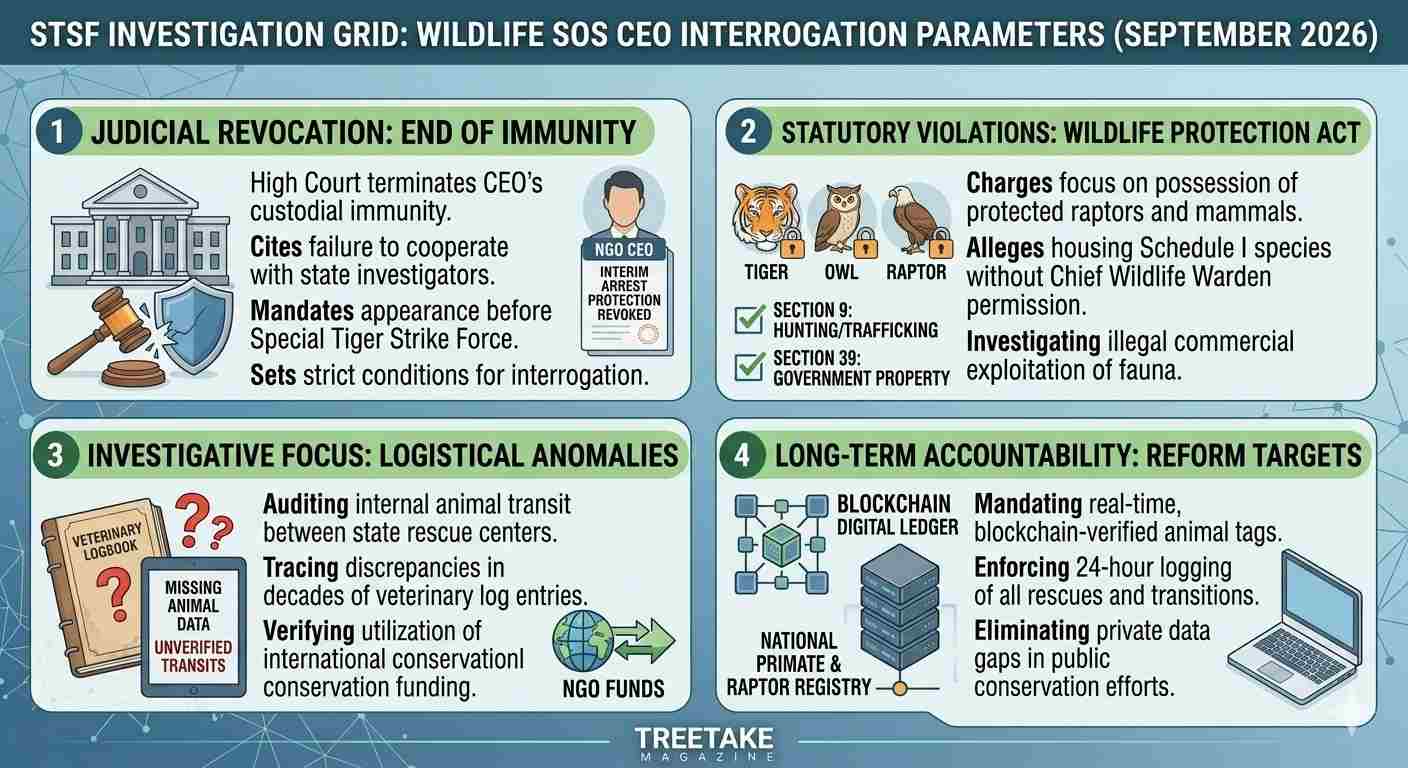
The institutional boundary lines governing wildlife conservation and state enforcement have fractured into a high-stakes legal confrontation in central India. Following the absolute revocation of his interim arrest protection by the High Court, Kartick Satyanarayan, the high-profile Chief Executive Officer of the non-governmental organisation Wildlife SOS, is scheduled to appear before the Special Tiger Strike Force (STSF) in Madhya Pradesh. The criminal probe, which traces back to a severe wildlife trafficking dragnet involving the illegal possession and commercial exploitation of protected raptors and mammalian parts, has sent shockwaves through the national conservation community. TreeTake delivers an in-depth operational report on this enforcement showdown, examining the statutory violations under the Wildlife Protection Act, the state’s aggressive stance against non-governmental transparency, and the unfolding legal parameters defining the interrogation.
The High Court Mandate and the Revocation Shock
The administrative immunity protecting the executive tier of India’s most prominent animal welfare organisation collapsed following a decisive statutory order issued by the principal bench of the High Court. The judicial intervention effectively nullified the protective umbrella that had shielded the Wildlife SOS chief from custodial interrogation by state wildlife forensic wings for several weeks. The court accepted the empirical arguments brought forward by state prosecutors, who asserted that the non-governmental organisation had systematically failed to cooperate with field investigators and had actively withheld primary logbooks regarding the internal transit of rescued scheduled fauna across state lines.
The criminal case stems from an intensive field intercept executed by the State Tiger Strike Force, which uncovered a sophisticated network trading in protected species listed under Schedule I of the Wildlife Protection Act. The state’s case maps out severe anomalies, including the unverified housing of protected owls, raptors, and various mammalian specimens without the mandatory statutory permissions from the Chief Wildlife Warden. "The rule of law applies uniformly across the conservation sector, and no individual or non-governmental entity can operate a parallel rehabilitation network outside the statutory framework of the state," stated a senior law enforcement officer attached to the Madhya Pradesh State Tiger Strike Force during a press briefing at the headquarters. He emphasised that the revocation of protection allows investigators to pursue custodial questioning to locate the wider poaching rings. "We are investigating systematic lapses in animal inventory registries and verifying whether international funding networks were diverted into unauthorised animal trades."
The Non-Governmental Defense and Institutional Friction
The escalation of the criminal case has triggered immediate, fierce pushback from international animal welfare groups and the legal counsel representing Wildlife SOS, who assert that the entire probe is a coordinated administrative vendetta. Defense attorneys argue that the organisation has spent decades collaborating with state forest departments to dismantle poaching networks, and assert that the current charges are built upon clerical entry delays rather than active wildlife crimes. They maintain that the animals in question were safely housed in state-recognised rescue centres and that the current intervention is an attempt to damage the reputation of prominent activists.
"This aggressive focus against a dedicated conservation organisation represents a direct, structural distortion of environmental enforcement priorities," argued Geeta Seshamani, Co-Founder of Wildlife SOS, during an emergency strategy meeting with national wildlife advocates. She stressed that targeting field groups weakens the frontline fight against actual poachers, noting that the organisation has always maintained a transparent accounting model. "We have consistently provided comprehensive veterinary logs and rehabilitation data to the central authorities. Turning administrative inventory delays into high-profile criminal trafficking charges is an alarming development that threatens the survival of non-governmental conservation work across the subcontinent."
The Academic Critique and Legal Precedents
The institutional standoff has sparked widespread debate among environmental economists and legal scholars regarding the proper boundaries between state wildlife wings and private conservation networks. Independent jurists point out that under existing subcontinental laws, the ultimate ownership of all wild animals rests solely with the state, meaning that any private rehabilitation facility operating without precise day-to-day government oversight exists in a dangerous legal grey zone.
"Subcontinental wildlife law is rigidly state-centric, and private groups frequently run into severe regulatory roadblocks when their operations outpace administrative clearances," noted Dr Ramanathan Iyer, a senior professor of environmental law specialising in subcontinental conservation statutes. He warned that the current case establishes a highly restrictive legal precedent for non-governmental fields. "By asserting that administrative oversight failures are equivalent to active poaching violations, the state is effectively tightening its monopoly over wildlife management. This case proves that unless non-governmental organisations maintain digital, real-time synchronisation with state forest departments, they risk being dismantled by the very enforcement machinery they seek to assist."
From the state's perspective, however, the narrative remains strictly anchored in public accountability and resource sovereignty. Forest department officials maintain that independent animal tracking is a non-negotiable component of national biosecurity. "If we allow private entities to move highly endangered Schedule I species across state boundaries without real-time government tracking, we completely compromise our capacity to monitor zoonotic disease outbreaks and dismantle international smuggling cartels," stated a senior technical advisor to the Ministry of Environment during an institutional briefing. "Every single rescue operation, veterinary panel, and habitat transition must be verified by state forensic teams, ensuring that no corporate entity exploits the country's natural heritage under the banner of animal welfare."
Strategic Paths Forward
Resolving the systemic friction exposed by this conservation crisis requires a complete modernisation of wildlife rehabilitation protocols. First, the Ministry of Environment, Forest and Climate Change must establish a centralised, blockchain-backed National Primate and Raptor Registry, forcing all non-governmental rescue centres to log animal entries, DNA tags, and health updates within twenty-four hours of capture to eliminate data manipulation. Second, the central government must introduce a unified, multi-state transit permit system managed directly by the central database, preventing state forest wings from using regional borders to stall urgent veterinary transits. Finally, the judiciary must create a specialised independent audit board composed of both state scientists and international primate experts to evaluate rescue facility compliance, ensuring that regulatory disputes are resolved through empirical scientific audits rather than punitive police crackdowns.



Leave a comment