

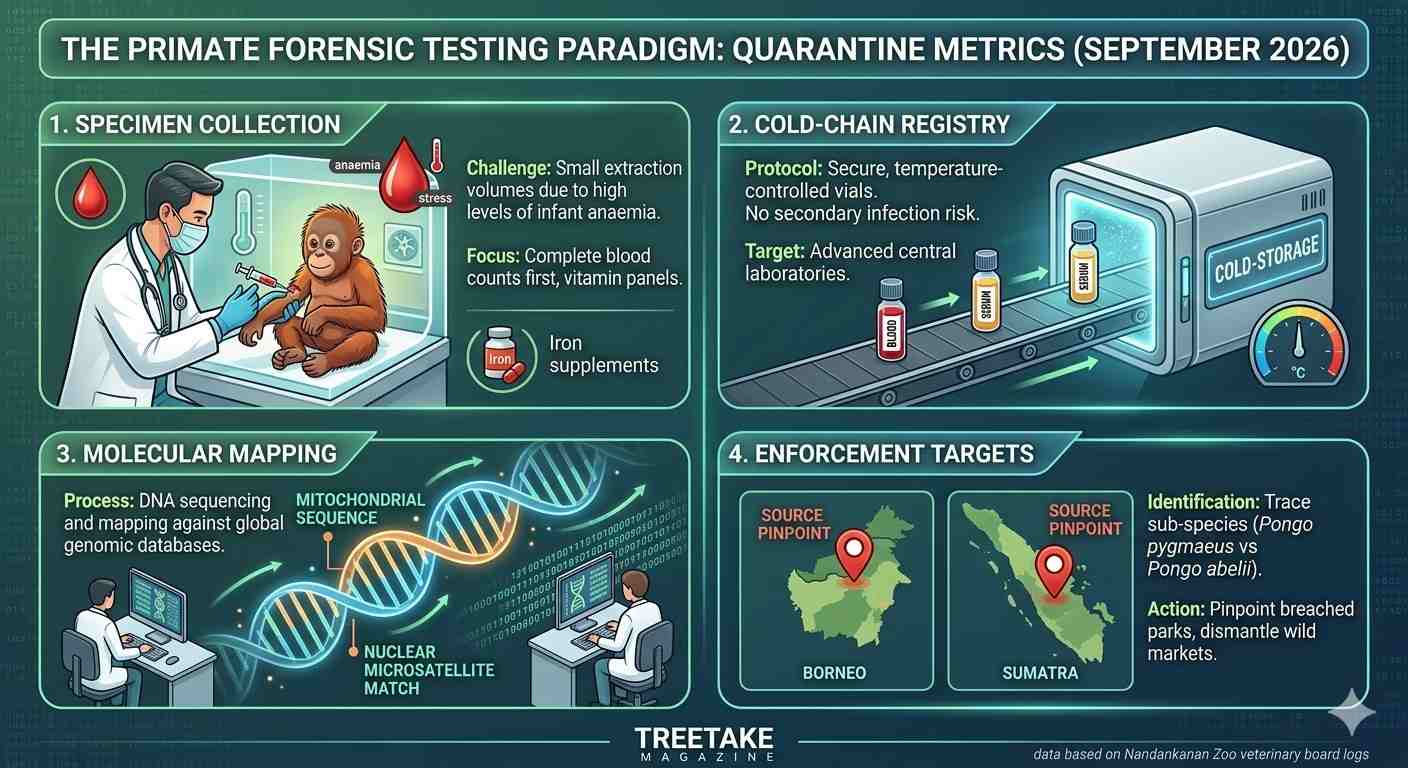
The international black-market trafficking probe surrounding the five infant orangutans rescued in Odisha's Balasore district has officially moved into its high-security molecular phase. While the juveniles continue to stabilise inside the restricted nursery wing of the Nandankanan Zoological Park in Bhubaneswar, the expert advisory panel has finalised the diagnostic parameters required to map their genetic baseline. TreeTake presents an exclusive operational update on these preparatory scientific measures, explaining why precise sub-species identification is vital to dismantling trans-continental poaching networks, the medical constraints restricting sequence extraction, and the current health data of the recovering infants.
The Necessity of Sub-Species Identification
The legal and enforcement parameters governing the repatriation of confiscated international fauna require absolute taxonomic precision before any transnational movement can be arbitrated. The six-member technical committee managing the infants has completed the logistical coordination required to transfer biological samples for comprehensive DNA profiling. Because orangutans are completely non-native to the Indian subcontinent, establishing their exact geographic origin is an absolute necessity for state investigators tracking active smuggling corridors. The genetic analysis will focus on differentiating whether the five infants belong to the critically endangered Bornean (Pongo pygmaeus) or Sumatran (Pongo abelii) species. This distinction is far from academic; identifying the subspecies allows the Wildlife Crime Control Bureau and the Odisha Police Special Task Force to pinpoint the exact national parks or protected reserves in Southeast Asia that were breached by the poaching syndicates. By identifying the specific island source, international enforcement bodies can deploy targeted field operations to disrupt the local supply chains that fuel the illegal exotic pet trade.
Logistical Challenges of Molecular Forensics
The execution of advanced molecular diagnostics on highly sensitive, compromised infant primates introduces severe clinical and bureaucratic hurdles. The state advisory panel, which includes senior veterinary specialists from Sri Chamarajendra Zoological Gardens in Mysuru and the Wildlife Institute of India in Dehradun, must execute sample collection under strict conditions to prevent introducing secondary vector-borne infections. The initial health audits reveal that three of the five juveniles are currently suffering from varying degrees of anaemia, classified as severe in one infant and mild in two. Consequently, the veterinary team must carefully restrict current extraction volumes to avoid inducing hypovolemic shock or elevated cortisol stress spikes in the recovering animals. Deputy Director Pradeep Mirase confirmed that because the primates are still fragile babies, only small amounts of blood can be drawn safely at one time, meaning that initial samplings were strictly limited to complete blood counts and essential vitamin panels while the core DNA processing is scheduled to take place once haemoglobin levels improve. Once the full blood vials are secured, they will be moved under a continuous cold-chain registry to premier central laboratories equipped with standard baseline profiles of orangutans for comparison, where scientists will map mitochondrial DNA sequences and nuclear microsatellite markers against global great ape genomic databases to crack the case.
Current Nursery Health Parameters
While the laboratory logistics are being finalised, the day-to-day veterinary bulletins indicate that the infants are responding exceptionally well to their restricted quarantine routines. The acute monsoon fever scare that affected the youngest juvenile earlier this week has been completely resolved under a strict treatment regimen of paracetamol and targeted fluids, with all five primates maintaining stable body temperatures within the normal physiological spectrum of 98 to 99 degrees Fahrenheit. Specialised keepers continue to hand-rear the primates inside the climate-controlled nursery, using milk formulas administered every two hours alongside apple and banana fluids to minimise stereotypic separation anxiety.
"The priority remains the baseline well-being of the babies, and all five are currently stable with normal feed acceptance and improved activity levels," announced Aditya Acharya, Head of the Centre for Wildlife Health at the Odisha University of Agriculture and Technology, during an institutional status review. He confirmed that the technical care panel is carefully monitoring the haematological response of the three anaemic infants to the recently introduced iron supplements. "We have established a completely secure clinical buffer around these animals to facilitate their physical recovery. The collection of additional biological samples for DNA mapping will proceed in strict accordance with the safety thresholds defined by our veterinary board, ensuring that the scientific requirements of the international smuggling probe do not compromise the immediate well-being of our charges."
Strategic Paths Forward
Dismantling the complex logistics of international great ape trafficking requires transitioning from slow, reactive domestic testing toward immediate, frontline molecular enforcement. The Ministry of Environment, Forest and Climate Change must establish a specialised, high-security Wildlife Forensic Wing at all primary international entry ports, equipping frontline customs teams with portable, rapid DNA-sequencing kits capable of identifying protected species within hours of interception. Second, India must lobby for the creation of a permanent, automated digital registry under the framework of the Convention on International Trade in Endangered Species that links national DNA repositories across Southeast Asia, enabling instant cross-border verification of confiscated wildlife origins. Finally, the central government must establish strict statutory timelines that compel central laboratories to prioritise exotic wildlife cases, ensuring that forensic data is delivered to judicial bodies within a maximum of seven days to accelerate fast-track repatriation protocols before long-term captivity causes permanent behavioural degradation.



Leave a comment