

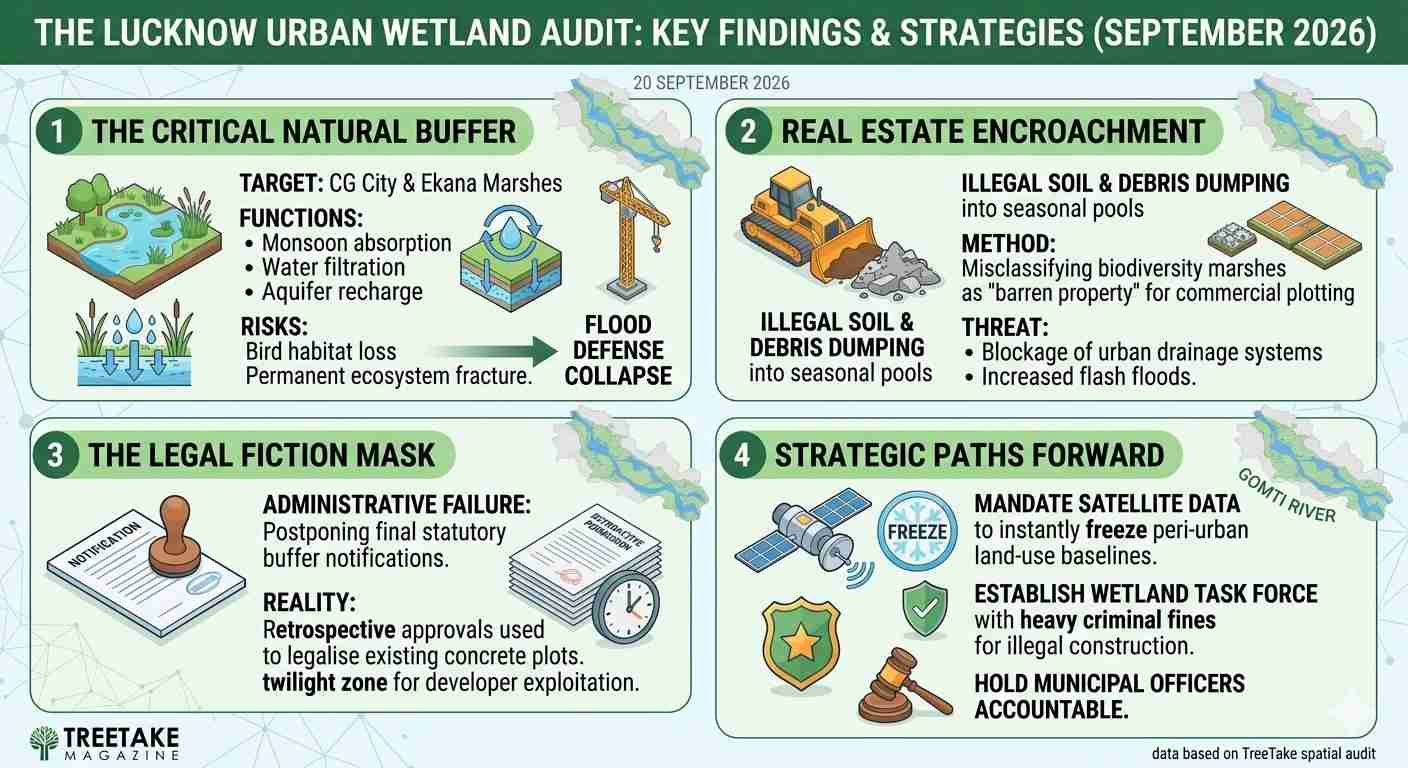
While federal and global bodies debate macro-level climate frameworks at Vigyan Bhawan, local ecological lines are actively fracturing across the state of Uttar Pradesh. Following a statewide mandate by the Uttar Pradesh State Wetland Authority to systematically bring high-priority water bodies under the protection of the Wetlands Conservation and Management Rules, a comprehensive internal enforcement sweep has exposed severe ground-level violations. TreeTake presents a detailed, in-depth audit report on the state of Lucknow’s urban marshes, examining the aggressive real-estate incursions transforming natural drainage channels into concrete real estate assets, the data suppression mask hiding peri-urban wetland decay, and the urgent implementation of scientific boundary demarcations to protect the region's remaining carbon sinks.
The Enforcement Sweep and the Floodplain Fracture
The operational parameters governing how local water systems are monitored underwent a significant escalation as the State Wetland Authority, in coordination with municipal enforcement wings, executed an intensive spatial audit across the capital district. The regulatory intervention followed the statutory expiration of the public review window for the initial notifications issued under the 2017 Central Rules, which aimed to formally insulate delicate aquatic terrain from commercial development formally. However, field telemetry and physical boundary surveys conducted across the city have exposed a staggering gap between administrative protective orders and the raw reality of urban sprawl.
The audit focused heavily on the fragile floodplains of the Gomti River basin, particularly the peri-urban marsh mosaics expanding around the CG City and Ekana sectors. These seasonal pools and reed-heavy marshes serve as vital hydrological shock absorbers for Lucknow, capturing heavy monsoon runoff, recharging regional aquifers, and filtering urban contaminants before they breach the city's water tables. The field findings reveal that real-estate conglomerates and local private developers have systematically targeted these unmonitored terrains, pushing extensive soil-dumping operations, dumping illegal construction debris directly into seasonal pools, and building commercial infrastructure layouts over active low-lying buffers. By artificially filling the marshes to create solid ground for residential plotting, developers have severely constricted the river's transitional flood zones, setting the stage for catastrophic urban flash floods during late-stage monsoon deluges.
Data Suppression and the Science of Preservation
The crisis is aggravated by a structural failure within regional planning bodies to accurately log and verify the ecological baseline data of peri-urban wetlands before commercial approvals are arbitrated. Independent researchers utilising Pressure-State-Response geospatial modelling have demonstrated that while the state has accelerated boundary demarcation at thousands of rural locations, the urban and peri-urban water bodies are being systematically misclassified in local revenue records. By maintaining these complex, high-biodiversity marshes under obsolete administrative headings like barren land or property available for municipal development, the bureaucracy effectively provides a legal loophole for real-estate interests to circumvent statutory environmental protection acts.
"We are tracking a deeply disturbing trend where our most critical peri-urban wetlands are being completely erased from municipal maps long before they can receive final statutory notifications," stated Dr Ashutosh Tripathi, a senior geospatial analyst specialising in subcontinental wetland health indices. He emphasised that the administrative exclusion of local community mapping data from official master plans has deliberately masked the death of regional bird habitats and groundwater recharge zones. "When you allow a concrete highway or a commercial complex to sever the direct connection between an urban marsh and its underlying aquifer, you are not simply changing the land use pattern. You are permanently destroying the thermal regulation capacities of the entire city. The current audit metrics prove that unless we integrate independent satellite biomass tracking with strict, unalterable revenue boundary registers, the statutory notifications remain purely decorative paper exercises while the ground-level destruction continues unfettered."
Official Discursive Frameworks and Contractor Pushback
The publication of the internal audit metrics has drawn quick, defensive responses from municipal development authorities, who maintain that modern public housing expansions incorporate adequate eco-friendly infrastructure. Regional planning directors argue that localised urban greening initiatives, such as the construction of artificial water bodies inside public parks, successfully compensate for any loss of natural marsh terrain. They assert that aggressive infrastructure projects like the CG City expansion are necessary to accommodate the rapid migration of populations into the state capital, and claim that all major works proceed subject to environmental clearance reviews.
"Every major public infrastructure extension in the peri-urban zones undergoes a rigorous, multi-layered regulatory review process before any brick is laid," stated Anoop Kumar Misra, a senior urban planning director attached to the regional development authority. He fiercely rejected allegations of data manipulation, claiming that the municipal administration remains fully committed to sustainable modernisation. "We are balancing the massive, inevitable residential demands of a fast-growing state capital with responsible environmental planning. Our layouts incorporate modern rainwater harvesting systems and designated green belts that far exceed minimal statutory mandates, ensuring that urban development does not compromise regional groundwater security."
Conservation Resistance and Avian Habitat Loss
This state narrative has faced fierce opposition from conservation groups and indigenous pastoral representatives who rely directly on open wetlands for traditional livelihoods. "An artificial, concrete-lined pond inside a manicured park can never replicate the intricate biological functions of a natural floodplain wetland," argued Shanal Khullar, a field coordinator attached to a prominent regional bird conservation foundation. She noted that the ongoing destruction of tall reeds and seasonal pools has led to a catastrophic decline in the nesting counts of resident and migratory waterbirds across the Lucknow-Barabanki corridor. "The administration is hiding behind superficial environmental public relations campaigns, celebrating token bird-watching events while simultaneously signing off on the destruction of the actual ecosystems that support these avian species. If we do not immediately freeze all heavy construction within a five-kilometre radius of these newly notified marshes, Lucknow's water tables will face a permanent collapse that no amount of engineering can reverse."
Legal Bottlenecks and Environmental Litigation
The legal dimensions of the conflict highlight a structural failure to enforce existing environmental safeguards against well-connected economic actors. Legal experts point out that under the federal rules, any unauthorised dumping, construction, or land-use alteration within a notified wetland or its buffer zone is a non-bailable criminal offence, yet prosecutions remain virtually non-existent.
"The statutory frameworks governing wetland protection in Uttar Pradesh are highly comprehensive on paper, but their enforcement is completely gridlocked by institutional lethargy and political pressure," noted Vibhor Gauba, a senior environmental advocate practising before the National Green Tribunal. He warned that the administrative practice of delaying final notifications allows developers to establish irreversible ground realities that courts struggle to dismantle retroactively. "When local bodies delay the final notification of checked wetlands, they are actively creating a twilight zone that developers exploit to concrete over natural basins. We need immediate judicial intervention to hold municipal officers personally accountable under environmental protection acts for failing to protect these designated carbon sinks."
Strategic Paths Forward
Dismantling the systemic corruption and data manipulation gridlocking local wetland management requires an immediate overhaul of urban governance protocols. First, the State Environment Department must mandate the use of high-resolution, unalterable satellite remote sensing data to freeze the land-use baselines of all high-priority wetlands, rendering any retroactive changes to revenue records legally void. Second, local development bodies must be statutorily banned from issuing building permits within designated eco-sensitive wetland buffers, forcing developers to alter infrastructure layouts around natural hydrology rather than destroying it. Finally, the state must establish a dedicated, independent Wetland Task Force empowered to seize machinery and impose heavy, non-bailable criminal penalties under the Wildlife Protection Act against corporate entities caught executing unscientific soil-dumping or illegal construction over protected marshes.



Leave a comment